Omenani - Traditional Igbo Spirituality
In Search of the Gods: Omenani - Traditional Igbo Spirituality
IGBO TRADITIONS
At the beginning of every ceremony held by Igbo people, whether it be a marriage, birth, funeral, or family gathering, one can hear the word Omenani said by elders when calling out greetings to Ancestors and everyone present. As a young girl, I did not give much thought to this familiar word. My grandfather told me that Ndi Igbo (Igbo people) who are composed of many tribes and various dialects; migrated from Egypt during the invasions, eventually coming to settle in the southeastern part of the region now known as Nigeria. The word Igbo is the name of the language, people and culture. The traditional spiritual system of the Igbo is ancient and has its origins still visible. Igbo spirituality can be found under variations of the names Ọdinani or Ọmenani or Ọmenana. By itself O me means “it happens” or “to do” while na means “on” and Ani can be interpreted as “nature, land, or ground. So Ọmenani, can be understood as “it happens on the land” or “to do on earth”.
Ọmenani is based on the concept that man’s activities must be limited to what is in concordance with nature. According to Ọmenani, the task of the human being is to maintain harmony with nature; and to live in alignment with what benefits all. This idea is visible in other traditional cultures, in modern times it can be seen in Buddhism and Hinduism, but the Kemetic spiritual system whose history and documentation outdates all other societies, is the root and foundation of all indigenous spiritual systems, under which humanity was once united.
Chukwu, Chi and Chineke are the primary names used by Igbo people to refer to what is understood in English as a Divine Being. Chukwu is a combination of the word “Chi” and “Ukwu”. Chi can be understood as the “active fundamental force of creation”. It is found in Yoruba as “Ori”, in ancient Kemet (Egypt) as “Ka”, in Asia as “Qi, Ki, or Chi” and in India as “Prana”. The interpretation of the word Ukwu can be understood as “master or great”. So as a whole Chukwu roughly translates to “master of the active creative force”.
The name Chineke translates to both “God Creates” and “God Divides”, but there is more meaning behind this name. Chi is also understood to be the masculine aspect of God and Eke is the feminine aspect. Igbo spirituality acknowledges that it takes both masculine and feminine to create life, so a Creator God encompasses both masculine and feminine principles.
According to Ọmenani, everything in the world (Uwa) has a Chi. Deities which are called Alusi in Igbo; give names to Chi found in nature (Chukwu’s incarnations in the world). The Alusi of the sky is called “Igwe”. The Alusi of the sun is called “Anyanwu”. The Alusi of yams is called “Ahiajoku”. The Alusi of water is called “Imo Miri”. The Alusi of the earth is called “Ani” or “Ala” and so on. Alusi, however, are not limited to nature; metaphysical and supernatural forces also have their own names and attributes. For example, “Chi di Ebere” is the Alusi of mercy, “Ikenga” is the Alusi of strength and “Agwu” is Alusi of wisdom and healing to name a few. Every Alusi has its individual personality and function but are all parts of Chukwu.
Some major aspects of Chukwu according to Ọmenani, which are manifestations of its existence are;
(1) Chukwu as Anyanwu, manifested as the sun. As the sun’s light is everywhere, so is the presence of Chukwu everywhere; the sunlight reveals things, so Chukwu is the source (revealer) of knowledge. Anyanwu is also the word for Sun in Igbo. An English translation of the concept Anyanwu is “the eye it shines”.
(2) Chukwu as Agbala, manifested in the fertility of the earth and the beings that inhabit it.
(3) Chukwu as Chi, the power and ability of living things to manifest.
(4) Chukwu as Okike, the law that governs the visible and invisible. The concept Okike can be translated as “The strength of energy or force.”
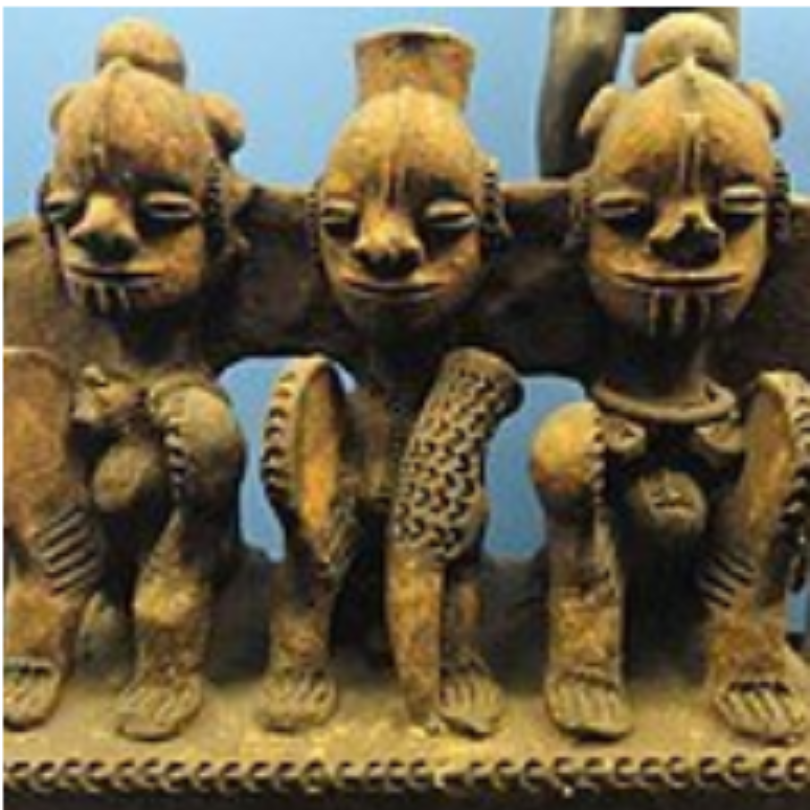
To the Igbo, Chukwu (the master creator) is infinitely powerful and impacts our worlds indirectly through lower entity(s). Mmadu is the word for the human being in Igbo, it is a combination of two words “Mma” which means beauty and “Ndu” which means life, so together Mmadu can be translated as “the beauty of life”. It is understood that Mmadu cannot directly access or work with Chukwu without passing through the lower forces called Ndiichie (esteemed Ancestor spirits).
This is why Ancestors hold a high place in traditional societies. Elders are honored in the world we inhabit as humans, but especially more so when they pass (or cross over) to the Be Mmuo (place or house of spirits). The concept that spiritual worlds exist alongside physical worlds is a key reality in African culture. Ancestors are consulted for advice, and they appeal to the Alusi on behalf of their descendants. Pouring libations, offerings in the form of food, chanting and incantations are just a few ways we interact with and respect our Ancestors. Ndi Igbo acknowledges the concept of reincarnation. Ancestors and all human beings are known to reincarnate seven or eight times depending on their Chi. In each incarnation, one either ascends or descends spiritually.
Ndi Igbo do not see humans as separate from their Creator, the Chi that resides within and without, keeps humans connected. Every person has an individual Chi - a unique personal Deity that serves as a guide and protector. The “Chi” is the Divine particle in humans which one shares in Chukwu. In Igbo culture, this aspect of Chi is called “Spirit-Double”. The Spirit-Double is different from a person’s soul. A person’s soul can be likened to looking into a mirror and seeing one’s reflection, but there is another being that exists behind that image. We can neither see nor touch this image; this is the spirit double.
The personal connection between the Chi and the human in Igbo spirituality is intricate. Ọmenani teaches that humans are one with the source (master creator) and maintain an interdependent relationship with all of existence. On earth, each human being has a personal world and it is inside one’s personal world that the soul operates.
Everything we can perceive in the world is made up of three dimensions. We can understand, therefore, that a 3-dimensional human being in Igbo spirituality consists of; (1) spirit-double (chi), (2) the soul and (3) the body. The soul controls the body while the individual spirit-double controls the soul. Ọmenani teaches that anything given to a human is what he or she has settled with their Chi. A person’s destiny is guided by their Chi. When one is in a good relationship with their Chi, they have health and prosperity, while those who are not in good balance with their Chi, are prone to sickness, poverty and bad luck. In order to survive spiritually this must be acknowledged – the good and the bad come from our individual Spirit-Double (Chi). We do not attribute our earthly problems to Deity(s) or to our fellow human beings. In Igbo culture inner guidance, dreams, divinations (spiritual readings) and visits to sacred spaces, are a few ways to interact with your spirit-double.
FROM KEMMIOO TO IGBO
Iji Ani (also under the names Iji Ala/Iji Ana) is the sacred science of temple building for Earth energy balancing purposes. This science was mastered and expounded upon by the Igbo people. It can be understood in the concept of “Anakwudo-ma-Enukwudo”. In English this can be loosely translated as “below allows life and above allows life”. This idea is seen in the Chinese concept of Yin and Yang and the Kemetic concept of Heru-Set. In the Heru-Set principle, we understand that life is a result of the balance between two opposing forces.
Iji Ala is found in architecture such as the Nsude pyramids in Agbaja and Mbari houses, also known as “Ikwunite-Aba-Igwe” which literally means “raising the crown of the celestial mound”. These sacred or consecrated spaces are places of pure spiritual energy where humans come to revitalize and purify their soul force. Ritual-priests whose specialty is performing these actions on a communal scale are called various names such as “Eze Ana” (chief of the land) and “Eze Uzu” (chief of the path).
In some Igbo cosmogonies, Amadioha and Ani (or Ala) is said to be the first couple created by Chukwu. The two are often honored in Mbari houses made with mud brick. Amadioha is known as the God of justice who judges the dead. Ani/Ala is his consort who is often depicted as a mother with a child sitting on her lap. This same concept is found in Kemetic culture as Wsr and Aishat (Osiris & Isis).
Iji Ala and Igbo cosmogonies can be traced back to documented civilizations of ancient Igbo including Ugwelle (6000 BCE), Afikpo (3000 BCE), Nsukka (3000 BCE), UmuEri/UmuNri (500 BCE) and Igbo Ukwu (900 CE).
HISTORY SPEAKS
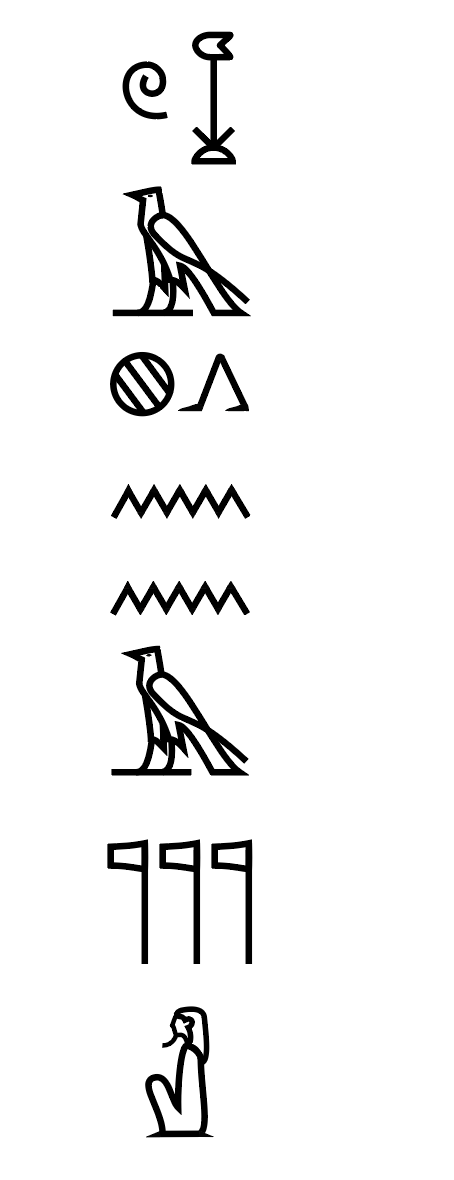
Medu is the first and original language of humanity. It is known in today’s society as hieroglyphs. Medu is a living language that is based on concepts; it is the concept behind a word, that gives a word its meaning. Being the oldest language known to humanity, Medu has influenced all other languages, every language is a dialect of Medu.
A closer examination of Igbo and Medu reveals numerous connections. The word Heru (Horus) can be found in the word “Iru” in Igbo. Iru means face, but in mystical usage, Iru means shrine or “Face of Deity” or “Face of the Sun” (Iru Anyanwu). Heru is also known as the “Lord of the Horizon” symbolized by two hills - a sacred landmark. Igboland (Biafra) is still known today as “the land of the rising sun” symbolized by three hills. In other mythologies, it is known as the center of the earth.
The concept of Djed in Medu, represents the backbone of Wsr (Osiris). This notion can be related to the Yam crop of Igbo – “Ji” pronounced “gch”. The yam crop and its harvest season are key elements of Igbo culture. In Igbo legend, there is a story that in olden times, there was nothing to eat, so Eze Nri (Chief of Food) considered what should be done to remedy the problem. He took the drastic course of killing his eldest son, cutting the body into small pieces and burying them, his daughter met with a similar fate. Strange to say, five months later, yam tendrils (Me Ji) were observed to be growing in the very places where the dismembered parts of the son’s body had been enshrined. In a similar fashion, cocoyam (Ede) began to grow where the remains of his daughter were. After six months, the Eze Nri dug up large yams and cocoyams from the places where his children were buried.
Another important note is that yams do not thrive unless properly tended. Not only must yams be kept free from weeds; but sticks must also support them. The tendrils grow several feet in length and will deteriorate unless they can climb up. The main crop of yams is grown on higher grounds and is not harvested until later in the year. The Ahiajoku Festival takes place every year around the yam harvest, celebrating the self-sacrifice of the God of the Yam. All of this closely resembles the Kemetic Holy Drama in which the Ancestral God Wsr (Osiris) is killed by Set. Wsr is known to die every year, in order to travel to the Imentet with his sister/wife Aishat to judge the dead.
A few of word similarities include;
Medu: sun is “Ra” | Igbo: sun is “Ora”
Medu: heart is “Ib”| Igbo: heart is “Obi”
Medu: words of power or speech is “Hekau” | Igbo: speech or word is “Okwu”
There are also similarities in concepts: for example, in Medu people say “iri Hru” when departing - it is used to express the idea of “goodnight” or “see you later”. “Iri Hru” means “to see the next day”. In Igbo people say “kachifo” which means “may the next day come or let the next day come”. Kachifo is also said to express the idea of goodnight or bye as said in English.
Initiation, which serves as a rite of passage into adulthood or society, plays a critical role in Igbo culture as well as in other spiritual traditions of Ta-Meri (Africa). Both men and women receive multiple initiations throughout different points in life. In the book “Akata Witch” author Nnedi Okorafor uses this metaphor to describe its purpose: “Imagine that you are a computer that came with programs and applications already installed. In order to use them, they have to be activated; you have to, in a sense, wake them up. That’s what initiation is.”
Another crucial part of Igbo culture is childbearing. Having children is considered both a right and a duty: naming ceremonies set the stage for every human life. Traditionally, a naming ceremony lasts an entire day and may take place anywhere from 4 days or more after a child is born. Names are given based on numerous factors that can include birthmarks, family traits, events, or observations that coincide with the child’s birth. Igbo names and words, bear messages, multiple meanings and history. As the name of a person is called and invoked daily, the bearer feels himself planted in the community and his roots are re-enforced into the history of which he or she is now a part.
One of the reasons humanity is currently in such a state of degradation is because we have forgotten our culture, history and Ancestors: which are our foundational links to the Divine Beings who are at the apex of cosmic harmony.
The Ọmenani spiritual system of the Igbo is one of the oldest on Earth. The roots of Igbo spirituality are the same as the roots of every other traditional culture, that is, Ta-Meri (Africa). Indigenous civilizations predate Buddhism, Taoism, Islam, Christianity, Judaism and many others whose history is limited to the past 3000 years, versus Kemetic culture which is over 140,000 years old.
The Igbo writer, Maazi Onwuejeogwu states, “The Spirituality of the Igbo is not founded upon man but for man. Prototypes like Jesus Christ and Buddha are not found in traditional Igbo societies because no man is so good that he should be worshiped as a special son or prophet of God. There are Igbo men and women who have lived noble lives but they are not deified because real GOD is invisible and superhuman”.
We must find the courage to release ourselves from the trap of modern (colonial) society, which paints itself as superior to traditional culture. Even though the Igbos are mostly Christian now, their traditional spiritual practices - along with many other indigenous cultures - still live. It is common knowledge in my grandfather’s village of Umuahia that one must receive or give items with the right hand. Using the left hand is considered an insult and any youth who mistakenly does this is immediately chastised. There is no explanation given as to why; we are just taught that this is not done. It is up to us to find what we think is lost; perhaps if we look closer we will find it has been there all the time.