
The Safety Net: The Importance of Female Postpartum Support
Our Mother’s Light: The Safety Net: The Importance of Female Postpartum Support
The cycle of pregnancy, birth, delivery and postpartum recovery is a rite of passage in the life of a woman and should be seen like this by the mother and the rest of society. It is sacred! As a doula, but a mother first, I understand the need for women to have the support of others during the process of birth, delivery and postpartum recovery. However, this is not the case in America and other western nations.
Recently I have been coming across many articles talking about America’s attack on mothers. The articles shed light on how the system has removed the legitimacy of motherhood and women are being treated like animals by being expected to give birth and return to life like it was before baby. This is absurd! But maybe, just maybe we can see how women have played a role in this phenomenon. We can see the Modern Women’s Liberation Movement (a movement that does not take into account the experiences of women of color in America, thus we are not a part of the big picture. We are just tools to advance their agenda) as the catalyst for what we are experiencing today as women in this society but that is another topic of discussion that can be saved for later. I’d like to share with you my experience of the first time I became a mother.
I was 23 years old and had just given birth to a little baby girl. When I brought her home from the hospital about four days after she was born, I walked into an empty house. At the time, my husband had just lost his mother and his immediate family was mourning so he spent most of his time with his family, planning the funeral, etc. while I was home caring for our little one alone. There was no one there to cook, clean or care for baby and me while I healed. I was alone. I had to be the one to care for myself and the baby. I cooked. I cleaned. I bathed the baby. I grocery shopped. My body suffered and my mental state was compromised. I struggled to adjust to life with a baby and felt rushed to figure it out so I could return to work in 12 weeks. There was no safety net.
I wondered why my grandmother (I lost my mother when I was 11), an aunt, a sister or even a friend hadn’t rushed to my side to help me. When I would try to talk about how hard it was to other women, I was made to feel that this is just what it is; so just deal with it. Needless to say I struggled the first two years of my daughter’s life.
Why did this have to be the way that it is? I could not imagine this being the way it used to be when our Ancestors were not allowed to birth in hospitals and as a result birthed at home with a midwife. Prior to desegregation (this includes pre-industrialized America) Black women gave birth at home under the care and watch of Black midwives. Black midwives cared for other Black women and their families by providing birth services, care for children, pampering of mother postpartum, herbs for labor, birth, and after. All during a time when the lives of Black women, their children and families were not valued. White doctors and midwives did not care where and how the Black woman birthed and what the mortality rates were. Though this was the case, the Black midwife and women in the birthing mother’s family cared and provided an invaluable service and sense of community during the most vulnerable time of a woman’s life. Black women understood the necessity of providing emotional and physical support to women during pregnancy and beyond. They understood that this was not the time for a woman to be alone! Why have we moved away from the model set by those that came before us?
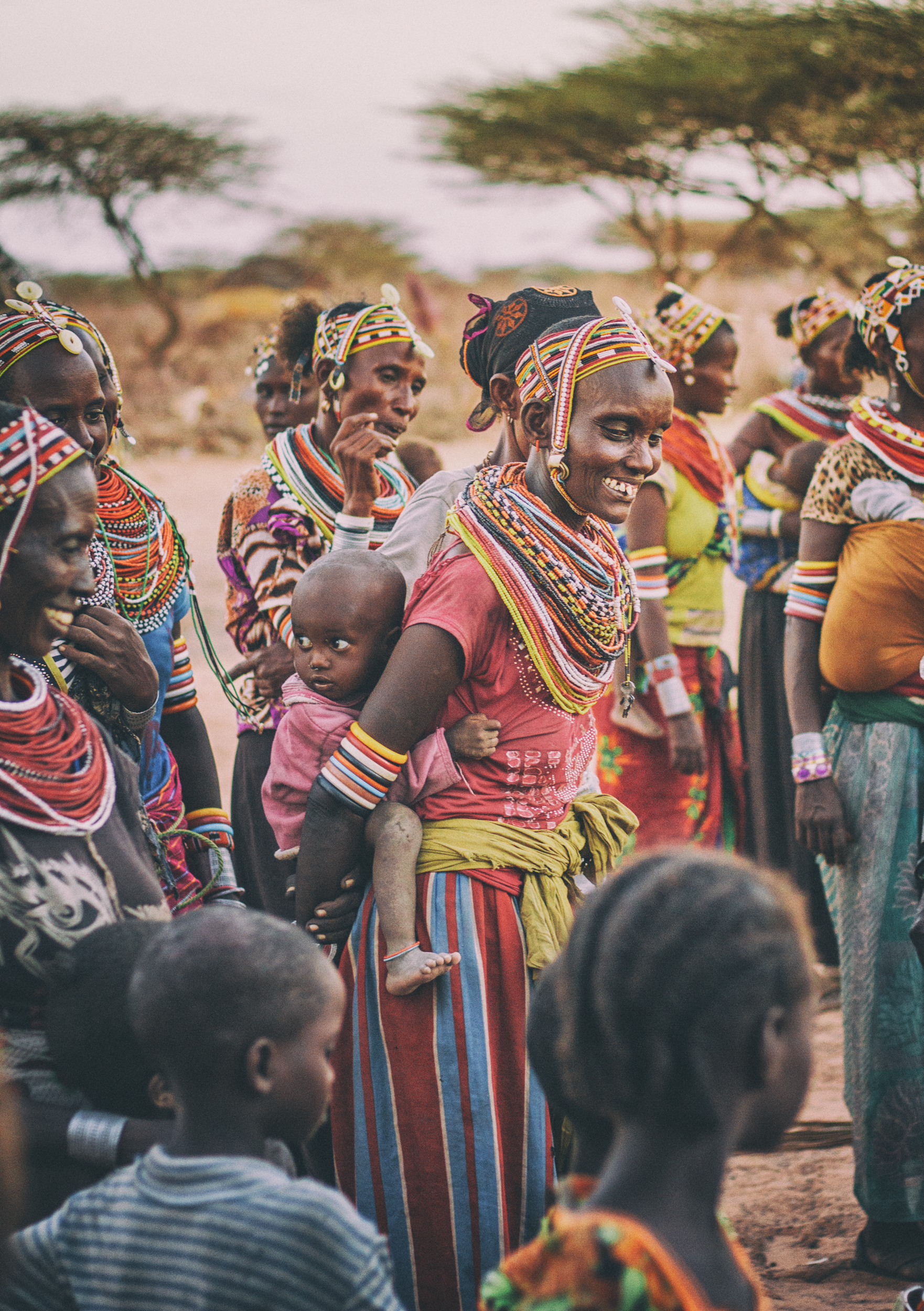
Shortly after my daughter’s second birthday my husband and I travelled to West Africa with The Earth Center and I witnessed first-hand the strong sense of community among the women and the responsibility that each of them assumed for each other and the children. What I observed in Meritah (traditional Africa) was what our Ancestors in America had maintained. The same sense of responsibility and community was apparent. I had my “ah ha!” moment. This is how it should be! I could now draw from traditional culture and make that my model for how I would live my life as a woman and a mother. I became a Kem mother-a woman who would nurture and raise her children using the values coming out of Western Meritah.
Through my personal experiences and my observations of women in Meritah (traditional Africa) I learned that during the time after giving birth, women need the support of other women to transition into a new phase of their initiation of motherhood. Whether it is her first child or her sixth, support given in this time is needed, even if she thinks she is capable of doing it without help. Sometimes the hardest thing for a pregnant woman or mother postpartum is to admit that she needs help and cannot do it alone.
Why should women be supported following childbirth? In modern society one in eight women suffer from postpartum depression. This is the most common complication of childbirth. Women who suffer from postpartum depression (also referred to as PPD) often do not realize that they are depressed. Most realize that they had been suffering from PPD or what some call the “baby blues” once their baby turns two years old. It is becoming more and more common for women to hurt themselves and babies during the postpartum period. There have been many news reports that highlight the fragile psy- chological state of mothers’ postpartum and have exposed the seriousness of the issue of PPD. Headlines have read: “Woman Beheads Her Baby”, “Mother Tortures Two of Her Children, Bodies Found In Freezer”, “Woman Killed by Secret Service Was Battling Postpartum Depression,” and the headlines go on. During the period following childbirth a woman’s body and mind go through various changes that will affect her mood and physical state. The hormonal shifts that take place have a significant impact on the brain. Some women may find themselves thinking they are inadequate or incapable of caring for themselves or baby. Some women may even have suicidal thoughts or thoughts of harming their baby. These thoughts, feelings or urges have a direct connection to the major shift that takes place after childbirth. Our Ancestors recognized the importance of teaching the new mother about these changes and supporting her after birth. Not because she could not do it herself but because they un- derstood the importance of having your elder mothers and other women of the community there with the mother who had just given birth. I call it, “The Safety Net”. This safety net educated the new mother on the different changes that take place in the body. It also taught the woman how to care for her healing body and new baby. This safety net understood that this phase of life should not be done alone and if done alone it could jeopardize the quality of the life of the new mother and subsequently her new baby. This at its essence is a rite of passage-an initiation into the a new phase of a woman’s life and this initiation must be guided by the elder women in the life of the new mother.
I remember bringing my baby home and needing help. I had many family members come by to see the baby. Some people brought food but no one brought the knowledge and wisdom of our Ancestors to assist me in that period of transition. In modern times, for some women, family and friends come to see the baby or hold the baby but not to provide care for the mother and child. I am in no way saying that people of African descent absolutely do not receive assistance from female family members but what I am pointing out is that the safety net is not as strong as it used to be, because of what we have endured in America and have lost as a result).
I have found various recommendations are made to women with the hopes that these suggestions will help to assist them during the period following childbirth, such as preparing freezer meals, adjusting budgets to eat out, hiring help and reaching out to friends and family to assist you in the first few weeks. These are great recommendations and have probably helped many women and their families during the postpartum period. I can even go as far as saying that some of these recommendations have saved some women from the throes of postpartum depression; but for most it has not. I have listened to many women as they share their experiences about their healing time following childbirth and for most it was very difficult for them if they did not have the assistance and support of close family and friends.
Though this approach may help to alleviate some of the stresses following childbirth, I find the model shown to me by the women of West Africa makes a great deal of sense. It is practical and has a spiritual significance to it, though this may not be seen on the surface. It is said that “only in the womb does a baby belong to the mother, once it is born it belongs to the world.” I found that with this saying being the guide for how the community approaches pregnancy, childbirth and the postpartum period, the women in the community, especially the elder women, really come to the side of the new mother (even women with more than one child). In the first forty days of recovery other women take care of the new baby while the mother recovers. There are medicines and herbs that are prepared and given to the mother and baby to help them heal. The mother’s belly will be bound to help move fluids and air from her womb and to help organs return to their pre-pregnancy positions. During this time the women in the community understand that the mother’s body and mind will be going through many changes and that she will need the support of others to heal effectively in both body and mind. And instead of leav- ing her to struggle, they surround her with a community. This is a stark contrast to what we experience here in America these days. Just like our Ancestors from earlier times here in America, the cultural value of community in Western Meritah holds strong. The cultural value of community in Western Meritah trumps isolation, death, despair and destruction of the West any day in my book. Though it may have been done through necessity, let’s reach back to the time in our history as Black people in America when we were a tight knit community. Let’s provide the support that our sisters and subsequently ourselves will need during the time of pregnancy, birth and postpartum. We cannot and should not be alone during the most spiritual and powerful yet vulnerable times of our lives.