Postpartum Care Part I: Healing the Mother
Harmonious Healing: Postpartum Care Part I: Healing the Mother
This article is part one of a series that will cover the aftermath of childbirth for both the mother and her newborn(s). In this issue I will focus on healing the mother during postpartum care. Future segments will focus on caring for the newborn’s health from traditional perspectives using my experiences in Meritah and research of other cultures’ customs.
Postpartum healing is one of many ways a family is bonded together: ensuring the survival of a new mother. Caring for women is a time-honored tradition passed down generation to generation from grandmothers to mothers, mothers to daughters, and sisters to sisters. And becoming a mother is a rite of passage, in order for a girl to become a woman, creating new life and continuing the bloodline. It is a dangerous experience that without the ancient knowledge of our foremothers could more often than not be life-threatening. There are many technical applications that have been preserved from all peoples across the globe. Each culture carries its own unique traditions. Interestingly, many of these healing techniques are universally seen across wisdoms, even though some of these practices have been lost or disregarded by the modern medical system. I gave birth in Meritah (Traditional Africa) and have firsthand experience with living in a traditional community. The following paragraphs recount my own postpartum healing in Meritah and discuss these healing practices as well as perspectives from around the world.
WHY I CHOSE TO BIRTH IN MERITAH
I started studying traditional customs with The Earth Center five years before giving birth. Along my initiation I came to respect the logic and beauty in the customs. I wanted to experience as much as I could from the continent of Meritah even though I have come from a modern (colonial) upbringing. When I became pregnant, I decided to give birth to my baby on Meritah soil, and I also spent the majority of my pregnancy in West Meritah. Why would an American like me decide to do such a thing? I wanted the experience of my ancestors - which is an ongoing learning process for me - especially among a community where the traditions are still honored.
The following topics of postpartum culture come directly from my own experiences, as well as my research of other cultural postpartum customs: West Meritah (my own birthing and healing); Ayurveda or Ancient Indian healing; Chinese and Korean medicine; and the Mixtec (pronounced “Meece-TEK”) tribe from Mexico. Through my research, I have found that there are similarities that seem to be universal amongst ancient customs: the mother-in-law/daughter-in-law relationship, the importance of heat, the notion of rest and confinement, a diet with healing properties, and avoidance of the presence of death.
THE MOTHER-IN-LAW/DAUGHTER-IN-LAW RELATIONSHIP
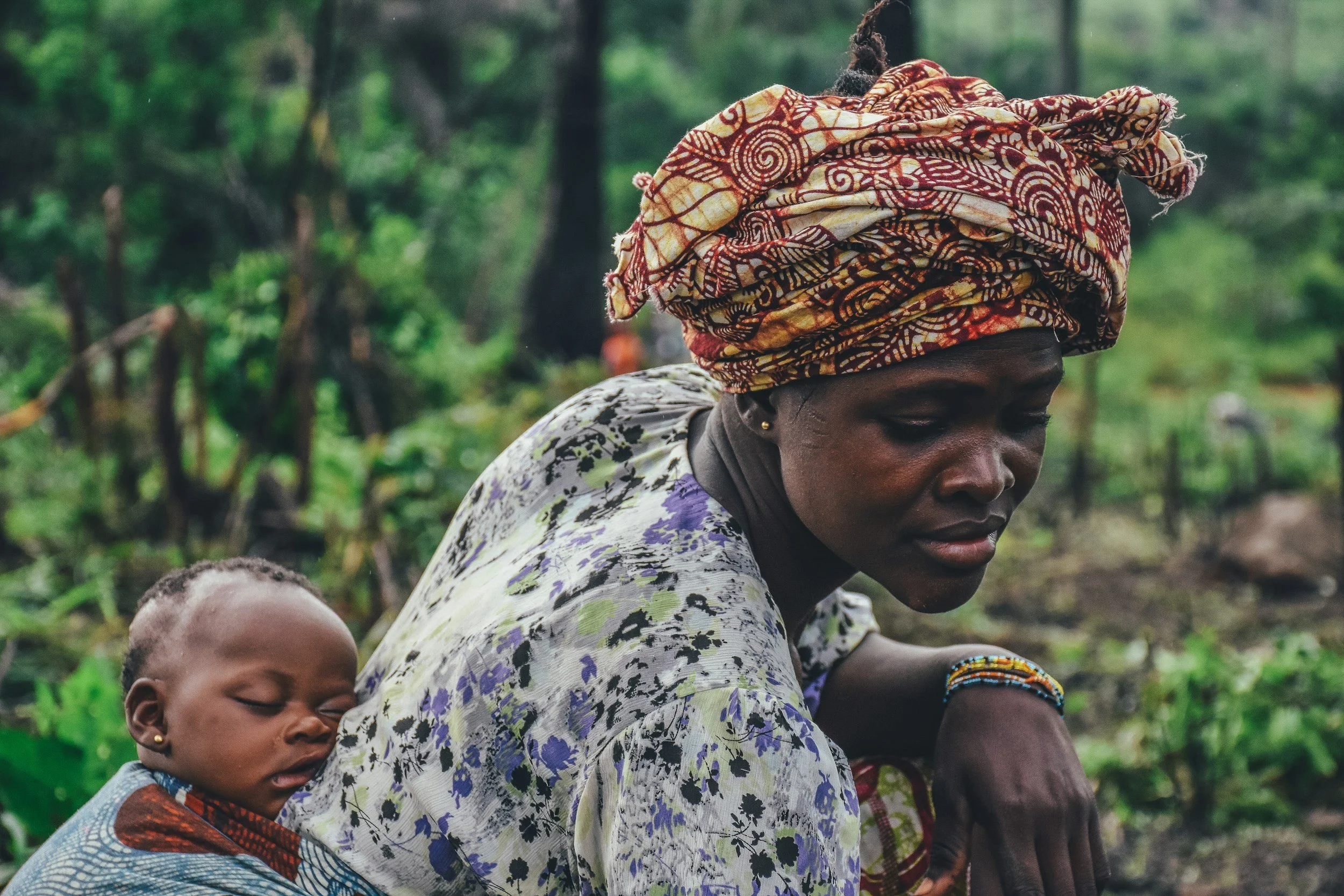
After I gave birth in Ouagadougou, Burkina Faso (known simply as “Ouaga”), it was my mother-in-law who oversaw my entire healing process. My baby was born ahead of schedule, so my mother-in-law had not yet arrived. But before I knew it, she was there in the hospital with us. When she received news of the healthy birth, she traveled night and day from Togo to come greet her new grandchild. I was astounded at her excitement. It is said she went running to the neighbors with her portable mobile phone, laughing and yelling in joy as she heard the news. She came straight to the hospital upon arriving in Ouaga, not even pausing for rest. I have since framed the photos of her holding my daughter for the first time.
I would soon find out that there is no boundary a mother-in-law knows when it comes to the well-being of her daughter-in-law and brand new grandchild. She once told me that she sees me as her own daughter now, and therefore, no topic was taboo: she asked me about my body and I asked her what to do. She would continue to cross a lot of privacy lines I had previously never blurred. This is something that is second nature to the women raised with traditional customs, but as a woman with an American background, it was a challenge to adapt. Looking back, it was a necessary sacrifice for the sake of my healing that I wouldn’t have any other way, and my relationship with my mother-in-law is now very strong because of it.
Similarly, in Mixtec culture, the new mother will be at home with her baby in relative isolation, being cared for by both her mother and mother-in-law, keeping warm and avoiding housework (such as sweeping and washing).
The same is true In both old Korea and China, where wives would live with their husband’s family, so the mother-in-law would be the special caretaker for the new mom. She is the one to oversee the mother’s healing. Even today, these old fashioned mothers-in-law still exist, even if the new mothers themselves may want to be lax on some of the traditions. It is the mother-in-law who will tell her daughter-in-law to wear oven mitts when opening the refrigerator, or make you get your socks with your slippers on the spot.
In the Ayurvedic tradition this custom is different. A woman lives with her mother-in-law and her husband’s family, but before giv- ing birth she would leave her in-laws to live with her mother who would be her customary support group during the delivery and postpartum.
THE IMPORTANCE OF HEAT IN POSTPARTUM HEALING
The most important aspect of my healing revolved around my twice daily warm showers. In four months I didn’t miss a single day of this regimen. In the beginning, the fire outside was prepared for my hot water, and the hot water was brought to my room in a bucket by one of the young girls staying in the house. After a couple months, when my body was strong enough to be trusted to carry on with more responsibilities, I was the one who would prepare the fire and water for both my baby and myself. But in the beginning, I didn’t know how to build a fire. I had to learn by watching and practicing, and one day it was just part of my daily activities.
I didn’t know what to expect when my mother-in-law followed me into the shower with a bucket of steaming hot water and a wash-cloth. After giving birth, I became somewhat less shy, so rather than being focused on my modesty, I just looked to her for what could only be instructions to come. She took the washcloth and soaked it in the hot water, and then began pressing gently on my upper torso. I recoiled at first. It felt very hot. She gave me a blank look and asked if it was too hot, and continued patting systematically from side to side gradually moving downward towards my belly and lower abdomen. I didn’t know my body could tolerate the steaming water, and I found myself proud that I was able to withstand such heat. She told me to do this every time I shower. And I did for four months. Later I realized this was done to coax the lochia out of my uterus, which is the discharge of excess placental tissue (which looks like blood) that comes out of the vagina (like a menstrual cycle) after one gives birth.
After patting my belly a few times, my mother-in-law told me to sit over the bucket of hot water. It required a little balance, but it was soothing. I had stitches after giving birth and this was a good way to heal that area gently. It also had the added effect of introducing heat to the inside of the birth canal helping to encourage the lochia to flow out of me. She told me it is poisonous for the lochia to linger in the uterus, so it’s very important to make sure all of it comes out. If any lochia stayed in the uterus, it would leave the belly with a pouch-like look for the rest of the woman’s life.
In Meritah I carried around a thermos with hot water so that I had something to drink whenever I was thirsty. I was not allowed to drink the water from the tap because it was too cold. I was also not allowed to eat sauces that had reached room temperature, and my mother-in-law was always testing my food and telling me to eat faster, because at a moment’s notice my baby might need me and my food would have gone cold while I was tending to her.
In the Mixtec tribe, the reason for heat comes from an interesting phenomenon. It is said that the mother must recover heat from the birthing process and that cold is associated with death - and also the “subterranean world” - and thus must be avoided. Similar to Meritah, part of the regiment during the cuarentena (see the following section on confinement period) for the mother is kuchi nde ‘ini (in Cuicatec) - to take steam baths at least every 3 days - in which she kneels in a tub while another woman pats her with a cloth dipped in a plant remedy - from the crown of her head down to her feet. The plant baths “cook” the woman’s body, heating the blood and producing breast milk. It is said that a steambath is necessary in order to make a full recovery from childbirth.
In ancient Chinese medicine, indeed the major threat to a new mother during her weakened state is the cold. According to Chinese theory, loss of qi (pronounced “chee”) is linked to childbirth, which makes the mother vulnerable to cold. If cold temperature manages to penetrate the mother’s meridians - a Chinese concept of channel where qi flows - it could leave her weakened with joint pains for life. In Korean families, where the climate is colder, postpartum women have been known to be very warmly dressed in thick clothes and are not allowed to leave the house.
The Ayurvedic practice also emphasizes heat as part of the women’s healing process. According to Ayurvedic wisdom, absence of the mother’s baby in her belly creates an excess of the air element - called vata (in phonetic Sanskrit) - which brings the condition of dryness and coldness. Part of the new mother’s care is to be massaged daily with hot oils with extra focus on energy points called marma (in phonetic Sanskrit). The hot oil massage, called Abhyanga (in phonetic Sanskrit), restores the balance from the outside-in, bringing warmth and therefore pacifying excess vata. Hot massages are essential to a mother’s rejuvenation and one of the top ways to prevent problems after childbirth. After the hot oil massage, a warm bath for the mother and baby awaits to soothe their muscles and nerves, and it also provides bonding time for the mother and child.
THE NOTION OF REST AND CONFINEMENT
For the first few weeks I was encouraged to sleep during the day. “Go sleep,” my mother-in-law would say, and I could barely believe it. I knew I needed sleep in order to have energy to wake in the night to breastfeed. But that was very difficult to do. During the day my baby was asleep, so I could get things done. I was still in the mode of doing laundry (by hand) every day and cleaning the room in which I slept. I felt guilty about resting. As a woman in Meritah, you don’t just rest in the middle of the day when there’s work to be done. Lack of sleep would later contribute to my “baby blues” feelings (when the deprivation caught up with me). But at some point I managed to surrender to the necessity of sleep, and a daytime nap became part of my rights as a new mom (when I could fit it in). As a result of this experience, I’ve made a mental note that the next time I give birth I will feel less guilty of taking some daytime rest and see it as necessary for my recuperation. Gradually as I healed, I returned to my routine of day to day activities. However I continued to do laundry even three days after I gave birth.
I was also encouraged to stay near the baby, even while the baby was sleeping. The times I did leave the room, I was asked by others, “where is the baby?” or I was told, “go see your baby.” This resulted in a kind of seclusion from the rest of the house, which lasted for two months. In Meritah, I was told that the mother typically doesn’t leave the home until her baby is 40 days old and is ready to make travels for the first time. We weren’t able to keep to this rule strictly, but we never traveled beyond our neighborhood.
In Mixtec culture, childbirth is followed immediately by twenty days of rest for the new mother, but a period of forty days is preferable if possible. This period of rest is called La Cuarentena - meaning “quarantine” in Spanish - and is common amongst many other tribes in Mexico as well. For Mixtec women this is a time for rest, precautions and prohibitions, sexual abstinence, massage and other care, a special diet, herbal medicines, and steam baths.
Korean postpartum customs are called samchilil (in phonetic Hangul) which means “21 days,” which is the minimum number of days the mother is confined to the home in order to heal. The Chinese refer to this time as zuo yuezi (in phonetic Mandarin) or “the sitting month.” During this time, visitors are prohibited and new mothers and their babies are not allowed to go out. In the oldest customs, the mother is confined to bed rest. The belief is that the mother should be looked after very closely, limiting her activity as much as possible (no chores), to ensure her uterus and pelvis heal from giving birth. Many would agree that focusing on recovery for 30 days is better, and even up to 100 days if possible.
In Ayurvedic healing, it is the womanly wisdom (and right) to bring the body back to “beautiful,” and the body demands relaxation and rejuvenation to revert back to her normal pre-pregnancy state. In order to ensure the mother is receiving the proper care, she stays at home while recovering from birth for a period of 40 days, also known as postpartum confinement. This is a time for the woman’s body to recover from the intensity of childbirth: the uterus returns to pre-pregnancy size, the breasts begin to produce milk, and the perineum heals. During this time, the focus is on the mother’s recuperation.
DIET WITH HEALING PROPERTIES
My daughter was born midday and I was served a lunch with rice and sauce at the hospital quite soon after she came. But when I returned home with my mother-in-law, it was motoh, motoh, and more motoh. Motoh (in Tem) is a traditional dish made of cassava flour and corn flour that is always served with sauce, and is a staple dish for everyone in Meritah. All around the continent a similar dish exists with similar flours by a different name. Motoh is known for replenishing one’s energy and making one strong.
My mother-in-law prepared a special sauce that assisted in breast milk production. I ate that same sauce twice a day on some days. No matter what I was eating, I was also only allowed to consume warm or hot food and drinks, and cold was strictly forbidden. My mother-in-law would watch me eat. “Eat all,” she would say, and sometimes, “all, all, all!” and she would stay with me until she was satisfied with my mostly empty plate. I was encouraged to eat quickly in order to tend to my baby’s needs at a moment’s notice, and she made it known if I wasn’t eating enough.
In Mixtec culture, a diet with hot foods including chicken broth, hot greens, cooked meats, and soft tortillas are considered nourishing foods to help the mother recover. The woman is also encouraged to consume fluids that will help her produce milk such as shukwi (in Cuicatec), a white cornmeal mush or gruel. According to the traditions, a new mother must avoid eating cold foods because she could become very sick and even die.
In Chinese medicine, the emphasis is on the warmth and rest for the mother, making sure she is ingesting warm foods and fluids (no hard or crunchy foods), avoiding cold foods (including fruits and raw vegetables) and cold weather, and wearing thick clothes (even in the summer). Older traditions even forbid the woman from showering, but that is to avoid the cold, not to neglect hygiene. A traditional Korean soup called miyuk-kuk (in phonetic Hangul) is a meal served to all new mothers. The main ingredient in miyuk-kuk is seaweed, which helps clean the blood, improves circulation, en- courages lactation, replenishes nutrients, and rehydrates the new mother. This soup is so important that it is prepared up to 3 times a day, every day, for the new mother. The Chinese have herbal soups and formulas with similar purposes, including balancing qi. One of these so-called “confinement dishes” is called geung cho (in phonetic Cantonese) which is a ginger vinegar soup with pig trotter (pig’s feet).
The Ayurvedic postpartum diet seeks to soothe and balance the body from the inside-out. Warm fluids, never cold, are ingested including special teas aimed at hydration, digestion, and rejuvenation. Also to avoid cold infection and to strengthen the mother’s digestive system, she is given raw sesame oil with a combination of herbs including ginger, chavya, chitraka, and long pepper. Rice gruel prepared with long pepper, barley, and sometimes sesame oil is eaten at least twice a day along with hot water to drink.
AVOIDING SPIRITUAL WORK AND PRESENCE OF DEATH
Part of traditional life in Meritah involves offerings (sacrifices) and spiritual work. This aspect of the existence cannot be ignored for someone like me who is seeking to reconnect with ancestral ways. Spiritual work is a part of the traditional culture that enables a human to affect their destiny by manipulating the energies in the universe using the ancestral knowledge of nature. These works are done as often as one needs to bring balance in their lives. Sometimes offerings and spiritual work involve animal sacrifices in order to bring the messages and wishes to the spiritual realm. Some examples of spiritual work done for an expecting mother are for good health in labor and birth, stabilizing the spirit that’s coming (the newborn), and overall protection for the mother and child.
However, after my baby arrived, and even during my pregnancy, I was deliberately directed away from all forms of death. My baby and I were not allowed to be present for certain rituals including cow offerings, funeral ceremonies, and even to participate in offerings meant specifically for me or my baby daughter. In these cases, my husband substituted in for me or our child, or sometimes a priest made sure to take care of our work in our absence. For these works, we were told ahead of time to leave the area so that we - my baby and I - were not able to witness or even be in proximity to death.
Through my research I found a similar custom in the Mixtec culture. The mother and newborn are also barred from cemeteries, wakes, and funerals because it is dangerous for them to approach the dead. It is known by the Mixtec people that the dead emanate tachi shee (in Cuicatec) or “evil winds,” which cause many diseases and troubles.
SUPPORT FROM WOMEN AND LEARNING THE ROPES OF MOTHERHOOD
As a first time mother I didn’t realize how much help I would need once the baby arrived. All of the help and support came from the amazing women around me. In Meritah it seems like all women love to perform childcare. They treat all children as their own. It is ingrained in their identity as part of who they are. The help and as- sistance I was offered came from all angles and all hours. For example, one thing, it seems, all women love to do is bathe a baby. When I was at the Tem House in Togo (a property owned by the Earth Center), the women would take turns everyday, agreeing amongst each other on whose turn it was. However, there seems to be a hierarchy of privilege, because if my mother-in-law was around - or my mother-in-law’s sister - she would be the only one to bathe this baby. It is just accepted that it is the grandma’s role to do it.
When I came home to Ouagadougou after giving birth, it was my mother-in-law who bathed my baby daughter twice daily. It was the one thing I always wanted to do, and was perhaps also the one thing I was most anxious about messing up. I wanted to try, but besides the fact that I couldn’t sit or stand easily and I was always fatigued, I also didn’t know how to do it. Even though I begged her every day to let me learn, I was only able to practice bathing my own daughter a handful of times while staying in Meritah. Except for a week or two when we traveled to Togo, my mother-in-law bathed my daughter every single day from the day she arrived till the day we left Meritah.
I was called away before my daughter was born, but I needed to recover and get my bearings as a new mom before I could even think about leaving. It was always the plan to leave Meritah when we were ready and able to travel. And there were many times I would scheme in my head how to take my mother-in-law with me, but it just wasn’t a possibility. Sometimes I would panic, wondering if I could do it all by myself - this was my version of the “baby blues”. My mother-in-law gradually passed on responsibilities and eventually stopped watching me meticulously during anything I did. This was a sign to me that she trusted me with her granddaughter - a real achievement for me. After 4 months, my mother-in-law sent me off on my own, and I felt like a proper mother - scared, apprehensive, but somewhat less clueless.
My mother-in-law helped me in so many ways to prepare me for motherhood. She woke to the sounds of my baby crying in the wee hours of the night and came into the room to help me breastfeed. She even spent the night in our room when I was feeling ill to help console the baby. My mother-in-law always knew what to do, and through her wisdom I was getting a crash course in how to take care of myself and take on my new role as mother. In the beginning, while my body was still unable to move as sure as I normally can, all I could do was watch: watch her give a bath and rub shea butter all over my baby; watch her take care of the umbilical cord; watch her dress the baby... put her to bed...burp her... hold her... everything. As time went on, I got stronger and my daughter got stronger, and eventually I was able to copy what my mother-in-law did.
In Mixtec culture, postpartum body care requires very intimate female knowledge and body practices, and is rarely spoken outside of women to women impartment. An elder daughter, a mother, a mother-in-law, or any other close female relative cares for the new mother in order to prevent suffering from recaida, or relapse into a ill-state of being. Someone from her female group of support will massage her to help with the flow of blood, increase milk production, and shrink the uterus.
In Chinese and Korean customs the new mother is looked af- ter closely by the female relatives that are available to help, and of course the mother-in-law and mother are an ever present force during the healing process of the new mom, preparing her miyuk-kuk and making sure she is always dressed warmly.
In Ayurvedic customs, many female relatives usually make themselves available to assist the new mother and her newborn with cooking, cleaning and other forms of help. It is the women who prepare her meals and massage her with hot oils during her postpartum confinement.
MODERN MEDICAL CONDITIONS RARELY SEEN IN TRADITIONAL COMMUNITIES
After I gave birth in the hospital, my baby and I stayed two nights as the staff watched over us. On the third morning my mother-in-law took my baby and wrapped her up while my husband walked me out of the hospital, and we went home. We had scheduled a check- up in one week for the baby and an appointment for me in 4 weeks. Honestly, we made an effort to make it to those first appointments, but after a certain point we stopped going and we haven’t been back since.
Other than those few doctor’s appointments afterwards, my own personal postpartum regimen did not include the modern medical approach to postpartum treatment. But from what I’ve heard and from what my family and friends have gone through back in the U.S., it is my understanding that America’s postpartum practices are rough on new mothers.
The first postpartum check-up in the modern medical approach is usually 6 weeks after giving birth, which is too long to wait if nobody else is looking after her, especially if she’s had an episiotomy or tear. There are concerns! Therefore many women turn to the internet for their postpartum support. This differs from the round-the-clock care received in a traditional environment from women who’ve come with their wisdom and energy to maintain the household as well as your health.
Another phenomena in modern society is that these mothers are expected to bounce back to the workplace, after their time of unpaid maternity leave, during which time they had handled most of their healing alone as many of their friends and family are too busy with work themselves to come help out with the baby and around the house. Personally, if I was handling things all alone, I would probably want to head back to work too, turning to a nanny or otherwise. In fact, in the United States, 7 out of 10 nannies work full time (spending 40 or more hours a week with the family or even living with them). Over half of these modern mothers remain in the workforce, and nowadays it is considered “normal” to pass the responsibilities of raising our own children and to others and use our time to contribute to the household income instead.
I grew up with a nanny, and I can remember staring out the window waiting in anticipation to see my mother’s car drive up to the house. Sometimes I would start doing that too early, and my nanny would tell me that there were hours to go so I should do something else. Once I caught on to the concept of time, I used to ask my nanny if it was almost time for my mom to come home, but I was almost always way too early.
There is also a prevalence of postpartum depression or postnatal depression in women in the modern world, which is when a new mother has overwhelming feelings of stress, inadequacy, anxiety, or frustration centered around her new role as “mommy,” and lasts for 3 weeks or more. The clinical term is defined as “a mental health problem characterized by a prolonged period of emotional disturbance occurring at the time of major life change and increased responsibilities in the care of a newborn infant.”
There are many treatments for postpartum depression including psychotherapy as well as pharmaceutical drugs, called selective serotonin reuptake inhibitors or SSRIs, which are basically antidepressants that trick the brain into being happier through chemical imbalances (which cripples the person’s ability to cope with life in their natural state). It is estimated that about 1 in 3 women will experience postpartum depression in the U.S. and 1 in 7 will experience depression sometime in the year after they give birth. Of these women, 70% will receive antidepressant medication.
It has been purported that postpartum depression is non-existent in cultures outside of the U.S. and Western European countries. Meaning, traditional cultures with postpartum practices and customs, not merely other countries following the U.S. modern medical model. Studies show that rituals in some cultures have been known to protect against developing post- partum depression, such as the social sup- port of staying with a female family mem- ber (as seen in all the ancient customs from cultures examined in this article).
CONTINUING THE CONVERSATION
I will always be a child of the modern system seeking to learn more from the traditional cultures of the earth. My experiences in Meritah have given me a unique perspective from that of the average per- son of the modern world. I consider myself different because I have begun to rethink how to approach life in general and what it is to be a human being in a community. I am very grateful to the Earth Center and Prophet Neb Naba Lamoussa Morodenibig for bringing the initiation camps to the modern world so that people like me can benefit from the dialogue that was previously cut off between myself and my an- cestors. Before I began learning of traditional values, I was a different person on a different path. Now I am the woman who has given birth in Meritah and learned firsthand about traditional healing from ancient wisdom passed down from gen- eration to generation. I am very proud to pass this information on to women who are interested in different approaches to life outside their colonial upbringing, and to serve as a bridge between the tradition- al woman to the modern woman. And I am grateful to all those women who helped me communicate this information so that everyone who reads this article will better understand this amazing time in their lives of bringing life into the world. Look for the next installment of this series on postpartum care in future issues of The Rising Firefly magazine.