Korean Ginseng
Herbal Healing: Korean Ginseng
For centuries, Korea has been well known for its quality production of beef and spices. Sixty percent of the total vegetable cultivation area is occupied by the commodities which are major components of Kimchi; cabbage, radish, hot pepper, garlic and onion. However, among many of the cultivated vegetables, there are a significant number of herbs that flourish with great quality. Due to the climate and location on the East Asian monsoon belt, the elements nurture the soil to provide a balanced environment which lends itself to produce some of the world’s finest, highest quality Ginseng. Some of the best ginseng can be found growing in moist and shaded mountain sides throughout China, Russia and of course.....KOREA. Which we all know to be the best place in the world. Don’t hate.
During the monsoon season in Korea, the very hot and humid time of the summer, you can see rice paddies and ginseng crops for miles and miles, mainly in the northeast. It is from many of these north eastern villages that the ginseng is distributed then exported. Ginseng is popularly sold in Korea as the bare root or as a tea. Only the ginseng root is used. Korean ginseng is available as a powder of the whole root, as cut and dried roots and as liquid or powder extracts. I personally observed and later came to learn that virtually every single vendor in Korea, local to commercial, sells some form of ginseng or ginseng tea. (It’s almost as if it were a requirement)
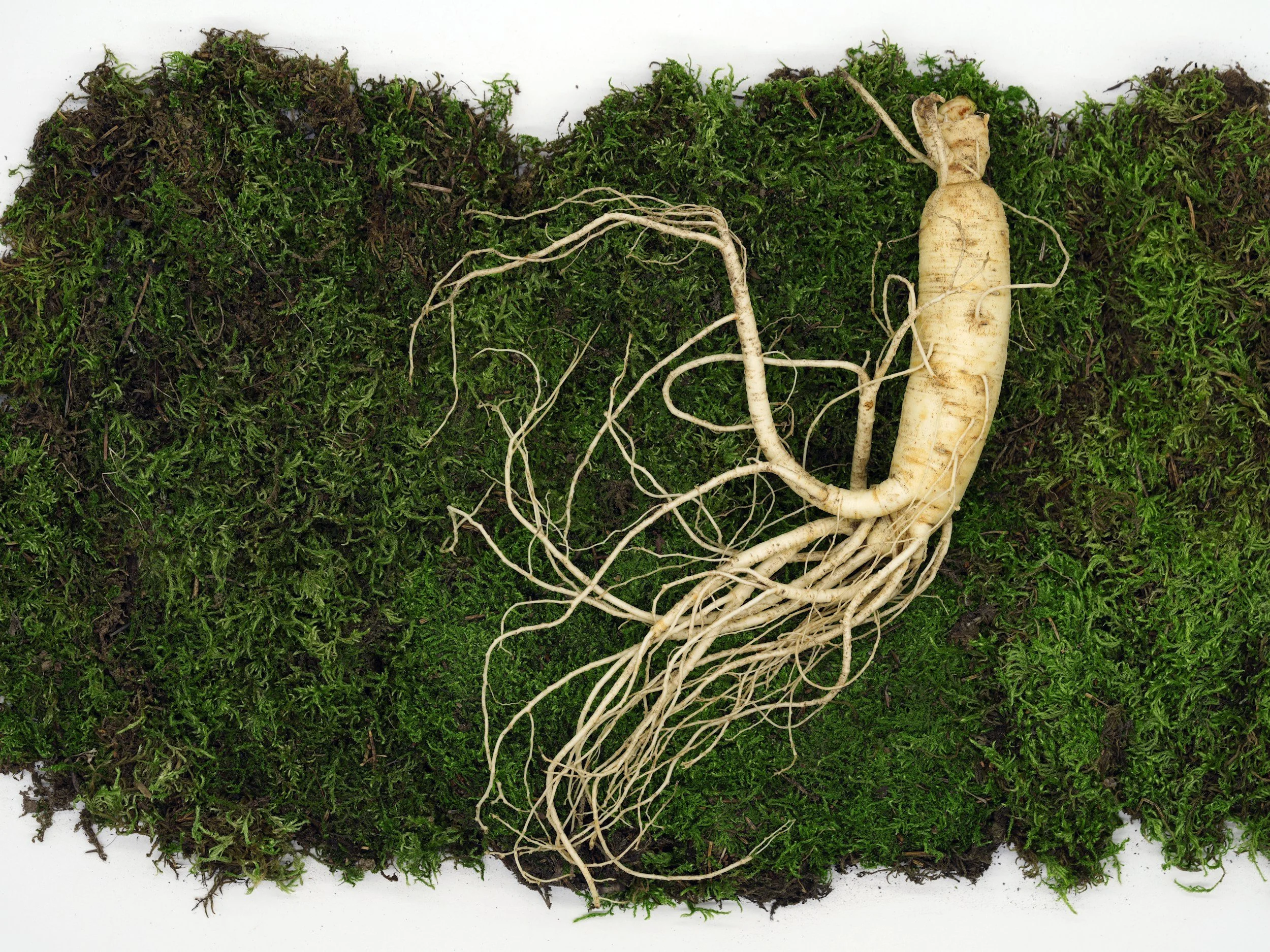
Korean Ginseng, commonly referred to as “asian ginseng” or “panax ginseng”, is a knobby, light tan root. The word panax is derived from the Greek word panacea, which means all healing. Occasionally the center part of the root will grow outward resulting in the look of having arms and legs. In fact, the English word for ginseng references the Chinese word “Jin-chen”, meaning like a man. literally meaning “man root” or “like a man”, in reference to the root’s characteristic forked shape, resembling a person. The ginseng plant is more commonly identified by its leaves that form a circular pattern growing around a straight stem. Yellowish-green flowers bloom in the center of the plant and produce red berries, however only the Ginseng root is used. Since ginseng root is only ready for use once it is about 4 to 6 years old, it is important to know that the age of the plant can be identified by counting the number of wrinkles around the plant’s “neck”.
Ginseng is often taken orally, as a tea, to produce mass benefits ranging from it’s popular energizing quality and reproductive assistance to immune support and infections. More specific conditions include Chronic Fatigue, genital herpes, impotence, stress, muscle soreness, low immunity and depression. Ginseng may also help to improve stamina, breathing, coordination, normalize blood sugar levels, strengthen appetite and increase alertness and reaction time.
Energy & Stress Relief
The main active ingredients of Korean ginseng are what’s known as ginsenosides. Ginsenosides increase protein synthesis and and activity of neurotransmitters in the brain. It stimulates the formation of blood vessels and improves circulation in the brain, thereby improving memory and cognitive abilities. These steroid-like phyto-chemicals have adaptogenic properties. Adaptogenic is just a fancy word used by herbalists and doctors to refer to a natural herb or herbal product that is proposed to increase the body’s resistance to stress, trauma, anxiety and fatigue. This is the component that gives ginseng such a widely recognized reputation for reducing the effects of everyday stress. When stress occurs, there is a gland located just above the kidneys that works to regulate the stress response it receives from different transmissions that the brain gives off. The more signals sent to this gland the higher the levels of stress we experience. The components of ginseng effectively work to prevent these glands from being overloaded or bombarded by these signals. This function is also utilized in the treatment of diabetes, migraine, infections, and radiation
Both American and Korean ginseng roots are taken orally as adaptogens, aphrodisiacs , nourishing stimulants, sexual dysfunction in men and in the treatment of type II diabetes. Both topical and oral forms of ginseng are used to treat erectile dysfunction (ED) in men. One large study also found that taking ginseng orally improved male fertility by increasing numbers, quality, and movement of sperm. Although the exact reasons that ginseng may enhance male fertility are not completely known, chemicals in ginseng are believed to activate the body system that increases production of certain hormones. Through the same activation of hormone production, chemicals in ginseng are thought to exert an effect similar to the female hormone, estrogen. In some laboratory studies, ginseng accelerated the growth of estrogen-dependent breast cancer cells, perhaps by activating estrogen receptors. Whether ginseng can help to relieve menopause symptoms and conditions worsened by low estrogen levels is not yet known. However, much more research is needed to understand more clearly ginseng’s possible estrogen-like effects.
Immunity & Blood Support
Studies of Western herbal medicine show that panax ginseng’s ability to regulate the immune system can assist in the prevention of colds, flu, and some forms of cancer. Case studies show that panax ginseng may also be effective in lowering the sugar content in the blood and lowering cholesterol levels. Consequently, panax ginseng may prove beneficial when used in connection with type 2 diabetes and when used by those suffering from high cholesterol. When it is applied to the skin, Panax ginseng may increase the production of both collagen and blood vessels. Collagen is a protein that makes up most of the connective tissues that support skin. Because collagen production generally decreases as individuals get older, collagen supplementation may prevent or improve signs of aging such as wrinkles and age lines. Topical Panax ginseng creams and lotions are also used to treat acne scars and skin wounds. Additionally, Rg1 and other chemicals in Panax ginseng seem to promote angiogenesis--the growth of new blood vessels when taken by mouth. While angiogenesis allows tumors to spread, it also helps wounds to heal and restores blood flow to injured tissue. Its other potential uses are not as well defined, however. In separate studies of laboratory animals and humans, Panax ginseng showed a relaxing effect on muscles in the lungs. The resulting airway expansion may help to relieve asthma symptoms and other lung conditions that result from constricted airways. In other studies, a combination of Panax ginseng and ginkgo is believed to have boosted memory and thinking processes. Early results from laboratory study may show that chemicals in orally dosed Panax ginseng promote the growth of blood vessels, which could be valuable in treating extensive injuries. Korean ginseng also contains natural steroids that are remarkably similar to the anabolic steroids found in our body. This makes it ideal for athletes and bodybuilders looking for a natural alternative to an anabolic steroid.
Indigenous Uses:
The herbs we use and are learning more and more about in the modern world have been around for millenia after millenia. It is helpful to get a glimpse of how these herbs were applied, observed and incorporated by indigenous tribes that were here long before us for a better understanding. These people lived their life much simpler and closer to nature and had various applications of different parts of the plant. The condition of this lifestyle was effective in obtaining the full benefits that nature has to offer particularly with the use and understanding of various herbs. Since the modern understanding of “herbology”comes from the pre-existence of traditional civilizations, it is intelligent to find our understanding of this particular herb from one of its many sources. <---this is really complex, i’m just trying to say that i’m including this part of the article so that we can see how ginseng has been used by people long before modern medicine
Fox and Meskwaki - used Ginseng chiefly as a seasoner to render other remedies more powerful. A compound of the root, called a “bagger” was used by a woman to get a husband. Ginseng was also used as a universal remedy for children and adults.
Cherokee - This tribe used ginseng alot for weakness of the womb, and nervous affections and headaches. This is due to the effect that ginseng has on the muscles. It is effective in supporting the muscles by releasing a natural steroid when ingested. The root is not only a tonic, but also used as an expectorant. In addition, the root is used for convulsions, palsy, vertigo, rheumatism, and “diseases induced by mercury”. It is chewed for colic. An infusion of ginseng is used to cure “thrush” and colic. Thrush is an infection of the mouth caused by the Candida fungus, also known as yeast. The Cherokee also sold ginseng in large quantities to traders in the late 19th century.
Creek - The Creek applied a poultice or dressing of the plant to bleeding cuts. A decoction of ginseng is taken to produce sweating for fevers. A *decoction of the roots is also taken for shortness of breath and by children for croup. It is also used in ceremonies to protect from negative energies.
Houma - This tribe took a decoction of ginseng root for vomiting. This decoction was also taken with alcohol to cure rheumatism.
Iriquois - The Iroquois use a compound infusion of roots as a blood remedy and for tapeworms. A decoction of the root was taken for vomiting from cholera and a root infusion taken for vomiting gall. It is also used to treat tuberculosis and to cure a bad appetite. An infusion of ginseng root is used on sores and boils, for earaches and sore eyes, and also for night fevers. They also smoke the dried roots as a cure-all and for fainting spells. Smashed root of ginseng is smoked for asthma. The Iroquois use the ginseng plant as a tonic also, as well as a stimulant. It was also used to treat gonorrhea. Dried roots are smoked for every ailment including fainting spells. A compound is used for chest pains and and infusion of roots used as a wash for fishing equipment. A decoction of the plant rubbed on the arms and legs was used for traditional sporting events.
Menominee - This tribe used ginseng as a tonic and “strengthening of mental powers.” The root was wrapped as a good luck charm in war and hunting bundles. The root was also chewed by hunters as a means to impart a lure to the breath and attract deer.
Micmac - These people used the roots as a “detergent for the blood”, due to its blood cleansing properties.
Mohegan - This tribe highly valued ginseng as a cure-all. A compound infusion including ginseng root is taken as a spring tonic. However, the root alone can also be used to produce an effective tonic.
Pawnee - The men of this tribe used a compound of ginseng root as a love charm. Women used a root infusion to increase fertility.
Patowatomi - The Patowatomi use ginseng root as a seasoner in many powdered medicines. The root was also pounded and applied to earaches and a wash for sore eyes.
Seminole - The Seminole use a decoction of roots as a body rub and steam for joint swellings and a poultice of roots is applied to burns and drain boils and carbuncles. An infusion of the roots is taken for shortness of breath. The plant was also used to treat gunshot wounds. It was placed in medicine bundles for bullet wounds. Seminole men also rubbed the plant on the body and clothes to get back a divorced wife. Not only that, but ginseng and other plants were used as a baby’s charm for fear from dreams about raccoons or opossums.
Chippewa - For the Chippewa, ginseng root became a monetary commodity because of the white traders’ demand for it. The root is considered a good luck charm if carried in the pocket.
Decoctions:
Since Decoctions are a popular way of preparing Ginseng, here is a quick and easy recipe. Decoctions are stronger than infusions and provide a more concentrated form of the herb. They are similar to tinctures, but can be used a little more flexibly. Pills and powders are more often used for long term administration in the case of chronic disease. Tinctures can be taken for acute patterns, it’s just that acute patterns may change frequently and with decoctions, your formula can be altered as needed. This is just a general recipe that can be used with any herb.
To make your own:
You will need to make a decoction if your herbal remedy requires the use of a fluffy herb, rough, woody or the roots. Use 1oz of the dried herb, torn or cut into pieces, to 1.5 pints of water. The amounts can obviously be reduced for making smaller batches.
Put the herbs into an enamel, glass or stainless steel pan, then add the water. Do not use any other type of container as it may affect the herbs.
Bring to the boil and simmer for about 10-20 minutes or until the liquid has reduced by about one third, then strain. Generally speaking it should be used while it is still hot.