
Earth Center Spiritual Pilgrimage
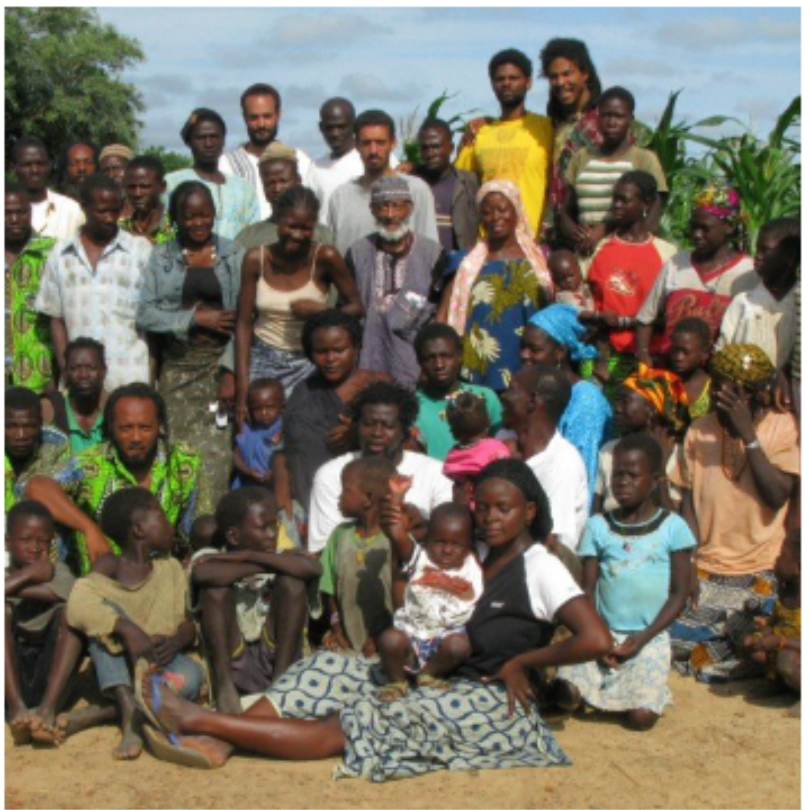
As a student at The Earth Center (E.C.) in Chicago, I was privileged to accompany other E.C. students from Chicago, New York and Ouagadougou on a pilgrimage to Tombouctou in Mali, West Africa. Master Naba Lamoussa Morodenibig, the founder of The Earth Center, guided us on this pilgrimage. At the E.C. we learn many things. Whether in the Medu language class, the Ka'at Ibi meditation class or the Healing Class, there is a philosophy presented. It is the philosophy of the survivor. And it comes from the most trusted source, the culture that has survived on this Earth for the longest time.
The Kemetic culture that is presented at The Earth Center provides an individual with an understanding of the human condition. With this understood, the individual has greater insight into why humans behave in the ways that they do. Our actions are based on our motivation. At their root, our actions are either constructive or destructive, and what we believe them to be makes no difference. So what is our motivation? Traditionally, a human being's fundamental motivation is survival, and hence, the traditional authority on this concept of survival is the Kemetic culture of the Nile and Niger valley civilizations. This is where humanity reigns, and remains. The Niger valley is where we took our pilgrimage, and I am privileged to tell you about it.
The banks of the Djoliba River, as the Niger is called in Mali, can be very small. So small that a young child can reach a hand into the river while sitting at the river bank, just a few steps from their house. "This shows the age of the river", Master Naba said. We refer to him as Maakheru, or truth teller. Our group traveled for three days and two nights by a motorized wooden canoe to reach Tombouctou from Mopti, another traditional city of the Niger valley. It was in Mopti that we hired the services of two young men, in there twenties, and their canoe for transport. The canoe carried twenty people with baggage comfortably, and the men told that they built it themselves.
Along the Djoliba there is much delta. This is where the shallow banks of clay and sand disappear. We were navigated along a winding channel through the deltas. At times the channel was bordered with tall grass that obscured the horizons. We were secluded from everything but the river, grass and sky. At other times the delta seemed like a sea spreading to each horizon, a maze of grasses rising all around and offering no indication as to the way ahead or from which we had come. Despite no appearance of a distinguishable main channel through the deltas, our navigators and many others proceeded with efficiency. I say many others because we consistently encountered canoes traveling the opposite direction along the channels we traveled. Some of the larger wooden canoes we saw carried a hundred people or more and stacks of cargo.
The largest delta that we traveled through let us out onto Lac (meaning lake in French) du Bol. We crossed the lake as the sun set; the surface of the water was as still as the wind, offering clear reflections in all directions. Our navigators had no problem finding their way after dark; neither did others, as canoes we passed at dusk showed no indication of stopping. Our two nights along the river were spent on the Djoliba's sandy bank, in the southern Sahara Desert. The landscape is sparsely populated with thorny shrubs and small trees, enough to find firewood and tie up mosquito nets over our sleeping mats. It was here that we bathed in the river, doing our ablutions in the manner of those who live here now and have lived here for thousands of years.
It was dark and I had entered the river for the first time. The water was cool, the clay soft underfoot. I went in further, until the water reached my waist. It tasted sweet and clean in my mouth, nose, ears etc... I could not feel a strong current this close to the riverbank. We had seen hippo during the day, but I was not worried about such things: this was too thrilling. I moved into more shallow water to finish my ablutions. Upon finishing I exited the water and noticed that Maakheru had entered the water and had begun his ablutions. The water barely reached his knees. I continued about my business but never forgot this. Why would I go into the water deeper than Maakheru? Why was my action different from his? What was my motivation?
Anyone with a basic Kemetic education is able to understand this. In America and many modern nations around the world, the populations are encouraged to be thrill seekers. Governments and industries want dependants, not independents. The survivor has no need for such things. I was willing to put myself waist deep into unfamiliar waters because it was thrilling; that is not smart. To be willing to take your chances, do whatever it takes or "be all that you can be" shows how simple the philosophy of an individual has become. It is the philosophy of "one life to live". This philosophy is acceptable only when the individual is convinced of a right to a heavenly afterlife, based on the fact that he or she attends a church or mosque. Politics and religion are bedfellows.
Our pilgrimage is a terrific opportunity to be in the presence of people who know how not to act. The customs are original, with many variations in use around the world. It is a traditional culture that has not been corrupted by colonial subversion techniques. The culture has remained strong by adhering to its ancestral ways which have enabled them to survive for over one hundred millennia. To abandon one's tradition for the latest fad reflects this modern culture, which resembles the culture of a parasite more than the culture of a human. To know day from night, one must experience both.
Baashu Tutsanaii
4th generation Earth Center Initiate
Chicago, Illinois USA
Kyle woke us in the morning "Ya'll need to do ya'll ZemZem n' stuff caus' we gon' go on a boat ride."
I rolled over and blearily glanced at him standing in the middle of the room. I didn't mind getting up. I had not slept particularly well, but I was rested enough. I began wandering around looking for... I don't know what. I finally did my ablutions and climbed the stairs to the roof to do my ZemZem. I came down to Menzeba setting out bread and coffee for breakfast. "Let's eat now, we must get ready to go soon." Makheru said.
I was thankful for the Nescafe, as my friends had told me I would be. We had plain baguettes and butter as well as canned milk and sugar to go with the coffee and bread. The meal was satisfying if simple. Soon we were assembling inside and outside the room. Maakheru said. "OK, everyone who is ready, stay outside. First I think we are waiting for one person, then they go inside, then we are waiting for someone else." I stood outside near him and waited for whatever would develop next. Everyone began to file out and we finally were on our way to the river. BaAshu and I were the last to come. We stayed behind to fill up the five gallon collapsible jug and put it in the sling that he had brought. I hefted it on my shoulder by its straps and hoped that our walk would not be too long.
We turned left as we exited the little compound and walked down the sunny street. There were trees lining the right hand side, though they provided little shade on the dirt road on which we walked. It was surprising how compact the compounds were, sharing walls with each other and composed mainly of white-washed bricks made from local clay. Everything was very neat and tidy in comparison to Bamako. We approached a paved cross street and made a right and then an immediate left down Rue 21. There were trenches on the sides of the streets here, but nothing more offensive than the usual donkey dung. I had seen worse dodging goose poop when I used to walk to work in Addision, IL. This road was obviously a tourist area. It was lined with quaint looking restaurants that soon gave way to souvenir shops. I caught site of an arch in the distance that was covered with a finish the color of the red earth surrounding us. Beyond this was a ferry boat and I soon was looking upon the Djoliba river.
It was wide and placid today. The water was a living green and though I could smell the usual fishy background, it was not too unpleasant. A cool breeze caressed my body as I stepped up to the sloping retaining wall leading down to the traditionally constructed boats, one of which would carry us on our adventure up the river.
Kyle was walking beside me. "I know we ain't takin' the big boat hungh? We gon' take one a them lil' boats over their." He said with some trepidation. I smiled over to him and nodded. "Do you swim?" I asked. "No." he replied with an adolescent squeak in his voice. "If the person next to you can swim, you can swim, just don't panic." I said.
We walked down the embankment to the largest and most colorful of the boats and climbed in. This boat was a larger version of the boats that the river dwellers used for every purpose. It was long and narrow with a long prow that had a pole sticking far ahead of the boat. I noticed a wheel in the prow with a couple of brightly colored seats for a passenger and the pilot. The boat had several compartments for passengers all of which were covered by a canopy of woven grass that stretched most of the length of the boat. Khefira seemed anxious to board. Though she was in her second trimester, she scrambled aboard like an old deck hand, as comfortable as if she were walking through her own living room. "It's traditional for the pilot to enter first!" someone called out. Baheru said, "Look at you!" Khefira turned and smiled, "Hey, I'm at home.", "She's a pirate!" said Makheru. I would find out later that she really is a pirate. It is in her bloodline.
After the pilot had climbed aboard and positioned himself in the main steering area, aft of the engine compartment, we all began to file in one by one. I handed the jug of water to one of the deck hands before I climbed aboard myself. The deck hands braced the plank that we were all using, as if they were expecting me to be nervous. I walked on with as much grace as I could muster and thought the plank had the worst of it.
I felt no particular excitement as we pulled away from the small pier. I have been in boats of many sizes before so I was comfortable in the compartment with Kyle, Malik, Bass, Amouzou, Justice and Bouankhi. Malik, Bass and Amouzou were playing Ghanaian Five. I joined in and we had a wonderful time. Next thing you know, we looked to the riverbank and saw a small temple approaching as our boat motored placidly toward the shore.
The temple was sitting a ways back from a stone retaining wall that circled it like a small version of some medieval castle. Sprouting from the earth at the top of the wall and in front of the temple was a huge majestic tree. This tree seemed to stand guard over the temple like an ancient warrior. The folds of its trunk reached far into the ground, rooting deeply in the earth and creating crevices and crannies where children played and the elderly sheltered from the hot sun. The birds seemed to treat this tree with a kind of reverence.
It soon became clear that this was our destination. The children of the prosperous nearby village came running out to meet us as we made landfall on a small beach of reddish brown sand in front of the temple. Boulmin, who always seemed to revel in the attention of the children, soon was surrounded by innocent little faces filled with curiosity and joy at our appearance.
I climbed out from under the straw canopy and disembarked onto the firm sand and walked up to the wall. A steep stair of about seven steps led to the top of the wall, which was just higher than my six foot five inches of height. As I climbed the stairs, the scope and beauty of the temple and the tree which sheltered it came into full view. I immediately noticed an elder sitting in front of the door to the temple. Everyone was gathering around under the tree for the presentation of our guide, Ibrahim. Instead I went to the elder and paid my respects. I felt a strong affection and respect for him. When he looked into my eyes, I felt as if gentle hands were caressing my soul. This was a wonderful day.
My colleagues required my attention as Maakheru began to speak. At first, he was only translating what Ibrahim was saying. Ibrahim told us that the people of this village, Segou Koro, were the descendants of the first Islamic people to come here and that this was one of the oldest Islamic temples in the world. All of a sudden, Maakheru turned to Ibrahim and just took over the lecture completely. He explained that this was not and Islamic temple, though it was used for that purpose now. In fact, all Islamic Temples must have their entry way pointing toward Mecca. This building had an entryway pointing directly east. The building's age pre-dates the Islamic religion.
Maakheru said that it was true that the people who came here were Muslims, but they found this temple here when they arrived along with many other architectural artifacts. I somehow got the impression that the tree was even older than the temple and that it predated civilization itself. It seemed that there was something special about the tree and I really couldn't take my eyes off of it. My ignorance of the meaning and purpose of my perceptions began to wear upon me again, and I was reminded of the questions that continued to burn inside me. "What is fantasy, and what is reality?", "What is the difference between imagination and fantasy?", "What is real?"
We soon moved on to the interior of the village. I followed along with the group, enjoying the sunshine and the attention of the children. They seemed to enjoy walking along with us and holding our hands. I took this as a sign of genuine affection.
Rezib Tutsanaii
4th Generation M'TAM Initiate
Chicago, IL USA
During our pilgrimage to Merita this year, the Initiates travelled to Mali for three weeks with our Maakheru as our guide. Traveling through such a deeply historical area with him was truly a blessing for he was able to disseminate knowledge about the history that was more honest, accurate, and able to reach back further into history than what the best local tour guides had to offer. The reason for this is that all of the local tour guides, no matter what their cultural roots, have been educated by an Islamic system. This religious presence was bold and deeply felt by our group. We often observed that the presence of Islam in Mali was in the forefront of what we saw there, much more so than we had experienced in Burkina Faso on previous visits. This could be due to the proximity to the Sahel, and thus to the Arabic slave trade that entered into Mali through Tomboktu and lasted for many, many generations. Islam is the lasting witness to this barbaric history, just as Christianity is to the Atlantic slave trade. Master Naba, who is a high priest in the Initiations in Burkina Faso, comes from an ethnic area that was able to protect itself from the influence of Islam enough to make sure that it was never re-educated about its historical knowledge. The knowledge of history dating back to the Pharaonic era is intact and alive in his tradition.
While in Mali we visited the historical city of Segou; it is situated on the banks of the Djoliba river. While staying there we learned that the original city that was founded much earlier was called Segoukoro and was down river about an hour by boat. We were asked by a local guide who had befriended us if we would like to visit there the next day. The next morning we boarded a river man's long wooden motorized canoe and set off towards Segoukoro. As we approached the village and pulled up to the shore, we saw what appeared to be a very old mosque near the shore; we disembarked and walked up close to it and within seconds our history lesson began...Master Naba began to tell us that this was formerly a traditional temple, and he told us the ways he was able to recognize this. Master Naba taught us that it is important to look at the orientation of the mosque, mosques are supposed to face Mecca, and from the point of orientation of West Africa that would be North East. But if one looks closely, most of the old mosques of West Africa face directly East, not Northeast. It is known by the priests of the initiations that the old temples face east because they were in fact temples honoring the Deity Touba, who is a Solar Deity and thus the temples faced East towards the rising sun. The history regarding this Deity and the reasons that there are so many old temples in West Africa honoring this Deity is preserved as part of the initiatic education. Our tour guide listened with surprise and a bit of disbelief as Maakheru went on to point out the ostrich eggs that adorned the top of the temple's roofs, all traditional temples, he said, are adorned this way.
For several generations, since the time that these small cities were converted to Islam at the hand of the sword, small children have grown up learning that these places of power represented the religion that usurped them. If they are lucky, if there is a grandfather or other elder in their family who has carefully preserved the traditional culture, they might also learn about the importance of honoring the ancestors and of making ancestor offerings. These traditions are often passed down behind the scenes, and a family elder may appear to be a devout Muslim in public or in casual conversation, even while knowing the spiritual importance of honoring the ancestors, they might never admit it openly to those who are not family. The problem that this presents is that, to the public, to the children, to visitors etc., the impression that is given, learned, and taught is that this religion is indigenous to this area and this culture.
One example that we experienced first hand was in the village of Segoukoro; during our stay we were able to visit the chief of the village in his home. We entered and greeted him and then sat down and he and Master Naba began to talk. Master Naba asked him about the village, about some of the history, and then about himself. He told us that he was a Muslim and stated his devotion to his faith. Master Naba asked him why he was a Muslim and he seemed confused. He asked him why he would not be an Imam instead of the traditional chief of a village if he chose to be a Muslim? He then asked him about his grandparents, if they were Muslim and about the ancestors. The chief began to look a little uncomfortable but Maakheru continued the conversation. He asked him if he was familiar with fetishism. The chief looked around at the walls and the doors as if to see who might be listening and then looked down. For a few minutes he acted as if he didn't know what Maakheru was talking about and even asked him to repeat himself. Of course Maakheru did repeat himself and asked again did he know about fetishism? Finally after several minutes the chief admitted that he did, and he even admitted that he made offerings, and knew the importance of ancestor offerings. Master Naba explained to us how common this was, those who were living as Muslims although still trying to do what they could behind the scenes to secure their spiritual well being. Maakheru spoke with him for a while about the importance of representing traditional culture out in the open, and the hypocrisy of practicing traditional culture while denying it in the face of Islam. I am not sure how much of what Maakheru said to this village chief stayed with him, or if it changed his lifestyle at all, but I was so grateful and proud to be the student of a traditional priest who is not only a spiritual master but a steadfast cultural activist, unwilling to compromise his values.