His Majesty Behanzin - The King Shark
Benben: His Majesty Behanzin - The King Shark
The majority of the information in this article was contributed through an interview with Yemalin Ouezounvo, a native of Benin and member of the Fon people.
“This is what we came here for.” These are the first words that I heard when I saw the statue of Behanzin, located in Zou, Benin. Iritah Shenmira, the priest who lead our group of Earth Center initiates, is part of the leadership of The Earth Center and made the statement. At The Earth Center our goal is to return to the values of traditional culture, so the statue was an aspect of our trip that could not be overlooked. Shenmira continued to explain who Behanzin was and the more I listened the more I understood that Behanzin is the example of resistance that people can benefit from today.
Behanzin was the last of the traditional kings throughout Meritah to stand against European colonisation before it took over the land. His story begins in the kingdom of Dahomey.
Dahomey and the Family of Kings
The Kingdom of Dahomey was located in south central Benin, West Meritah. There were three major kingdoms in southern Benin at the time: Hojbonou (Porto Novo) which is located on the south western coast of Benin, Allada (Allada) which is in south central Benin but further south than Dahomey, and Dahomey itself. The founders of Hojbonou, Allada and Dahomey were Ouegbaja, Teagmalin, and Dacow, respectively. They were all brothers. Behanzin was one of many kings in his family to rule over the kingdom of Dahomey. His father Glele ruled from 1858 to 1889; his grandfather Ghezo from 1818 to 1858; his great grandfather Adandozan from 1797 to 1818; and the list goes on all the way up to Ouegbaja, Dahomey’s founder.
Early Life
Behanzin came into the world in a time of much conflict and strife in Meritah. European countries made claim to the land of Meritah and began implementing their plans to conquer the continent as discussed in the Berlin Conference (see Berlin Conference: Creating the Devil’s Garden). According to the conference, France was the country that was entitled to the area that we today call “Benin”. This environment set the stage for the very important life Behanzin was to live as an unforgettable leader of Meritah.
Behanzin was born in 1844 in the kingdom of Dahomey in the Fon traditions. He had several siblings from other mothers, but he was the first and only son of his mother (in the Kemetic family tree, all of your father’s children are siblings even if the children’s mothers are not the same). His birth name was Kondo which was given by his father Glele (see Names & Symbols section for an explanation). Behanzin was very active in his younger years and gained tremendous spiritual power, which he became well known for throughout the land. He was educated in the traditions and went through multiple initiations including Zanjbeto and Oro, both of which he became the leader of. Initiations such as these are vital for the youth. Without going through initiations such as these people cannot even be out at night without endangering themselves. Behanzin was also initiated by Adandozan, his great grandfather and former king of Dahomey. Adandozan (r. 1797~1818) was deposed through a coup d’état and was left alive but hidden in the palaces of Dahomey for the rest of his life. However, at a certain point Behanzin made contact with the former king. Adandozan saw this as a great feat considering the security he was under during his confinement. For this, he initiated Behanzin and became his spiritual father, providing him with many spiritual secrets. Behanzin received the initiation name “Prince Ahok’ponou” from Adandozan. Behanzin became so well known for his deep knowledge of the spiritual world that many of his peers were afraid of him, which earned him the name Houeman djo Gbedokeme (“The bird who never builds his house straight”).
Rise to the Throne
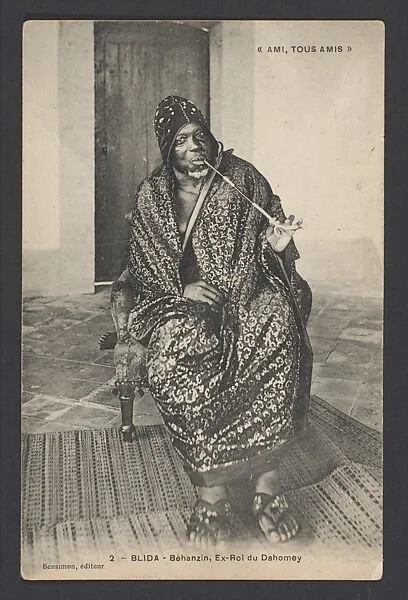
Glele’s oldest son Ahanhanzo was to take the throne as the undisputed heir but he died even before Glele did. In fact, many of Glele’s children died early, almost as if opening the path for Behanzin to become king. Glele passed in the year 1889, after which Behanzin rose to become king of Dahomey. It was then that he received the name Behanzin and three symbols: the shark, the egg and the pipe (see Names & Symbols). It is very common for a king to adopt symbols upon his enthronement. After becoming king one of the things that he did was build a palace of his own (Singbuji, meaning “the Great House”) separate from the palace that all kings before him lived in, which added to the reputation of being “the bird who never builds his house straight”.
Behanzin was a strong supporter of traditional culture and stood firmly against French rule. This was even to the point where he would attack nearby kingdoms that were friendly with the French invaders and that would let the invaders settle. An example of this is Behanzin’s attack on the kingdom of Hojbonou. Anybody that forfeited their cultural traditions became the enemy. Behanzin’s aggressiveness didn’t go unnoticed by the French military. He was an obstacle to successful colonisation, so they sought to destroy him.
War with the French
The French charged General Alfred-Amédée Dodds with the task of defeating Behanzin. He was deployed to Dahomey in 1890. Dodds was commander of French forces in Senegal in 1890 and in the second expedition to suppress The Boxer Rebellion in China, so he was well experienced in colonisation. In order to prepare for battle Behanzin used the tools of the traditions by mustering the gbeto. The gbeto was a very fierce female force trained both militarily and spiritually that were known to be even stronger than any male soldiers. The gbeto was initially created by Ghezou, Behanzin’s grandfather. At that time the numbers were small, but Behanzin expanded its size. As part of their training, gbeto would be confined to a convent for their initiation and not allowed to go outside. They also had milk-producing organs inside their breasts removed so that they wouldn’t grow breasts. This was to strengthen them, as it was understood that breasts prevent women from being as strong as they potentially can be. The ferocity of this force earned them the name “Amazons” among Europeans, a term that referred to the Amazons of Greek mythology, a force of female warriors. It was this force that Behanzin took with him when he went to war with Dodds.
There were two major wars between the Dahomians and the French. The first of them, the First Franco-Dahomean War, took place in Hojbonou in 1890 and the second, the Second Franco-Dahomean War, took place in and around Dahomey from 1892-94. At a certain point in the war as Behanzin and his military forces were battling with the French along the coast, the French overtook Dahomey and instilled Behanzin’s younger brother Agoli-agbo as a puppet king. Behanzin, with his troops, retreated to the forest and hid while training and preparing for more battles with the French. In the traditions, a king should never meet his death with shame and Behanzin was ready to prevent this by protecting his kingdom, his culture and his values with his life. But, as time passed his people were increasingly suffering at the hands of the French. For the survival of his people he made the decision to negotiate.
Exile and Death
Behanzin returned to Dahomey to discuss a resolution with the French. It wasn’t long before he realised that no negotiations were going to happen--he had been betrayed. When he arrived, he was confined to live in a house so small that he couldn’t even stand up straight. The French had already decided to exile the king to Martinique in the Caribbean, which was a French colony. After some time, Behanzin was brought to a train that was supposed to take him to the coast where the French navy was to bring him to Martinique. However, despite being a normal-running train up until that point, the train malfunctioned. Despite the maintenance that the train operators did, it would not budge for 2-3 days. The king just sat and smoked his pipe and laughed at their efforts, well aware of the reason why the train wasn’t working. In the traditions, kings normally do not leave their kingdoms due to the sheer weight of the responsibility that they have towards their people. So, when the French attempted to take him away, the king’s ancestors certainly did not approve. Behanzin told the French “I am king of this land. I will only leave my land in the condition that my ancestors allow me to go in.” He then instructed them to retrieve a white chicken. Behanzin cut the neck of the chicken in order to offer it to his ancestors and dripped the blood onto the railroad tracks, opening the way for his travels. The train suddenly worked again.
The navy brought Behanzin and a few family members, inluding his son Ouanilo, to Martinique. It took 4 years of negotiations in order for the king to return to Meritah. But, he was brought to Blida, Algeria and not back to Dahomey. The king was put under house arrest. After becoming sick with an infection, he died in 1906 without any proper king’s burial. Ouanilo was eventually brought to France to be educated. It wasn’t until 1928 when Ouanilo returned to Algeria that he was able to receive the remains of his father and take them to Dahomey for a proper burial. After the funeral, Ouanilo makes his way back to France but dies en route. It was as if the king, from his grave, prevented his son from giving any more of his energies to the oppressor that took him from his traditions.
What Does This Mean for Us?
As I stated earlier, Behanzin is the example of resistance that people today can benefit from because the life that he led is an example of resistance as defined by our ancestors. In our ancestors’ eyes resistance is about protecting something much bigger than any material gains or political status--it is about protecting and preserving the traditional culture and values that make a human being who they are. Prophet Naba taught that “What makes a human being are not the things that he does--but the things that he doesn’t do.” If a person has values that they are standing on and they refuse to go against them--even in the face of death--then that gives those values another chance to survive and live on through their descendants. This is what Behanzin fought for. For this reason his efforts, the efforts of the gbelo, and the efforts of the Dahomeans were successful. The proof is in the fact that not only is The Earth Center an organisation founded in these principles, but also you can go to Benin and different parts of Meritah to see the people living according to Kemetic principles, too.
So what can you do? If you want to return to the values of your ancestors then it is vital that you remove the values of your oppressor within yourself. There are three simple things that you can do in order to begin this process:
1. Identify a value that you hold
2. Identify where it came from. If it did not come from your Ancestral culture, then replace it with a value coming from your Ancestors (at The Earth Center we follow the 77 Commandments, which I highly suggest)
3. Apply the value coming from your Ancestors
Prophet Neb Naba taught that if you are applying the 77 Commandments then that alone is more than what many cultures and religions around the world started with. So, this 3-step process should not be taken for granted.
Interestingly enough, resistance has been going on for many, many generations. We usually don’t hear about “resistance” amongst people of colour until after the transatlantic slave trade or at least until after the destruction and havoc of an oppressed people. However, traditional people all over the world have given their lives for this notion of resistance in order so that their children could have the opportunity to live their lives in the same manner that their forefathers did. These are the brave, heroic stories that often go untold but yet all contribute to the legacy of our ancestors’ spirit of resistance.
“Kemet has never been conquered. Name an invader of Kemet and we’ll show you his grave.”
Prophet Neb Naba
Names & Symbols
King Behanzin was endowed with many names all the way from his birth to his death. Here is a list of some of those names and their meanings.
Behanzin - “Life holds the egg of life”; In the Fon language: Gbe - life, han - to carry, azin - egg. Can be understood as “I hold life/the world in my hand”
Egg - see Behanzin
Houeman djo Gbedekeme - “The bird who never builds his house straight” (the bird whose house has many paths). Behanzin’s knowledge of the spiritual realm was so vast that nobody really knew how far it went, what tools he had and what plans he had in store. Thus, this name was given to him by people in his neighbourhood.
Kondo - “Ko” means “clay” in Fon, and clay is considered very strong and durable, especially because water does not penetrate it when it is turned into pottery. “Kondo” refers to the act of digging a hole in the ground and placing clay inside, which is a symbol saying that “My son will be strong and will stand forever.”
Pipe - King Behanzin received this symbol upon his inauguration as king. In the traditions of Kemet smoking (particularly tobacco) is a spiritual act that has a relationship with the Divine World. King Behanzin was almost never seen without his pipe.
Prince Ahok’ponou - Behanzin’s initiatic name that he received from Adandozan, his spiritual father. No further information on the translation.
Shark - King Behanzin received the symbol of the shark upon his inauguration as king. Symbolic of his attitude--particularly his ferocity--, leadership, and ability to hide and ambush during war.