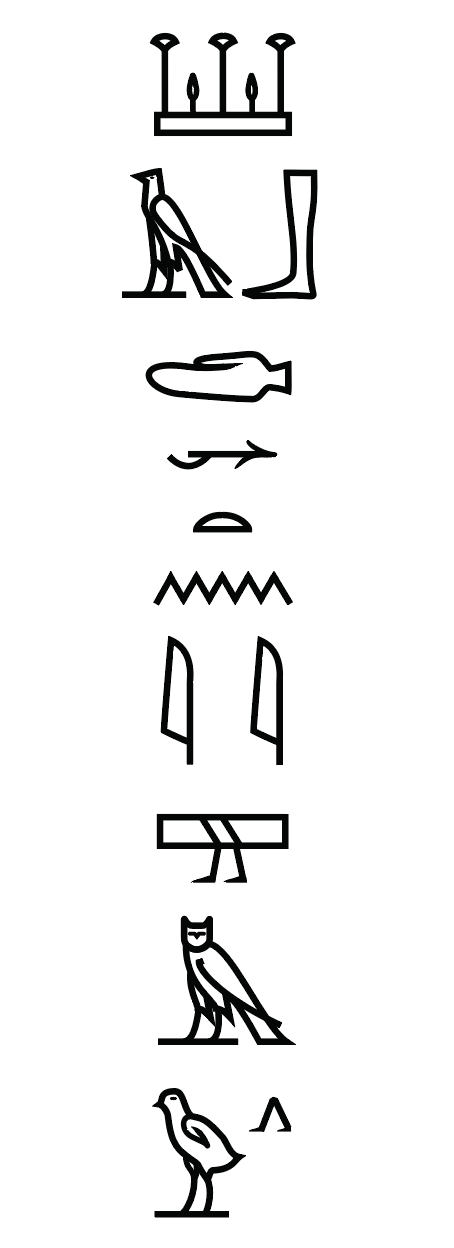
The Second Trinity
The Pilgrim’s Walking Stick: The Second Trinity
In the Philosophy Podium column, we have described the First Trinity and how it was born according to the Cosmogony of Thebes, after Ra and Amon, the third God Ptah announced that when He arrived the two first Gods had already created the Four Elements. He then decided to create life from these elements. He opened the door of the second category of Gods; in comparison to the creator and self-created Gods of the first trinity, one will now observe the birth of creator Gods who, themselves, are created by other Gods.
Ptah then created the couple Wsr (Osiris) and Asta (Isis), and the couple Seth and Nephtys. These two Divine couples will be the first creations of Gods from the four elements. Wsr married Asta and Seth married Nephtys. Wsr and Asta gave birth to Heru. In other terms, Osiris, the Godfather, and Isis, the Goddess mother, gave birth to Horus, the infant God. Seth and Nephtys could not have children because of the sterility of Seth.
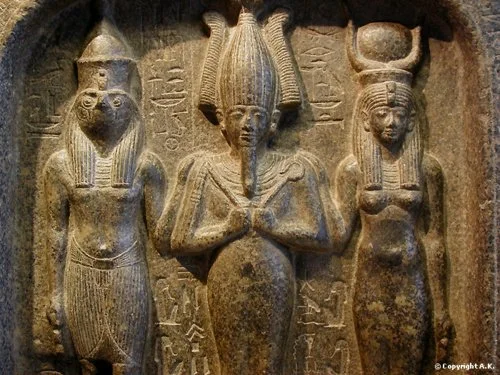
Osiris, Isis and Horus (Wsr, Asta, and Heru), from now on, represent the Second Trinity composed of God the father, Goddess the mother, and God the infant. In fact, these Gods are the mediators between humans and the Great Gods that guarantee the stability of the universe. The Gods of the Second Trinity resemble humans through the fact that they have been created, but they are still Gods through the fact that they are creators.
Wsr will be elected the God of the Dead after he is killed by Seth. Wsr (Osiris), dead, will find himself the sovereign of the Empire of the Dead in the middle of forty-two judges in front of whom every individual after his death will have to pass to render his negative confession. Resurrected through the magic power and the love of his wife Asta, Wsr will find himself God of redemption for humanity and keeper of the mysteries (Ker Seshta). Asta becomes the Divine mother, protectress, and giver of life. Heru, the God infant conceived posthumously, will find himself fighting against the enemy of his father with the goal of reestablishing the father’s authority and the empire of the good.
This small story could disturb newer religious convictions; let's check on the beginning of monotheism. To solve the problem of the two trinities, one adopts the concept of a creator God who was not himself created, giving birth to a God infant; the monotheist idea would find it difficult to defend itself if the God infant was born from love between the Godfather, creator but not created, and a Goddess mother. The infant God will then not be sufficiently human to attract the sympathy of humans. One introduced the idea of an infant God born from human flesh. These are some of the unknown examples:
Perseus, born from Zeus and Danae.
Hercules, born from Zeus and Alcmene.
Apollo, born from Zeus and Leto.
Dionysus, born from Zeus and Semele.
Minos, born from Zeus and Europe.
Asclepius, born from Apollo and Coronis.
Jesus, born from Yahweh and Mary... etc.
The believers of the newer religions will try to convince you that they have nothing to do with polytheism and paganism, but this could be considered an emotional reaction... Wsr, the God of the Dead, is called Unnefer Ker Shesta, which means, “the one that is continuously good, keeper of the mysteries”. Moses is a purely African name (Moi Asta) meaning “a gift of Isis”. Abraham (Ib Ra Hima) means, “the soul of the God Ra is in me”. Roma (Ra Ouma) means “a place protected by Ra”. Historically “the holy family” was composed with Wsr, Asta, and Heru. Asta became the most important Goddess of the pantheon of Pharaohs of the lower lands. When Justin the First, emperor of Byzantium (527-565) ordered the Temple of Isis to be closed in Philae in the year 537 of the Christian period, Asta had already been repossessed long ago under the aspect of a Goddess mother of Perseus, Hercules, Apollo, etc. and was designated by the names Danae, Alcmene, Coronis, etc.