The Goddess Aishat: The Model Woman
Our Mother’s Light: The Goddess Aishat: The Model Woman
The concept of a trinity originated from the Kemetic paradigm which is over 150,000 years old and has inspired Greek mythology, modern religions and new age movements that are all no older than a few thousand years collectively. The term “Trinity” presents to us the concept of three Neteru (Gods). Modern ideologies like Greek mythology have introduced many Trinities, such as Zeus, Leto and Apollo with the attempt to redirect humanity away from the original names and characteristics of Neteru. Although the goal of modern religions was to try to erase the history of Kemetic spirituality by introducing monotheism, apparently they find it very difficult to get rid of this idea of a Trinity. For instance, the Bible talks about the Father, Son and Holy Spirit, which are referred to as a Trinity while forcing the idea of one God who carries the characteristics of a father and a son. When the idea of a son/child is introduced it becomes difficult to convince an individual that a female entity is not involved with the making of a child. For example, Christianity and Islam find a way to explain that Jesus has come to be from God choosing a “perfectly pure” human being by the name of Mary to conceive a child through Immaculate Conception. This explanation introduces a conflict because the only entities that can be considered perfect are not human. So, what is the difference between a God and a human being?
Modern religions have taken away the notion of a Godmother and have implied that the closest model we, (as women) have to emulate is just another human being. However, humanity has a perfect model and this notion of perfection was only observed by humans after the Neteru (Gods) exposed their World to us. Since then, this has become humanity’s goal; to become perfect by modeling ourselves after the Neteru (Gods and Goddesses). In Kemetic societies around the world, every man and woman, from street cleaner to royalty, work together with the ambition of mirroring the Perfect Model. Anyone seeking to understand his or her role in this existence must look to the Divine for the qualities he or she must inherit.
According to the Kemetic spiritual education, there are several Trinities. However, there is one Trinity that is the closest model for us to emulate as humans. This is the 2nd Trinity of Uast (Thebes), consisting of the God-father Wsr, the Goddess-mother Aishat and their God-son Heru. Wsr and Aishat are the Neteru who had a human experience on Earth by perpetuating life through the birth of their son Heru. Aishat is one Goddess still revered all over the world and is known by many names such as Isis, Auset, Aicha, Mary, Mariama, etc. Although her name and some of her characteristics have been either mistranslated by archaeologists or corrupted by political agendas, the original concepts of motherhood, childbirth, healing, magic and love are represented by Aishat, humanity’s first Mother.
The role of Aishat is revealed to us in the Holy Drama. The Holy Drama, a chapter within the Kemetic Cosmogony, presents to humanity the fact that Wsr & Aishat, Seth & Nebfyst are two Divine human couples, created by other Neteru, who all have equal rights to Earth. Both Wsr (also Osiris) and his brother Seth (also Typhon) have chosen immortality but have made different choices in how they will perpetuate themselves. Wsr has chosen to live out his immortality through death and resurrection, which allows him virility. He can reproduce and reincarnate through his descendants. Wsr’s decision to reproduce opened the way for us to have life. Seth has chosen not to reproduce, making him sterile as he will live out his immortality by staying the same, not aging or dying. Seth, with the interest of gaining Wsr’s portion of the Earth and considering that Wsr has chosen death and reincarnation, has plotted to kill Wsr. In addition to the principles of good and evil, the Holy Drama presents to us a lifetime of meditations because it represents to humanity the triumphs and trials we, as human beings, will experience on Earth.
Netert Aishat carries the characteristics of a protectress and life giver who has an uncorrupted love and devotion to her family. Her devotion to her husband Wsr is apparent throughout the Holy Drama as she sets the mission to revive Wsr and assist him after Seth accomplishes his goal of killing his brother. Through her love for her husband she has an awareness of when he needs her and uses her magical powers on multiple occasions to successfully recover Wsr. Desperate and determined to help her husband she is relentless with her efforts to recover Wsr’s body. At one point in the Holy Drama, after Aishat has worked so hard to locate and retrieve her husband’s lifeless body, Seth finds Wsr’s body, cuts it into 14 pieces and scatters them in different locations. What a tragedy! It is Aishat who remains courageous and steadfast in her search for her husband as she uses magic to locate the pieces of his body, however, Aishat wasn’t able to locate Wsr’s phallus because it had been eaten by a fish. In the instance Wsr has faced death, Aishat resuscitated her dead husband in order to fulfill the destiny of procreation that he established. From a pure love, that can only be Divinely understood, Aishat was able to procreate with her husband without a phallus (the idea of “immaculate conception” was inspired by this).
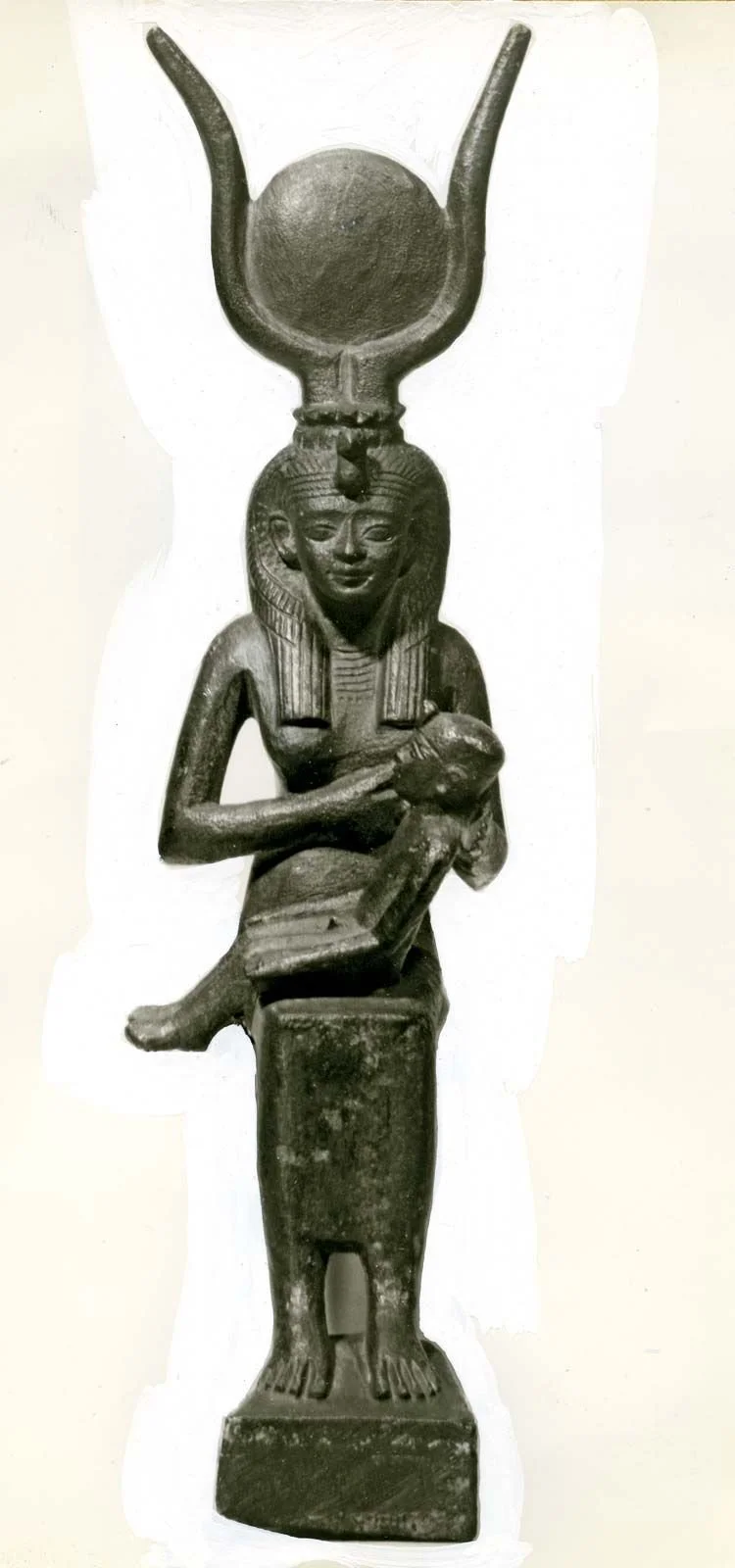
Aishat has given birth prematurely to a weak and fragile Heru and she, as sometimes depicted on the Kemetic hieroglyphs and statues, nurses the Godson Heru and works to strengthen him. Accepting the responsibility of raising Heru without Wsr, Aishat raises Heru with the assistance of other Netertu (Goddesses) who also protect Heru from the dangers and conspiracies of Seth. Heru’s health and life are protected and maintained by the magical powers of his mothers. The devoted Aishat is Heru’s first teacher and she raises him to the point where he is strong enough to carry out the mission dictated by his father.
The roles of a woman are clearly defined to us by the Goddess Aishat. As our maternal Ancestor, she reveals to us the responsibilities we will be presented with here on Earth. Aishat plays a vital role in maintaining a position of harmony and stability for her family as she was an unyielding supporter of the destiny of her husband and child. The qualities she possesses deserves our consistent meditations. In the Holy Drama, Aishat remains focused on playing her part as a wife and mother. Her interest was in serving the mission that was established by her husband. Apparently, Aishat accepts the fact that she is a helpmate to her husband who has set the guidelines for the family.
The Kemetic culture is the strongest, most stable culture the world has ever been exposed to. And it remains the strongest because, as humanity’s original culture, Kem people have maintained an unwavering level of quality towards spiritual evolution. Since the goal has been for a woman to embody Divine qualities, women in Kemetic societies aim to perfect themselves according to the principles our Mother, Aishat, has established for us. The women are recognised as the backbone of the community. It is said that a community is measured by the strength of its women. And our strength is recognised when we exhibit the discipline in maintaining our role as women. For us, this is where our stability can be identified in any community.
Our Godmother presents to us that life cannot exist without conception. What is a reality for us is that procreation is necessary. In traditional societies, girls are educated at a very young age on how to care for babies, prepare herbs, cook, clean and manage a household in preparation for her to one day support a family of her own. Although it is common for a girl to mimic her mother in many ways, traditional women aim towards Divine qualities which sets a solid foundation for all girls who will one day become stabilisers for their community. All childbirth is celebrated by the entire community in traditional cultures because with every birth comes the perpetuation of life.
Aishat also reveals to us that children cannot be raised alone and require additional assistance from others. Kemetic spirituality presents to us that the women of a community all play a role in the destiny of its children. Often adults other than the biological parents of the child play the biggest role in forming the child’s destiny. All traditional women take their responsibility as educators and examples to the youth of their communities seriously. The destiny of a child extends beyond their physical aspects, as it will be their qualities or lack thereof which follow them after death. A mother will always try to instill the best qualities in her children, as her reputation will be at question as that child goes forward into the world. But, it is also recognised that everyone in the community has a strength that can replace a mother’s weakness. And we depend on the community to help raise our children in order to give them the best chance at maintaining a destiny that is favourable.
The introduction of monotheism has snatched away the concept of a Goddess, which leaves us only with models that this modern world has set for us. Young girls of today are educated to look at people like Oprah, Beyoncé, Michelle Obama, Delma Rousseff, Sonia Gandhi, Mother Theresa, etc., as women to imitate. If the goal is to perfect ourselves by modeling after the Divine, then becoming like another human being, who is just as vulnerable and imperfect as we are, cannot be our greatest achievement.
The love, devotion, courage and steadfastness that Aishat expresses are qualities that all women must aspire to. Aishat is still admired, honored and acknowledged all over the world by diverse cultures. And there is a reason why religions have even maintained copies of her. Aishat has placed an unforgettable mark in history as humanity’s first maternal Ancestor. She created the blueprint for all women, Her daughters, to model after in our quest to perfect ourselves as mothers and wives as we come closer to the World of Neteru.