
Earth Center Children’s Dekan
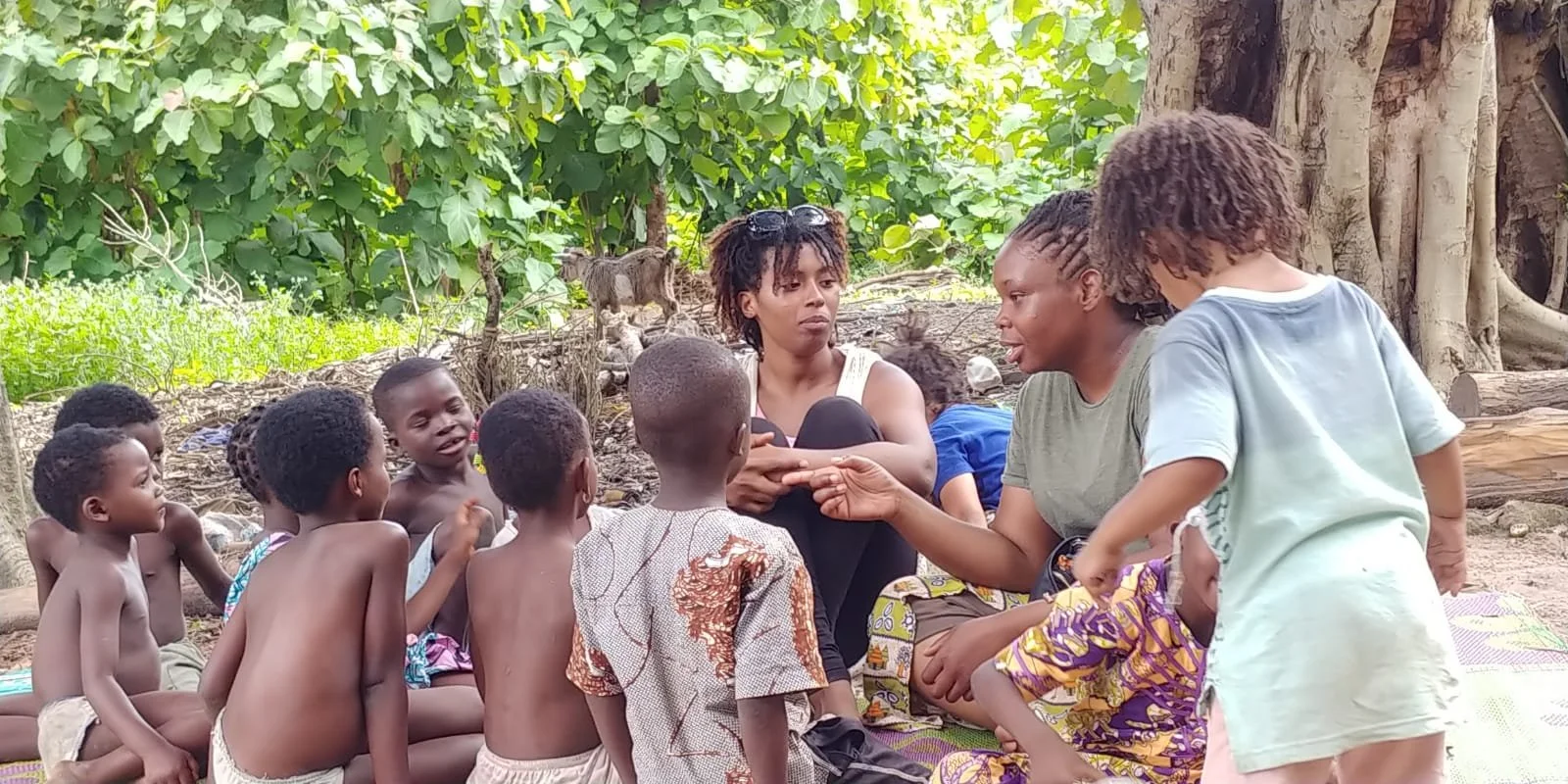
Earth Center Children’s Dekan
The children will inherit the world. Our job, as their parents, is to prepare them for this responsibility. Within the communities of the Earth Center, this means that we are giving our children an opportunity that we didn’t have: to be born and raised in Kemetic Culture. As adults, we understand the difficulty of overcoming our conditioning in order to assimilate the Kemetic values. Our children have the opportunity to grow up without having these obstacles to overcome, but only if we are successful in our goal of passing the traditions to them, or rather passing them to the traditions.
The Earth Center Children’s Dekan was a gathering of about 30 children of Earth Center students. These children, ranging from ages 2 to 15, spent about 8 days in a house together with minimal adult supervision. The goal was to duplicate the model within Kemetic culture in which the children have “their own world.” Children in Meritah (Africa) are primarily self-governed within their groups, being responsible for their own and each other’s behavior and well being. Children also have their place within the work of the society. When they are seen under the supervision of adults, they are usually assisting in some task, which is essentially a part of their education.
During the first Earth Center Children’s Dekan, a group of children was driven from New York to Chicago along with their parents or guardians. These children joined the children from Chicago who comprised the majority of the group. The adults from New York were allowed only minimal contact with the children during their stay. For the most part, there were only 1 to 3 adults responsible for supervising the children, taking rotating shifts throughout the days. The older children were involved in every aspect of care for the younger children. This was an intense experience for all of them and there were many complaints from both children and the adults supervising them. The environment was often chaotic but in the attempts solve the problems that arose, many lessons were learned.
This philosophy for parenting is very different from the modern idea of responsible parenting where children must be constantly supervised and provided with activities by the parent. While this may succeed in keeping the child safe, the child does not gain the sense of self-sufficiency of children held responsible for themselves and others. The learning process depends on the experience of making decisions, making mistakes, solving problems and building one’s understanding of the world without having a helping hand at every step along the way. Of course children need help and instructions periodically, but a balance must be maintained so they develop a capacity to do things for themselves.
When children are not provided activities by adults, it also challenges them to find ways to entertain themselves and each other. This also calls on their creativity and intelligence. Children who become used to being entertained often fall into a desperate state of seeking fun and escaping boredom. This often leads to a reckless and dangerous behavior as teens and young adults, bored with childish things, begin experimenting with sex, drugs and other ways of chasing thrills and pleasures. Instead of being entertained by adults and TV, the children were forced to develop games and activities for themselves.
With a group of this size coming together, conflict is inevitable, however the children primarily settled their own differences. In any culture, every generation of parents is aware that their position as leaders in society is temporary. Once their children come of age, they will take the responsibilities once held by the parents. Such is the circle of life. It is the parents’ responsibility to prepare the children to take the lead. In a society, we know that we have to deal with other people and that we don’t always get along. Conflict resolution is a vital skill that is important to learn early in life. If not, we see the consequences of the intolerance, violence, hatred, divorce, gossip, etc. that has made our world such a horrible place to live in many cases.
The Children’s Dekan, while it was something experimental for the community, set an example of what’s possible when parents let go of the control they want to have over their children. When the children come together in large groups with few adults, all of the children are able to build the bonds amongst each other, learn to work together and establish order amongst each other. This takes the load off of the adults, particularly the women, who are otherwise charged with supervising them constantly. It was clear that many of those parents were more comfortable with the constant supervision they can provide. However, the advantages of the adults being able to take their attention off of the children is clear when considering what we are able to accomplish when we aren’t focused on the children.
This event was a small, but important example of the strategies the parents in the Earth Center community are using in parenting. The goal is to return our children to the traditions of our Ancestors. It is difficult given the fact that the people of our society, including our own family members, are intentionally or unintentionally introducing values and behaviors that conflict with what we are teaching our children. This will present yet another problem for them to solve.
We, as a community of parents, are building the next generation to inherit this Kemetic Culture which our Ancestors led us to and the responsibilities that come with it. The children must be raised to be survivors and thinkers, and not inherit the task of overcoming the retardation that has been passed on to us by colonial society and its values. They must be able to overcome the challenges that put us on our knees. May our Ancestors guide us in preparing them.