The Perpetuation of Slavery Through Constitutional & Criminal Law
Earth Talk: The Perpetuation of Slavery Through Constitutional & Criminal Law
The Emancipation Proclamation is the instrument in American history that is associated with eradicating “slavery”. However, this is a misnomer on more than one front. According to American History itself, Lincoln issued the Proclamation as the country embarked on its third year of Civil War. It declared that all those held in captivity within the rebellious states would be free going forward but it applied only to those states that withdrew from the Union. This meant that “slavery” was still permissible in the border states (like Delaware, Maryland, Kentucky and Missouri) and those territories that were under the Confederacy that had come under Northern control. But ultimately, the Emancipation Proclamation hinged on the Union winning the war.
The Proclamation was not issued to protect the interests of enslaved Kemmioo (traditional Africans) but rather as a military tactic.
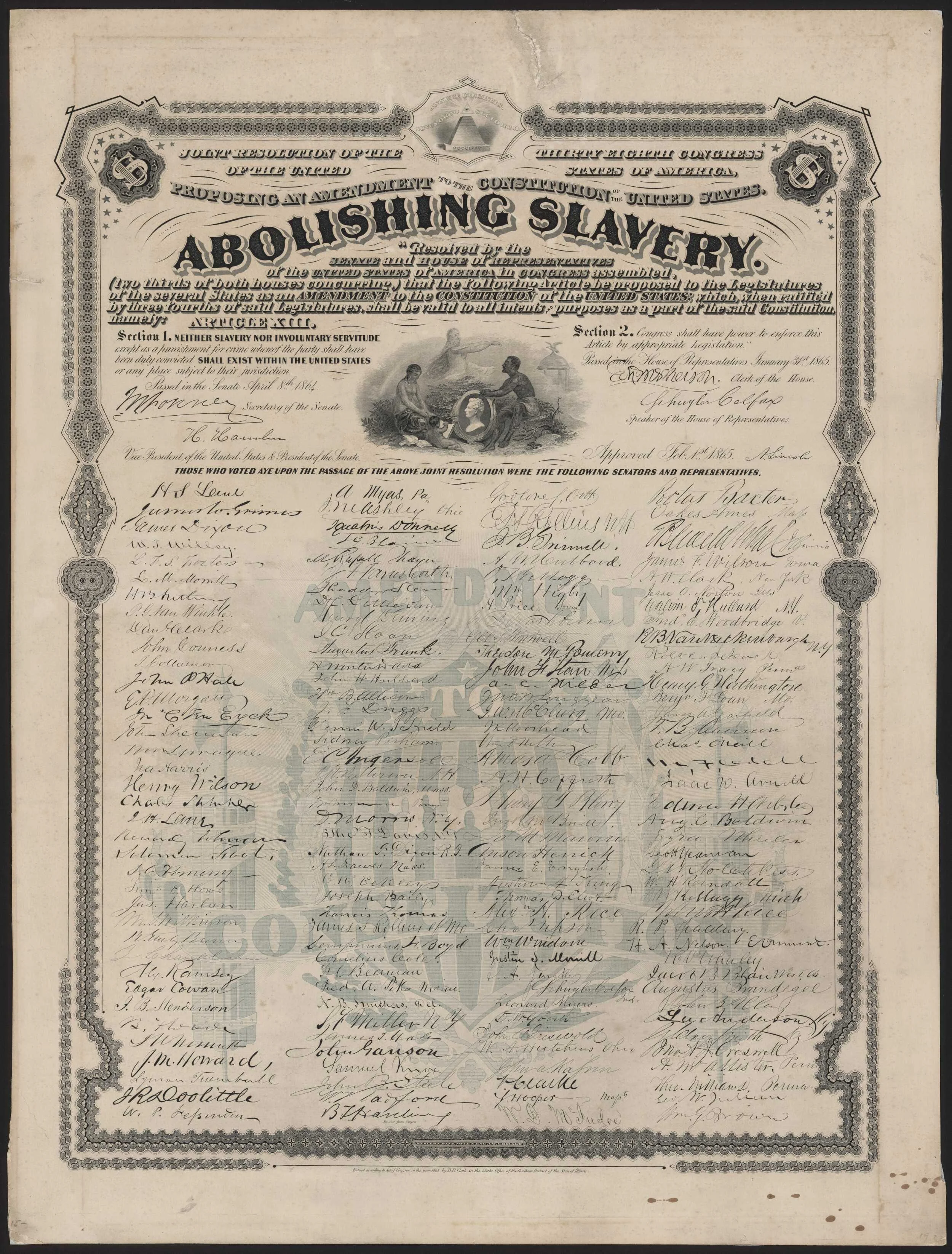
It is the 13th Amendment of the Constitution that is said to have ended enslavement, but the United States reaped far too many benefits by keeping humans in bondage to end this institution. Perhaps “slavery” as a term was promoted as unacceptable, but black people were not absolved from serving the white man. Colonizers continued to force black people to work against their will, predominantly in the South. In fact, work could not proceed without black peoples’ hands. Up until this point the country profited from the free labor, so why would the country begin to make payments now? By power, force and brutality, enslavement or indentured servitude, whatever term you want to use, the use of free labor continued. Let’s take for example the cotton industry that was very profitable for enslavers; it is the slaves that made this industry possible and profitable. However, once free human labor was not available, this industry began to suffer.
With the aid of President Andrew Johnson, the American ruling class began to attack and intimidate blacks because they saw them trying to uplift themselves, get land, raise families and seek opportunities. This was a threat to the ruling class. Based upon these jealousies and intolerances for freed Kemmioo’s attempted success, the propaganda began to spread that men and women formerly enslaved were like caged animals that were not ready to be set free once released.
It is around this time in history when the essence of crime and punishment in America, particularly the South, changed. Laws were established with the intent of targeting black people and criminalizing their behaviors following the abolition of slavery. The following average human behaviors were considered crimes: a farmer walking beside a railroad, speaking loudly amongst white women and selling farm products after dark. Spitting and loitering in public spaces could result in incarceration.
Some of the worst laws implemented to criminalize black people were the Vagrancy Statutes. These laws made it a criminal act to wander from place to place without a visible means of support; to be jobless or to be homeless. These laws criminalized types of people and not necessarily their actions. Vagrants are often those that move from place to place without remaining in one location for any length of time. For those that were just freed from slavery, it’s only natural that they would be transient and unemployed, particularly in a political, social and economic climate where their upliftment was resisted and detested. Vagrancy statutes have been struck down by many courts as unconstitutionally vague as well as cruel and unusual with the resulting punishment. Then it was the Pig Laws passed in the South that allowed for misdemeanor offenses to become felonies which hugely impacted the population of those in confinement. For example, theft of a farm animal or property, worth more than ten dollars constituted grand larceny and could get you locked up for five years in Mississippi. About 90% of those being arrested were black people. These laws quadrupled the prison population at the time.
Due to southern states’ claims of poverty, they had a history of placing prisoners with industries that would pay housing costs in exchange for their labor. Prison then started charging fees for renting prisoners by the month, rather than paying to keep prisoners locked up in facilities. The highest rates were for the strongest workers and for those with the longest sentences. This system was known as convict leasing.
In 1883, the state of Alabama derived roughly ten percent of its total revenue from convict leasing. 15 years later, almost 73 percent of its total revenue came from this same source. Due to the great profits, all the states in the South began to engage in some form of convict leasing to private industries. This essentially gave businesses a free ticket to use prisoners however they wished to meet their needs. When leased to businesses the state had no responsibility to oversee the system and therefore businesses had the freedom to manage the prisoners and their work conditions in whatever manner they deemed acceptable. Industrialization took great advantage of this realization. Slavery had grown into an industry.
Based on the nature of the work and the conditions they worked in, these prisoners’ lives were in constant jeopardy. It was not unusual for them to die as a result of tunnel explosions or mountain landslides. In 1825, 25% of black people working in the convict leasing system died.
Mississippi leasing records revealed the deplorable conditions imposed upon the prisoners.
The convicts ate and slept on bare ground. They were punished for “slow hoeing” (ten lashes), “sorry planting” (five lashes), and “being light with cotton (five lashes). Many dropped from exhaustion, malaria, pneumonia, sunstroke, dysentery, gunshot wounds, and “shackle poisoning” (the constant rubbing of chains and leg irons against bare flesh). A doctor sent by the state on a rare visit to a Delta plantation wrote that the word “unsanitary” did not begin “to express the filthy conditions of the convict cage”: bloodstained dirt floors, overflowing waste buckets, and vermin-covered walls...Not a single one lived long enough to serve out a sentence of ten or more years.
During slavery, enslavers in many cases felt responsible for taking care of their slaves but under convict leasing such a sentiment was non-existent, if one died the attitude was to just replace him with another.
In Texas the sugar industry could not have survived without convict leasing; in Tennessee, convict labor mined the cheapest coal ever produced by the Tennessee Coal and Iron Company. In Florida, private companies had a hard time finding people to do the turpentine labor so it was convict laborers to fill those jobs. Turpentine operators went so far as to work in conjunction with the Sheriffs to recruit the black people they wanted to use as laborers. So it was the sheriffs to arrest the hand-picked individuals on petty charges and as a result the turpentine operators had the “husky fellows capable of a hard day’s work” that they wanted.
Well, the 13th Amendment says “Neither slavery nor involuntary servitude, except as punishment for crime whereof the party shall have been duly convicted, shall exist within the United States, nor any place subject to their jurisdiction.” So in essence, the grounds of punishment were used to extend slavery.
It’s no mystery that to this day the 13th Amendment exception for punishment has the prison system functioning as a multi-billion dollar industry that continues to target predominantly black people and other people of color. There are approximately 2 million inmates in state, federal and private prisons throughout the U.S.. The U.S. locks up more of its citizens than any other country in the world. The numbers are rapidly on the rise. One in every three black men can expect to spend some time in prison. Although black people comprise 13% of the U.S. population, they are about half of the prison population.
The rising numbers have a lot to do with the private contracting of prisoners for work. This provides an incentive to lock people up. Corporate investors are lobbying for longer prison sentences to expand the corporations’ workforce. The prison industry is one of the largest growing industries in the country and its investors are on Wall Street where enslaved Kemmioo were once traded.
Prison labor produces 100% of all military helmets, ammunition belts, bullet-proof vests, shirts, pants, tents, bags and other war supplies. Along with war supplies, prison workers supply 93% of paints and paintbrushes; 36% of home appliances; 30% of headphones/microphones/speakers; 21% of office furniture, and the list goes on and on. Some of the companies using prison labor are the cream of U.S. corporate society: IBM, Boeing, Microsoft, AT&T, Dell, Macy’s, Target Stores, and many more.
The practice of placing human beings in subjugation or captivity and forcing them to do burdensome and degrading labor has not changed. For a country that was founded on slavery for profit, even after formal slavery, it continues to do what it needs to, to maintain free labor in developing its capital base. Now that the U.S. sits in the world’s number one power position, there is no forbidden territory for maintaining that position. The prison industrial complex is just one example of what it is willing to do to maintain its capital and promote its agenda.