Political Games: A Women’s Rebellion
Our Mother’s Light: Political Games: A Women’s Rebellion
When we observe the history of colonization, it is obvious that new ideologies have been introduced to humanity in order to attempt to manipulate original culture. Those who colonized the world are responsible not only for introducing modern slavery, religion and politics - they are also responsible for disrupting social structures, including family. Colonization is nothing but a game of politics associated solely with the struggle for power. The world’s largest catastrophes, where millions and millions of people have lost their lives, are due to this phenomenon, this power struggle.
Modern man and woman mirror the behaviors of their colonizers, those who have stripped them from their original identity which is rooted in their Ancestral values. Who they are and the goals they strive to achieve are now defined by the leaders of this system, a system that leads society on a slippery decline towards the destruction of human quality. With this reality in mind, this article is the first of a series of articles that will focus more specifically on the female gender, and the influence modernization has had on our identity. It is intended to uncover the true definition of womanhood and the original goals the existence has placed on us.
In order to have a greater understanding of the depth of politics and how it has destroyed women’s roles within the original family structure, we must understand its motive. Traditional people (and those who colonized them) understood that their communities are only as strong as their women. Colonialists had to sever family ties for the sake of power, and women became their target. A huge propaganda was introduced about women being oppressed. Oppression carries the concept of suffering or a behavior that is unjust or cruel. It was then that the original roles of women became devalued. Men became the enemy and the reason women were oppressed. Women’s trust was redirected away from the men in their communities who valued them and was placed in the hands of political monsters. Women began fighting for their identity within the modern structure and redirected their goals towards perpetuating this new system.
Investigating the modern influences of womanhood will inevitably lead us to the overbearing influences of feminist ideologies. Feminism has been defined as “the doctrine advocating social, political, and all other rights of women equal to those of men”. The rise of feminist movements began as early as the 1400’s, but was recognized by a broader public in the late 1700’s, during the French Revolution era. The reign of King Louis XVI, during the French Revolution, brought forth an order to bring solutions to financial troubles within his French government, known as The Estates General, or “the long list of grievances”.
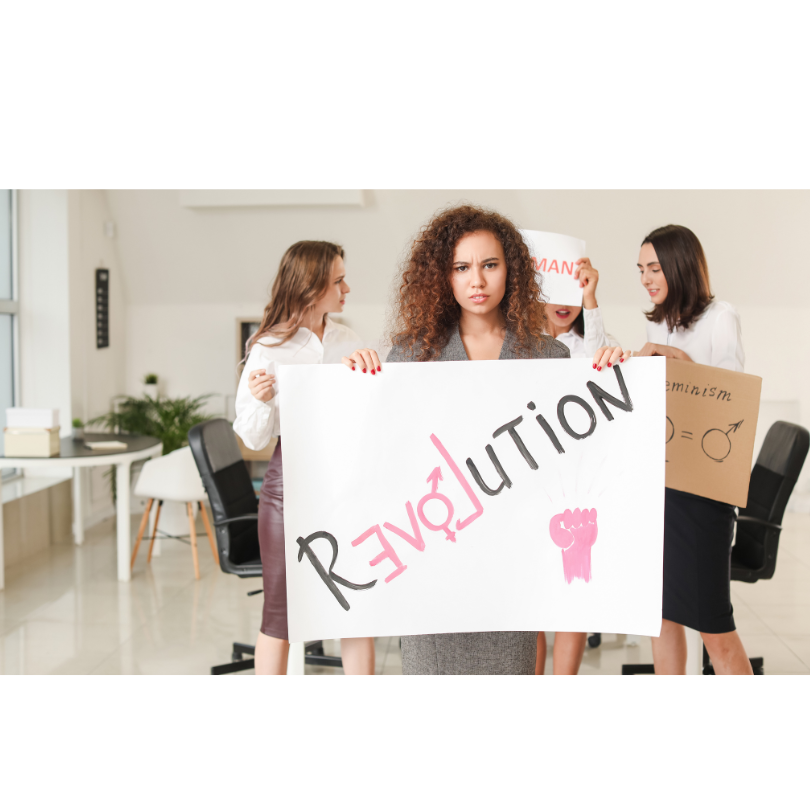
European women saw the beginnings of the French revolution as an opportunity to make demands for their placement in the new social and political structure. The women in this region insisted that their needs be supplied, which included solutions to the harsh economic conditions they faced, and their set of demands were added to this “long list of grievances”.
Soon after, it became clear that the demands of these European women weren’t being met, and even in the year 1792, the French constitution continued to ban women from legal rights, divorce from their husbands and ordered women to continue to play a domestic role in their families and communities. The French social system refused to treat women equal to men and this immediately led to a rebellion because these women began to compare how they were treated to the legal status of a slave. Throughout Europe, the idea of servitude had transformed into an inhumane form of abuse, known today as slavery. So, it is not surprising that this attitude affected many people who were a part of this region who did not hold any positions of power within this culture. To summarize, European culture was built on the principles of politics, and these women decided that they were worthy of claiming a position within the power struggle.
The ideology of feminism has sparked a worldwide fire of controversy that remains lit. Although some countries have been impacted more than others, this movement shares the same common goals all over the world. It has confronted the oppression of women influenced by modern socio-politics. It has targeted additional issues such as male supremacy, arranged marriages, sexual exploitation, excision, and abortion rights. In addition, the role of a homemaker, which includes rearing children in the home, was no longer satisfying. In other words, women recognized and addressed the fact that they did not have the same “equal opportunity” as men.
Since its beginnings in Europe, the feminist movement has gone through several stages, and these stages have been referred to as “waves” - the first wave, second wave and third wave. The “first wave” of this movement targeted issues such as women’s suffrage (voting rights) and property rights. The “second wave” dealt with issues regarding reproductive rights, responsibilities within the family and the workplace. The “third wave”, also referred to as “neo-feminism” is indeed a new phase that began around the 1990’s and is still active. This “neo-feminism” movement, materializing from a younger generation of women who have reacted to the “perceivable failures” of the second wave, has targeted demands of the past, in addition to welfare, lesbianism, sexual freedom, and the unification of ethnicities around the world who support its mission. Let us recognize that the objective of this movement has changed several times over the course of a few hundred years. However, every change has steered women away from their traditional identity.
Presently, women fight to become authorities as politicians, CEO’s, engineers, soldiers, athletes... you name it. The modern woman has abandoned her responsibilities within her home. She no longer values her traditional roles as a woman and seeks opportunities to redirect her energies towards proving to the world that she is capable of handling a man’s job. The modern woman, occupied with concerns of political affairs, has left her family to find solutions to the challenges they face in her absence. In Meritah (traditional Africa), many women have family businesses as farmers, herbalists, potters, hair braiders, jewelry makers, etc. where they are able to profit, whether by currency or barter. Traditional women are able to stay at or near home to work and care for their families which provides stable conditions for the community.
The notion of “equal opportunity” emerged from the introduction of oppression where women were pitted against men in order to finally break the strength of these unions. As feminist Grace Williams states, “It is absurd how some males live in a delusional world believing they are the better sex. Unbeknown to them, females are just as capable and worthy. By suppressing, controlling and engaging in sexist behaviors, these small populations of male supremacists are proving just the opposite truth. They are going against the notion of universal equality and are thus not the lower sex but the lower form of human”. This statement expresses the sentiment that men who do not see women as equals are even lower than women. This statement is just another presentation of the power struggle.
“Universal equality” and “equal opportunity” are terms that are not logical when we consider the nature of a man and woman. For example, nature has set the rule that the female gender is who will birth human life onto the Earth. This is a role that men will never have the opportunity to experience. The general makeup of our bodies and its functions are not equal by design. So, this notion of equality becomes an issue that is not worth debating because even nature has presented the fact that men and women are not equal. In this example alone, we should be able to see that the reactions society has to this notion of equality has been based on emotional principles which are rooted in politics. Somehow being unequal turned into women being valueless.
Any society, community or individual will find its identity in its values. We put our allegiance towards whatever we value. Modern society has given us the perception that this is where our power lies. But the only power the modern world has guaranteed us is the power of destruction. Our perceptions of the new world and our place in it have caused us to detour away from our original goals on Earth. Women gave up their responsibilities to their traditions and became vulnerable to corruption. We relinquished our true power in this world and placed our destinies in the hands of a society that has a history of deceit. A society that has groomed the concept of feminism to be a logic to take pride in. How can we take pride in the fact that we as women have failed our mission in stabilizing our communities and families? How can we take pride in the fact that we are able to do a man’s job but not a woman’s job? Some women today prefer c-sections and pain killers because either they don’t have the courage or strength to endure a natural childbirth. Children are eating restaurant and junk foods instead of home cooked meals because some mothers have surrendered their obligation to their children’s health in order to maintain a career. We women hold vital responsibilities as daughters, sisters, wives, mothers, grandmothers and elders. Women have a place in this existence and we must return to our traditional obligations if we want to reconnect with our true identity.
There are many traits that define a woman. The qualities found in these traits undoubtedly reach back to the origins of civilization: the Kemetic paradigm (which will be addressed in depth in Part 2 of this article). Since modern culture has imposed itself onto a world that has had traditions which women have lived by for thousands of years, these traits are constantly redefined and, today, can even be considered “trendy”. Meaning that the roles of women change according to what is popular or what the majority of the modern world dictates. As it is defined by modern society, the term “womanhood” means “the composite of qualities thought to be appropriate to or representative of women.” This should lead us to question - whose “thought” are we considering to be the appropriate qualities that a woman should possess? In order to make a comparison, there must be an original prototype or model to compare it to, right?
The truth is that the effects of feminism on the world are too broad a topic to uncover in just a couple of articles. What we can admit is that the idea of feminism is only a few hundred years old. In this short time, corrupting the nature and purity of a woman’s true goal in this world has been achieved, although the origins of our responsibilities we have as women will always remain. Our strength as women is not measured by how well we can compete against men in playing their roles, it is measured by how well we can live up to our responsibility as women defined by something much greater than any human being.
The next article will present a Kemetic history of humanity’s original model for womankind that is over 90,000 years old. This history begins with the famous God-mother, Aishat (also known as Isis, Auset, Asta, etc.) who defines the original characteristics of love, devotion, healing and motherhood, and who traditional women in society aspire to model themselves after. The famous Goddess Aishat is the wife of Wsr (also known as Osiris, Ausar, etc.) and the mother of Heru (Horus).