Ablution in the Modern Religions & their Link to Humanity’s Original Culture
In Search of the Gods: Ablution in the Modern Religions & their Link to Humanity’s Original Culture
When we think of Divinity and things Holy, we are often instinctively led to visualize images that reflect the notion of purity and cleanliness. In fact, within the modern context, there is a familiar adage, “Cleanliness is close to Godliness,” that highlights the clear relationship of Divinity with the state of cleanliness. This notion of purity as a pathway towards Godliness has been part of the human psyche as far back as we can remember. Perhaps the reason for our deep resonance with this idea stems from humanity’s first encounter with the Divine World.
According to the Kemetic civilization, the original culture of humanity, it was the setting in which this first encounter occurred that initially defined the relationship between the human world and that of the Divine World. They exposed their world with a distinct separation between themselves and us. This presented humanity with the very first notion that the World of the Divine and Sacred is separated from ours by one major factor: Purity. The Divine beings we call Neteru (Gods or Deities) were found to be incorruptible, which in essence, means they were perfectly pure and beyond defilement. Their state and world were perfect relative to our own, where we find ourselves producing pollution and impurities and subject to corruption and degeneration even in the very functions of our physical bodies, not to mention our thoughts and behaviors.
As we were newly exposed to their perfection and purity, all we could do was wish to be like them. To that end, we were given tools that included the Divine Code of Human Behaviour (77 Commandments), after our solemn vow to uphold the binding agreement to follow them, in our quest to become like the Pure Ones we beheld in that moment. Within these Divine Ordinances we find a reiteration that comes to reinforce humanity’s awareness of the significance of purity in our march toward the Divine. It was given in the form of commandment number 20: “Thou shall not be impure”. Perhaps, this historical context will give credence to the present association of the notion of purity with Divinity, as well as the necessity of purification as a prerequisite to achieving proximity to that which is Sacred and Divine.
In this awareness, humanity’s original culture has preserved Divinely prescribed purification rites in its various aspects. We still see or hear of them being performed by traditional societies today, in initiatic rites such as circumcision and excision to ablutions and cleansing with various plants, elements, etc. However one is particularly germane to our present exploration. It is the rite of ablutions. This rite of purification, as preserved and practiced by the Kemetic Civilization, comes as part of the highly technical process utilized in approaching the Divine World. It can even be seen as the paramount step toward that end, for without it, one would pose his or herself as a threat to the very Divinities one is attempting to approach. However, approaching the Divine World only begins with that step, as devotees, initiates, priests, etc. must also be aware of the sequence of that approach to which ablutions have set the platform. This understanding, that one is still not able to communicate directly with the Divine World after having performed this rite, may come as somewhat of a surprise. Nonetheless, the process of ablutions has only prepared us primarily to the point of approaching those who can intercede on our behalf with the Deities. These intermediaries are our Ancestors. They represent an unavoidable aspect in the sequence of one’s technical approach to Divinity.
Traditional Kemetic Ablutions
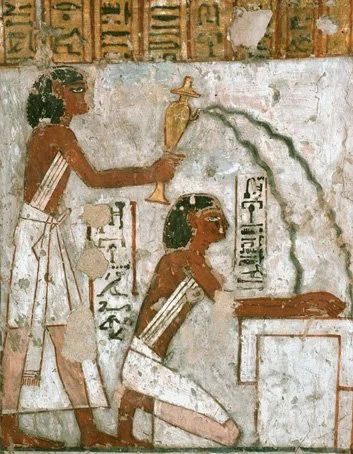
Ablutions, in the Kemetic tradition then, are performed reverently in light of the energies one will be engaging in order to achieve the intended objective of their spiritual activity. It is, as mentioned, a highly technical process that involves not only our physical body being cleansed but more significantly our mental and spiritual aspects as well. Additionally, it may be undertaken simply to purify one’s self, in which case there is no specified limit to how many times it may be performed in a single day. One of the primary reasons it is performed, however, is to prepare the individual for spiritual activities; namely, prayer, which is known in the Kemetic initiatic language of Medu as, Zem Zem. This essential spiritual activity comes with its own particularities specific to the days on which they are to be performed or refrained from. Ablutions, however, do not generally come with such specificity, as they may be performed every day. It is the challenge of maintaining purity itself that makes ablutions a necessary part of one’s daily practice. As for the physical aspect, it is performed primarily but not exclusively with water. Note that the prerequisite for ablutions, within the Kemetic traditions, is for one to have already bathed and cleansed one’s excretory and sexual organs. Next, we will observe briefly how it is performed and the conditions that would render one’s ablutions void.
Water is used to rinse or wash the hands, mouth, nose, ears, and face. This is followed by the rinsing of the armpits, washing of both feet, and anointing of the head lightly with water. At each body part, there are invocations that are pronounced and a prescribed number of repetitions for both washing and invocations. Part of the technicality of ablutions can be found within the Sacred names being called upon during each repetition of washing and the fact that they are being pronounced in the language (Medu) which comes from the World of Divine entities themselves. These are all performed in the order as stated and concluded with incantations and gestures that set the transition to Zem Zem with minor variations otherwise. Once this is complete and in the process, one has cleared their mind of distractions, one is considered “Pure”. She or he will invalidate their purity by passing gas, belching, using the toilet, speaking to or touching anyone over the age of eight or who is not also “Pure” etc. Acts of intercourse and menstruation also invalidate one’s ablutions and one will be unable to successfully perform the rite until one has washed his/herself thoroughly. These, however, are just the physical situations that invalidate one’s ablutions. It is holding the mental and spiritual focus devoid of distractions, deliberate thoughts, and emotionality for the duration of the process and, while trying to maintain the state, that can pose an even greater challenge. Purity is indeed a fragile thing.
This is a basic description of the rite of ablutions and the conditions for its maintenance, as handed down by humanity’s original civilization through the millennia. However, since there is nothing new under the sun, we should not be surprised to know that even some subsequent offshoots from traditional cultures maintain vestiges of these practices. These cultural offshoots we observe in the form of certain modern-day religions is where we still find purification practices that may be somewhat familiar to us in the present era.
Let us emphasize here that while most known forms of ablutions, outside of the Kemetic traditions, involve the use of fluid, primarily water to clean the physical body, the intended focus of ablutions in modern religions is said to be spiritual not merely to get clean. Yet, in most cases, we will see how they ultimately fall short in the fulfillment of the technical sequences necessary to achieve said spiritual goal.
Today, eastern religions like Buddhism and Hinduism as well as Abrahamic religions like Judaism, Christianity and Islam are some beliefs that still maintain, to varying degrees, the notion of purification as a precursor to accessing the Divine. They even prescribe certain technical steps and conditions as to the execution of those rites at the opening of religious prayers, rituals, ceremonies, etc. within their respective beliefs. Let us briefly explore some of the rite of ablutions remnant within these modern religions given some of our previous insights into the original practice.
Ablutions in Eastern religion
Hinduism
For Hindus, morning spiritual cleansing with water is a basic obligation. It is often done in the living waters of Rivers that are considered Holy according to Hindu belief, including the Great Ganges. Here, Hindu devotees can be observed performing purification rites that include the washing of the body or even possessions with the intent of purification, clearing of sins or preparation for prayer. Tarpana is the point of the rite at which the worshipper makes a cup with his hands and pours the water back into the river reciting mantras. After sipping some water, he may then apply the distinguishing mark of his sampradaya (tradition), and say the morning prayer, samdhya. Holy ablutions can be performed in the morning and evening; water and salt can be used. Ablutions have also been performed with blood, and even the urine of the cow, a sacred animal in Hinduism.
Sodhana is another Hindu purification and is necessary for different reasons and at different levels. This practice of physical purification is a part of daily ritual which may, in the case of sadhus (Hindu holy people who renounce the world seeking Brahman), be very elaborate. Sodhana is also necessary if caste rules have been broken, for example, if someone drinks from the same vessel as a member of a lower caste, and before puja (worship).
Buddhism
In Buddhism, followers seek spiritual awakening through meditation and wisdom, thus rites and rituals are often absent, or essentially in the hands of monks. However, water is used in Buddhist funerals. It is often simply poured before the attending monks and the dead body, allowing the bowl to overflow. As it fills and pours over the edge, the monks recite “As the rains fill the rivers and overflow into the ocean, so likewise may what is given here reach the departed.” Here water appears to be used more like a libation to the deceased than an actual purification rite. In some funeral rites, however, there is included a bathing ceremony where family and friends pour water over (or dip) one hand of the body. The water, according to Buddhist philosophy, “illustrates that life is ephemeral like water falling from a hand.” There are some sects within Buddhism nonetheless, that do use ablutions more directly in the vein of purification. Monks of the Theravada Buddhist tradition, for instance, wash themselves in the monastery pool before meditation.
Ablutions in Abrahamic religion
Judaism
A remnant of ablutions still exists within Judaism. There are three forms according to sources that explain Rabbinical law and practice. First, is the ritual washing of the hands. Before any holy act, the ablution of the hands is requisite. This particular form of ablution is the one that has survived most completely and is most practiced by Jews today. In addition, there are specific requirements as to the purity of the water itself and even how it is to be poured for the washing. For example, the water must be in a state of natural purity, not discolored or defiled by the admixture of any foreign substance. It must not have been used for any purpose and must be poured out by human act, the mere flow of water is not sufficient.
The second form of ablution is the washing of the hands and feet. This form is prescribed by Mosaic Law for those who desire to function in the priestly capacity. It would most commonly be fulfilled before entering the sanctuary or approaching the altar and was observed at the Temple of Jerusalem. Thirdly, there is the immersion of the whole body. This final form of ablutions is the most frequently ordained in Mosaic Scripture and for the greatest number of causes. It is to be performed, according to rabbinical interpretation, only by immersion of the whole body in a natural fountain or stream or in a properly constructed mikveh (ritual bath) which contains about one hundred and twenty gallons of water. The cases that would warrant the necessity of this form of ablution cover a wide range of situations in which the objective is purification or consecration.
For instance, one would be required to be fully immersed after one has given an ox or goat as a burned sin-offering, or for whomever touched a menstruous woman, or any article used by her. The same was true for anyone who came into contact with the body of a person having an issue of being unclean or having contact with any article he may have used. He or she would be required not only to be completely washed but also their clothing and they would be considered unclean for the whole day. Immersion was also required in consecration rituals when a Gentile wished to become a convert to Judaism. This particular form may also be recognized as part of the Christian faith.
Christianity:
One of Christianity’s most common forms of spiritual washing is known as Baptism. The practice is said to be derived from Judaism’s immersion bath of consecration or conversion into the religion. In today’s Christian denominations, one can find a few expressions of this rite. They include the act of immersion, affusion (pouring of water over the head), or aspersion (sprinkling of water over a new believer), and are believed to symbolize the individual’s rebirth as a member of the Christian church, or mystical body of Christ. These Baptisms can occur inside the Church in a specially made tub, in the case of full immersion, built to the specifications of the Jewish mikveh which can accommodate the person’s full body. Additionally, they may be done in live bodies of water, typically a river.
Another form of ablution is the blessing, which is the sprinkling of holy water over a person or congregation, symbolizing the conveying of God’s blessing upon them. Lastly, there is the form of purification used in exorcism, which involves the use of holy water to purify the body of a possessed person and/or to drive out the evil spirit which is tormenting him or her.
Islam
The Islamic religion may, for some, be the most well-known for its ablution rite. It is generally performed as a necessary requisite to prayer, which is observed a minimum of five times a day. Its importance is so significant that their prophet is claimed to have said, “There is no prayer for one who does not have ablutions, and there is no ablutions for one who does not mention the Name of Allah (before it).” So the occurrences that warrant this ritual washing, also called wudhu in Arabic, are primarily geared toward the preparation for salah these five times daily prayers, and are expressly meant to direct one’s supplications directly to Allah (Arabic for “the deity”). Wudhu may also be done at any point one wishes, however, and it is encouraged, according to Islamic sources, to be in the state as consistently as possible. The main conditions for impurity, that invalidates a Muslim’s ablutions are, specified as passing gas, using the toilet to relieve one’s self, falling asleep while lying down, unconsciousness, intercourse, or menstruation for women. However, the latter two states of impurity require another form of ritual washing that involves full immersion in flowing water. In these instances it also serves as a normal ablutions, allowing one to be considered clean enough to pray once it is performed. There is a final form of ritual purification that can be done in the absence of water or if one is experiencing illness or injury that prevents her/him from using water. It is called tayammum and involves some very basic steps that partially mimic those of wudhu. It requires a reduced number of steps and body parts to be cleansed and, instead of water, permits the use of a clean stone or a place with clean sand.
From the examples given above it should be clear that for some religions physical and spiritual purification in general and the rite of ablutions in particular, has played a significant role in their overall practice. While the purification of both aspects, in preparation for sacred acts of devotion, might have been the aim of these belief systems, we see in some cases, especially the Abrahamic beliefs, the breakdown in the sequence needed to achieve this end. However, whether preparing the devotee or those of the priesthood for prayer or offerings to the Divinity they espouse, to be generally purified from sin, or for the sake of blessings, etc. we can observe a consistent underlying theme. Evidently, religions and belief systems around the world have managed to preserve, at their core, the notion of purity and purification as a catalyst for accessing things Sacred and Holy. Clearly, it can be stated without great risk of being mistaken, that we cannot get anywhere coming from nowhere. In essence, the precedence for these expressions has already been established by humanity’s original culture since the time we decided to depart from the shores of barbarism and embark upon our journey toward the Divine. Perhaps we have illuminated the importance of purification to this journey, paying homage to those within the original culture who have preserved this knowledge and remain the world’s authoritative source.