The Night Fire: The Destiny of Man
The individual that is born into this world has died from the world of souls or the dead. The world of souls is generally called the Yendeni (divine house); it is the Imentet of the God WSR. After the judgment and the verdict of the God and his judges, the soul (for a lack of better commonly understood word) starts preparing for a new journey on Earth. It projects to itself all the possible courses of its destiny and selects the course that it finds preferable. The soul will formulate its request about both what it will wish to have and not have during its journey on Earth. This prenatal request is called the Yen-Miali or simply the Miali. We can presume that all the Yen-Mialis look alike, considering that every being hopes to accomplish their cycles of reincarnation in maximum comfort.
The Yen-Cabili is the destiny that the human being finds. The Yen-Cabili is the destiny that is imposed on the human by the Gods as a consequence of his preceding experiences on Earth. At birth, we are no longer able to remember the pre-existences of our Yen-Miali or our Yen Cabili; our inability to remember is a gift from the Gods.
The Yen-Miali (prenatal request) and the Yen Cabili (divine blessing) are complementary aspects of the concept of a human destiny. Every individual, before leaving the Imentet, formulates in his Yen-Miali all the good and the bad of the life he is preparing to have on Earth. Maybe a popular story about human destiny will help us to understand it. This story is known by most ethnologists who have tried to understand the spirituality of Gourmantche people.
This tale begins with a bow-hunter whose children always died at birth. People attributed this to his hunting, saying that unless he gave up hunting, his wife would never bear a living child. Relatives finally hid his bows and arrows away so that he couldn't use them. Sometime later, the wife was again pregnant and eventually was due for birth. The problems, however, were not over. Well, you see the day the wife knelt (to give birth)... well, she was kneeling all day. The next morning she was still kneeling (and in labor) and continued through that day into the next night. She was still in labor the next morning. Oh, everyone was really frightened and confounded. Something was blocking the way of the child. The medicine men had been trying to help her for two days without success.
When her husband lay down in his own hut that third evening, Tienu (God) revealed to him where his bow and arrows had been hidden. They were beneath the grass of the roof of his hut. Waiting until daybreak, he withdrew his equipment, and hiding them under his clothing, left the village for the bush.
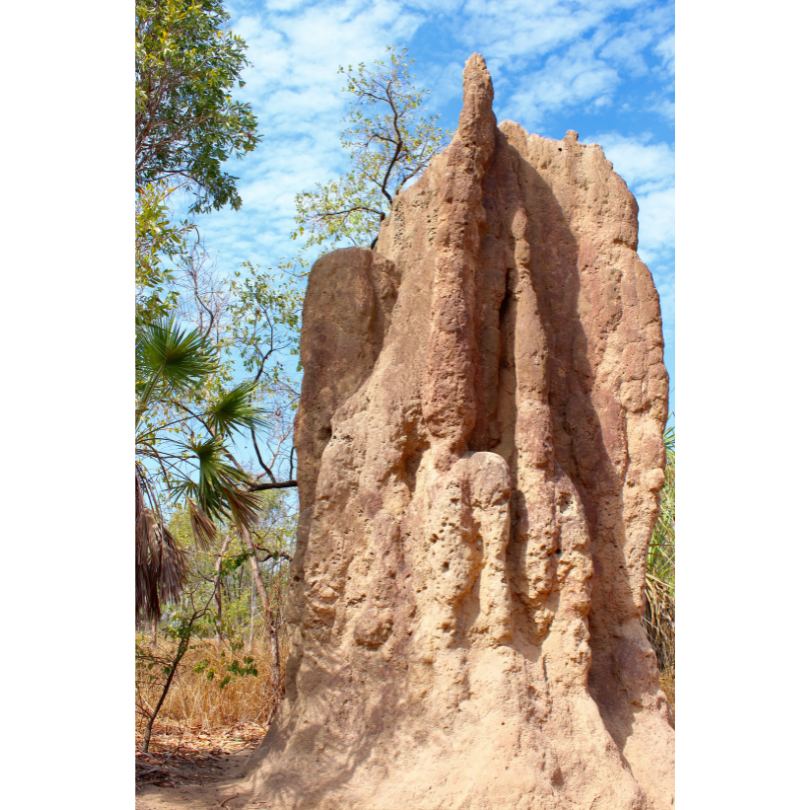
Before long, he spied ahead of him an unknown and very old man feebly digging up termite clumps and putting them into a basket. He hid and watched. Seeing the old man preparing to leave, he revealed himself and offered to carry the heavy basked to the elder's home. Accepting this offer, the old man led him farther into the bush. At one point they passed between two closely spaced trees. Glancing back, the hunter noticed that they really were the door posts of the entrance into an enormous cuuli (entrance hut) into a compound of enormous proportions.
It was within this compound that the elder lived; and here he finally disposed of the termites by feeding them to his chickens. He then took the hunter over to one corner of the cuuli and covered him with a fish trap basket, telling him to listen carefully to what he would be hearing. This was, in fact, the compound of Tienu (God) himself!
Time passed and passed until the sun was right overhead. Chief God called out, and all the "children" gathered into the cuuli so that it was packed. There was much noise and commotion. He then heard Tienu repeatedly shouting out for someone. Finally, one "child" came up and answered, "Here I am!"
"Not here!' you mean," said Tienu, "You arse hole. Ever since the day before yesterday, what's his names' wife has been kneeling in labor; and here you are still squatting there. What are you squatting there for anyhow? You should have gone already the other day!"
"Ai," said the child, "I can't go now at noon time. I will wait until the evening time."
"Get up. By the time you get there, it will be evening - it will be late, you hear. Get going!"
"All right!"
"When you have packed up and gotten ready to go, come back here."
"Yes, all right."
After a little while, the child returned and was standing before Tienu, ready to go. "I am on my way now," said the child.
"So you are finally ready?"
"Yes."
"Well, when you have arrived and they give birth to you, when can I expect you back, when will you return here?"
"Well, really I would like that when I reach them and they give birth to me, I am not asking for headaches; I do not ask for anything like that (sickness, death, etc.). I ask only that on the day they give me my wife, on that day when my wife comes home, I would like you to send your messenger (of death) to my birthing place. That is when I will return.”
"Is that so?" said Tienu.
"Yes," said the child.
"And what if that day should pass and you do not return?"
"If that day passes, I then ask that they will spread out cotton to lay me on (let me grow so old that they will have to use cotton to make me comfortable when I lie down)"
"All right," said Tienu, "get going then."
When he got up and left and was on his way, the old man ran over to the hunter and tapped him on the shoulder. "Did you hear all of that?"
"Yes, I heard."
"Did you hear all they said?"
"Yes."
"Well, that is your child! Your wife will give birth to it. Get up and follow it!”
Jumping up, the hunter went after his child, following him back to the village. On entering the village, he lost sight of the child ahead of him, not knowing where he had gone. He himself approached his own compound with confident strides, knowing that all was going to be fine. Still holding his bow in his hands, he entered the cuuli of his compound. Many people were sitting inside, worried and concerned as they had been before he left to go hunting. Seeing him, they were shocked. Remember what they said would happen should he hunt with his bow (that the baby would be stillborn), they began reviling him and verbally abusing him.
At that same moment, however, cries from within the compound- the wails of his child. Notwithstanding, insults continued; pound announced the birth of his child -- soon followed by but the hunter simply bore it all, knowing that his child's life was assured at least until the day of his marriage. Yet, he could not relay what he knew for fear of destroying the child. Even his wife later affronted him, by saying that she never wanted intercourse with him ever again after such a terrible delivery. She did not want to go through that again. "Only Tienu," she said had saved her. (She should have been grateful for her living child). Words harsher and more cruel would follow.
Sometimes a serious headache might come to the child; or its body might become feverish and the mother would become worried and say to the people: "Just My only son he wants to... come, look at him (her husband): he does quick, help me!" not care about anything. Look at him: he won't go to the oracle; he won't go anywhere to look for help; he couldn't care less (about what happens to this child...)."
These were spiteful words indeed. But the hunter knew the child wouldn't die, and indeed it continued to grow up. When old enough to speak, he asked his father for a grain to begin bride price payments on a girl in a nearby compound. These payments began and continued until he had grown up and was ready to accept a wife. The day of marriage came with all the relatives gathering and preparing for the evening feast. To everyone's consternation and indignation, the young man's father spent the whole day lying on the mat beside his son's bathing corner with a club in his hand. "What kind of filth was this anyhow," people asked. He wouldn't even get up to meet arriving guests at the entrance to the compound. Relatives were outraged by this unexplained behaviour.
During the day, the young man, on the other hand, was overcome by some mysterious drowsiness which put him into a deep and long sleep. People seeing this attributed it to "sleep of happiness" in preparation for his young wife that evening.
The father remained silent to all of this. When they prepared the saabu (meal) and finished and had divided up the food among everyone, they placed the young man's food next to that of his friends. One friend placed his food down and said "Hey, go wake up so-and-so (the son) and what's-his- name (the father)".
They went and tapped the young man on the shoulder to wake him. "Get up; get up and eat. They have already set out the saabu." When he jumped up Kudib (fully awake), he headed off for his bathing corner, but his friends called out, "Where are you going?"
He replied that we was going to wash his hands. They said, "No, don't do that. Come here.
follow; but the child grew. There is some water right here."
"No, no," he replied, "just let me wash my hands in my bathing corner."
"No, no," his friends called out; "you come on over here."
He should have gone to them; going to his bathing corner was a mistake. But his father was sitting there waiting. When he approached, the father jumped up and grabbed him, holding him back, struggling and calling out: "Oh, no, come help me!
The young man and his father struggled this way and that way. There happened to be one old man sitting in the compound who shouted, "May Tienu condemn to nothing all those who remain sitting! Won't you separate them and find out what it is all about?"
At that, they jumped up and grabbed hold of them. Separating them, they asked, "What is the matter?"
Everyone was absolutely shocked by their strange behaviour, and therefore asked over and over "What is the matter?"
The father replied, "Take your hands off me! Take him over there! And get some fire (for light, as it was night now)." They took the fire, went looking, and soon saw a cobra upon the large bathing stone with head raised high (coiled with several feet of body raised into striking position). "Lai-Lai!" (An expression conveying the horror and evil of its menace). Everyone set about quickly to put it "in place". When they had finished killing the cobra, the father called out, "Cut off the head and give it to me."
They cut off the head and gave it to him. He took it and went and hid it away. He then went and sat down and started shouting joyfully, "Go to the Fulani camp and catch for me my cow's bull calf."
When they returned with it, he told them he wasn't commanding anyone to do anything, but that he wanted them to throw down that calf right there and cut its throat; that he was offering it in thanks and blessing to all guests; that they should come and eat; that today he knows that he pia diegu (possesses a household), for today he has a male child!
This notion of the Yen Miali and Yen Cabili is demonstrated by the sense we have of playing a role, no matter how limited it is, in the orientation that is taken by our human destiny on Earth. The human being can see that he is not entering the game of life on Earth as a victim of a destiny that is imposed on him by the universal order. Man has in his Yen Miali mentioned all the good and all the bad that he would want to come across during his coming journey through Earth. The human, before his prenatal request, knows that his conception is nothing but a ball of energy that is in search of an existential legitimacy. He will then use all the energetic channels at his disposal to give strength to his Yen Miali. The energy of the mother, of the father, of the grandfather, of the mothers of the grandparents...etc. will then be accessible through their jengilis. The requests that are formulated in the Yen Miali usually come from the preceding experiences on Earth. And everything else is seen in terms of experience; the ones who were once criminal in their preceding lives will ask to find themselves in the position of the victim. The ones who were masters will ask to find themselves as servants...etc.
The human knows that not all the requests of the Yen Miali could be granted to him as his Yen Cabili; but he can be assured that the major parts of his Yen Cabili will be selections made from his requests in the Yen Miali and the Yen Milali of his ancestors. This way, we can say that through the Yen Milali, we all take part in, or at least influence by our prenatal requests, the course of our destiny on Earth.
The problem we observe every time the ego finds itself facing its destiny is that we are seeing life through new values that never stopped becoming. We know that we are taking a lot of risk if we include in our Yen Miali values that are defined by a society. We must keep in mind that social values come in the form of moods and fashions that change constantly. We increase the chances of our Yen Cabili fitting the practical aspects of the life of our ego by asking for more transcendent values (like chances of procreation, good fortune, resistance to disease, etc.).