The Traditions of the Kayumanggis
In Search of the Gods: The Traditions of the Kayumanggis
Our search for enlightenment eventually leads us to the unification of humanity. History shows us that all of the Deities that have been presented to our awareness find their history within the schools of Kemet, the original civilization of mankind. As humanity dispersed around the world, our ancestors brought with them the knowledge and dedication to the Divine World and in many cases specific Deities of worship. With the resurrection of Kemetic culture, the people of the world are brought together by the goal of furthering our understanding of the Gods in order to approach the Divine World.
In the eyes of traditional indigenous spirituality, the seeker must remain more interested in gaining an awareness and knowledge of the Divine World and the qualities within it rather than choosing their favorite Deities to worship over the other pantheon of Gods that exist. In our continued search for the Gods we are led to the Philippine Islands. This group of Islands located in Southeast Asia between the Philippine Sea and the South China Sea just east of Vietnam was originally known as the Maharlikas. It would become "Philippines" in the 16th century, named after King Philip II after being colonized by the Spanish.
The people of the Maharlikas were called Kayumanggis. They were made up of many indigenous tribes or societies. The indigenous Kayumanggis, like all others around the world, have been forced to vigilantly protect themselves from the onslaught of colonization. As is the case with most remaining indigenous cultures, a secret system of initiation was set to preserve and protect the indigenous knowledge. The beauty of these systems is in the fact that the knowledge remains uncorrupted and out of the hands of those who would use it to exploit the native populations. However, the disadvantage to the seeker of true uncorrupted traditional knowledge is that it is very hard to uncover.
There are many differences among the Kayumanggi tribes however there are some common threads within their spiritual philosophies. They all seem to have an emphasis on the importance of the human spirits' well-being in the afterlife. The Benguet Igorots have long practiced a form of mummification. These mummies were placed in wooden coffins after a process of smoking on a papag and treatment with special herbs. Their tattoos are still visible today. It was understood that all souls are immortal not just the Creator Gods and the smaller Deities. All souls eventually work their way up to the highest heaven, which usually is the one right below that inhabited by the Creator God(s).
The Kayumanggis understood that life was a struggle. It was an uphill journey with forces constantly acting upon the individual to commit evil. Humans must struggle to conquer illness and poverty, but at the same time must protect their behavior and actions from participating in evil so as to avoid going to lower worlds after death. As well as the evil forces that exist to challenge the individual, there was also a strong awareness of the assistance by the ancestral spirits and the diwata or anito. These spirits were said to be in charge of different activities and phenomena within the existence.
In the tradition of the Tinguian cosmogony, the ancestors were the first inhabitants of the world. The God Bagatulayan created the world and lives in and rules the celestial realm. Kadaklan is a Deity subordinate to Bagatulayan. He teaches the Tinguian how to pray, harvest their crops, ward off evil spirits, overcome bad omens, and cure sickness. In another such tradition, Kerenen, the highest Diwata, is not only the creator, sustainer, and ruler of the world, but his example also inspires the people to right action and speech. For those who follow his example and carry on his legacy, he created the paradisiacal afterworld, Suruga, while the wicked are banished to Nereka.
The Tinguian is a tribal group whose ancestral domain covers a mountainous region that includes four valleys and four river systems joining up with the Abra River, which empties into the China Sea. Tinguian territory is bounded on the North by the Illocos Norte, on the West by llocos Sur, on the South by Bangued, and on the East by Kalinga-Apayao. The Tinguian are mainly in the towns of Tubo, San Quintin, Luba, and Buliney in Abra. They number around 57,000.
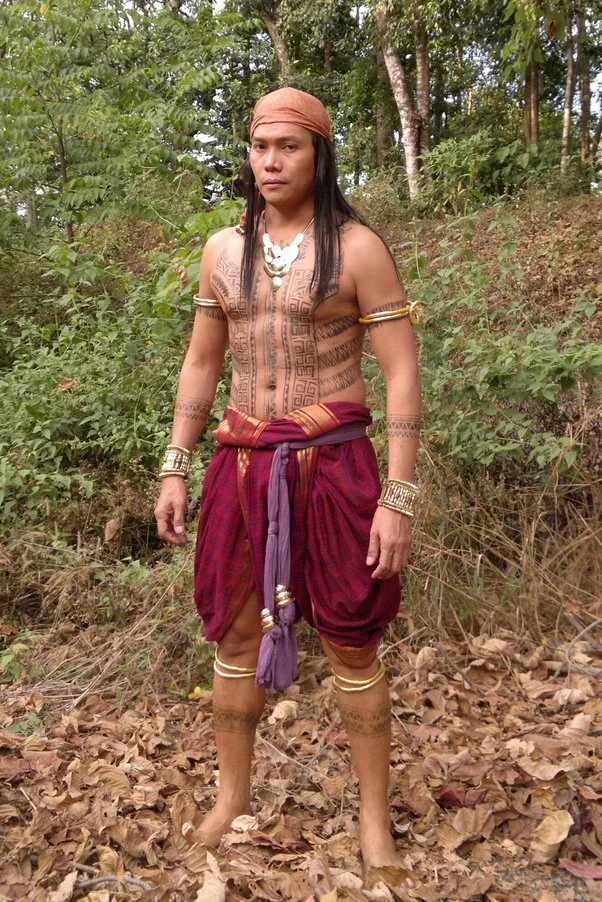
The Tinguian classify sasailo (spirits) into two categories: the malevolent and the benevolent. They know that sasailo dwell in the natural surroundings and move among human beings, and exert their influence on events and activities in human society. They possess powers and intelligence that are equal or superior to those of human beings, and they become the basis for certain sanctions and prohibitions that must be followed by people, on pain of retribution. They are feared and respected in traditional Tinguian society. Taking the form of human beings, they move about aware of everything that is going on. One benevolent spirit who dwells in the natural surroundings is Makaboteng "the one who frightens" the guardian of the doer and the wild pig. A key figure in the Tinguian system is Kumau, a malevolent spirit who can change its appearance at will, taking on the appearance of human beings, even the individual whom it is trying to ambush.
Within Tinguian society, there is only one person who has the power and ability to communicate with the sasailo: the alopogan (medium). The alopogan is usually a middle-aged woman who undergoes possession by the spirits who speak and act through her in rituals of communication with the tribe. She presides in the various rituals and ceremonies. Rituals that she presides over aim at combating the workings of unfavorable sasailo, or seek the blessings of the benevolent spirits.
Another tribal group is the Tboli. Their cosmogony says that when the world first began there was no land, only the sea and the sky, and between them was a kite, a bird similar to a hawk. One day the bird, which had nowhere to sit, grew tired of flying around. So she stirred up the sea until it threw its waters against the sky. The sky in order to restrain the sea showered upon it many islands until it couldn't rise but could only run back and forth. Then the sky ordered the kite to alight on one of the islands to build her nest, and to leave the sea and the sky in peace. Now at this time the land breeze and the sea breeze were married, and they had a child which was a bamboo plant. One day the bamboo plant was floating about on the water. It struck the feet of the kite, which was on the beach. The bird, angry that anything should strike it, pecked at the bamboo, and out of one section came a man and from the other a woman. Then the earthquake called on all the birds and fish to see, what should be done with these two, and it was decided that they should marry. Many children were born to the couple and from them came all the different races of people. The children were idle and lazy and after a while, their father seized a stick and began beating them on all sides. This frightened the children who fled in different directions inside the house. Some concealed themselves in the walls, some ran outside, while others hid in the kitchen and several fled to the sea. Those who went into the hidden rooms of the house later became the chiefs of the islands, and those who concealed themselves in the walls became slaves. Those who ran outside were free men and those who hid in the kitchen became black people, while those who fled to the sea were gone for many years and when their children returned came back, they were white people.
This story has many variations among the different Kayumanggis tribes. In one, the sea, the sky, and the kite are seen as a trinity of Gods, and two human couples plead to the kite from inside the bamboo to peck and break open the bamboo. The Tboli cosmogony includes the two couples. They are the descendants of these two couples: La Bebe and La Lomi and Tamfeles and La Kagef. Tamfeles and La Kagef begot twelve sons and daughters. In another Tboli creation story,, the supreme Gods are a married couple Kadaw La Sambad, the sun God, and Bulon La Mogoaw, the moon goddess. They reside in the seventh heaven. They've begotten seven sons and daughters who end up marrying each other:
Cumucul - the eldest son, is given a cohort of fire, a tok, and shield.
He is married to Boi Kabil.
Sfedat - the second son, married the second daughter, Bong Libun.
Their marriage produced no offspring. This threw Sedat into depression. He asked his wife to kill him. His corpse becomes the land from which sprouts all kinds of trees and plants.
Dwata - the third son married two of his sisters, Sedek We and Hyu We. Dwata requested one of the powers that were granted Cumucul but was refused. Dwata leaves the sky realm with his wives and seven children from Hyu We.
Litik - God of Thunder
Blanga - God of Stones/Rocks Teme Lus - God of Wild Beasts
Tdolok - God of Death
Ginton - God of Metallurgy
Imugut Mangay - God of Life and Growing Things.
Fun Bulol - God of the Mountains. He also had six children with Sedek We.
He asked his big sister Bong Libun for the land that was Sfedat's body. She agreed on the condition that she would marry one of his sons. Dwata spreads the land, and plants the trees and other vegetation the result is the Earth.
In this story, the first people were created when Dwata breathes life into clay figurines made by Hyu We and Sedek We. Dwata's son didn't keep their side of the deal to marry Bong Libun so she married her youngest brother, Datu Boling. She had seven sons with him who became the scourges of the Earth:
Fun Knkel - God of Fever
Fun Daskulo - God of Head Diseases
Fun Lkef - God of Colds
Fun Kumuga - God of Eye Afflictions
Fun Blekes - God of Skin Disease
Fun Lalang - God of Baldness
To alleviate the damage done by these scourges, the divine couple Loos Klagan and La Fun assume the role of healers.
Besides the pantheon of Gods, the Tboli also know of busao, or malevolent spirits which cause trouble in the lives of humans, causing misfortune and illness. Desu or propitiatory offerings of onuk bukay (white chicken) or sedu (pig) are made to gain favor from these spirits. Tboli rituals are normally presided over by a morally upright who is proficient in Tboli tradition.
The Maharlikas have suffered many invasions and religious imposition from the Spanish and Catholic Church. As stated, any attempt to present the spiritual system outside of their tradition of initiation is futile at best. Considering there are so many variations among tribes, only within the initiation can one have access to the true indigenous history of the people and their spirituality. This is why the Kemetic initiation is so cherished because it unifies all indigenous spiritual systems. As is the case with the Kemetic spiritual systems the spirituality of the people can not be separated from the daily lives and actions of the people. It provides the people with practical ways to protect themselves from the evil forces of the universe and live a healthy life of evolving towards the world of the Gods. In our search for the Gods, we humbly greet and honor the traditions of the Kayumanggis and urge any honest seeker to connect with the traditional initiation system of the Maharlikas.