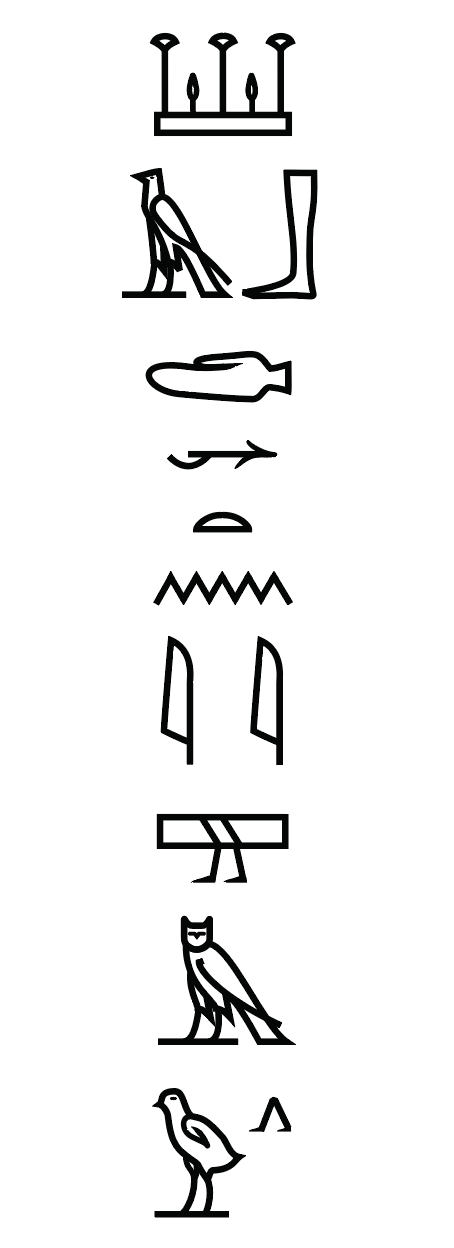
Preserving the Idea of Creation
The Pilgrim’s Walking Stick: Preserving the Idea of Creation
I would like to clearly signify to the reader that my intentions here are not to disgrace any belief. I consider that a religious belief is a personal affair and depends on choices that we make according to our environmental realities. We should recognize that the "world" evolves, and the human consciousness appears to be affected by social transformations. It is these transformations and changes of values that impress me.
I have pursued the origin of the word "God" until the Mediterranean word "Deai" before the phonetic aspect disappears into the word "Neter" of the language of Pharaohs of the Nile Valley. The word Deai is literally defined as the mother of maize. At this level, one can already see a difference between the concept of God and Deai. The definition of Neter has survived until the present time. Neter is defined as a fluid that covers the universe and knows no borders. The concept of "neter" can be found in modern science under the name of ether, with almost the exact definition and almost the same letters.
Neter and Deai have one fact in common: they can be considered as titles or common names for certain entities, whether they are universal or local. It is very important to notice that these two words that are considered ancestors of the modern word "God", have always represented a clear concept. The concepts of Neter and Deai do not represent a problem to the existential aspect of a human being, because, at every scale, these names or titles define entities that are waiting to be specifically called by their names. Consequently, their names are also a symbol of our recognition of what they are and what they are not. This can be understood as proof of our capabilities to distinguish what they do from what they do not do, and their place in the universe as created or creator entities. It is human nature to get confused and lost in chaotic and disordered environments. Our way of affirming our presence is our tendency to rationalize and put order in our surroundings.
The idea of a world created by the Gods has many arguments in its favor. If we accept the idea that the Gods (Neteru) have created us, we are affirming that we have organized and hierarchized them so that our consciousness can exist in the universe of cosmic forces. The psychological calm for the human being is the space created by the order in us. It is the egg of the world composed of diverse elements; this egg could only give life if the order among the elements is preserved. If we shake the egg vigorously, the components inside this philosophical egg get mixed up and the egg becomes rotten and is destined for destruction.

Our way of preserving creation will be to introduce the characteristics of our basic nature to the world: the concept of order. Let us take a look at the path followed by the evolution of concepts that have stimulated our actions and explained our lack of action. Can we base our actions of today on what we want to become tomorrow? If yes, what type of future are we constructing in the present that is entirely based on social ideologies? Social motivations are nothing other than the will that we have to create an impact on each other.
None of the monotheist doctrines have given a satisfying definition to either the concept of creation or the idea of death and resurrection. The universe, as presented in The Book of the Dead, is composed of four principal elements that are created by the first trinity (Ra, Amon, and Ptah). This concept is a lot more human than the concept of a complex world, such as the one we live in and have not yet finished discovering, having been created by a "unique God". It is almost like saying that one can identify the subject of an action without knowing the action itself, or like identifying an inventor without knowing his invention. The idea of finding a creator of an unlimited creation is close to being ridiculous.
Meanwhile, one should recognize that monotheism capitalizes on the emotions of the follower by way of beliefs. But the fact remains that these doctrines do not recognize the most important base of the human psychological nature on which his subconscious relies: logic. Existence is too complex to be entirely created by a lone divinity! This is why the ideas of trinities and creative enneads are continuously haunting the human species.
It is clear that, in every human, there are two types of psychological spaces that are not necessarily antagonistic but complementary: the emotional and the rational. The rational space allows us to classify and identify elements of our surroundings. These identifications and classifications originate from a logic that at the very least, is acceptable on an individual level.
This logic allows us to, at least, have a sense that we are progressing through our search for the world and in our transformation of the universe. The emotional space is the one that ends every logical procedure and, consequently, the emotion itself is then defined as a procedure that doesn't need to be acceptable. One should recognize that the rational space is the one that conditions our actions and lack of action on the basis of conscious and subconscious logic.
As said by many psychologists, "It is the environment that determines the personality of the individual". I will push this idea a lot further by saying that it is the logic born from the identification and classification of what we have seen, felt, heard, touched, tasted, etc., that predetermines our attitudes and reactions to events.