The Kuomboka Ceremony, A Tradition in ZambiaBy
BENBEN: The Kuomboka Ceremony, A Tradition in Zambia
Nyambe, a God, lived peacefully on Earth with his wife, Nasilele. Nyambe was a great God, as he had created the forest, the Zambezi River, the animals and fish, and the first man, Kamunu. Shortly after his creation, Kamunu spied on Nyambe while he was creating, and he began to imitate the God, which separated himself from the other animals. When the God carved wood, Kamunu copied. When Nyambe forged iron, so did Kamunu. One day, Kamunu made a spear, which he used to kill the male offspring of the great red antelope. Nyambe scolded the human, telling him that it is not right to kill his brothers and that he was forbidden to do it again. Kamunu did not obey, and this drove Nyambe from the Earth. The God escaped to an island, but the sly Kamunu was able to follow him on a raft of river grass and, later, in a dugout canoe. Growing tired of the human's antics, Nyambe, his wife, and his messenger Sashisho crossed a great river and then ascended to heaven (Litooma) on a spiders web. Since that day, Kamunu (man) still looks for the Gods by honoring Nyambe's influence in daily affairs and with cere- monies throughout the year.
The Malozi people of Western Zambia have a rich and full culture that pays homage to Nyambe. The Malozi (or Lozi) ceremonies are numerous, but the Kuomboka ceremony generates more interest than any other cultural celebration in all of Zambia. The history of the Kuomboka ceremony is often recounted, as it is an interesting story indeed
The first male king of the Lozi was Muyunda Mwanasilandu, or Mboo. Mboo was known to have very special human qualities, none of which other humans possessed. According to legend, before Mboo's rule, a great flood called Meyi-a-Lungwangwa, meaning "the waters that swallowed everything" came, killing animals and destroying farms. These floods came every year, killing many villagers and destroying most of the Kingdom. It was Mboo who was inspired to build a barge to transport people and valuables to a higher ground to avoid the devastating loss each year.
The first barge, Njonjola, was made of local reeds called mefalingi. The reeds were sewn together using roots and fibers, which created portions of the barge. Once the sides were attached to the base, the barge was ready for its work. Mboo quickly discovered that the barge was not sturdy or long-lasting, and he decided that the barge must be made of wood rather than reeds. The Lozi Kingdom was not rich in wood, so the new barge was built in a village called Liaylo by a man called Akabeti. Spears were obtained from people living in the forest, which were used to make holes in the wood planks. Roots and fibers were passed through these holes to attach planks to each other, and Lingonwe, a glue made from the bark of local trees, was used to seal the holes. The Chief Rainmaker at the Nakato village provided paddling sticks for the barge.
Dried clay, chalkstone and dried makenge root were used to decorate the barge with vertical scarlet and creamy- white stripes, recreating the designs used to worship Nyambe, Later, the stripes were changed to black and white. The great barge (Njonjola) was used during the annual floods to transport people and animals to higher ground. The barge later became known as Nalikwanda, meaning "for the people" as it was used by everyone who could paddle. As time went on, the barge was adopted for use only by the King, who led a procession of other crafts, such as smaller boats and canoes. This procession was called Kuomboka or "get out of water" • Held in March or April, depending on the water level of the Upper Zambezi River, this festival is a vital one in the Lobi society.
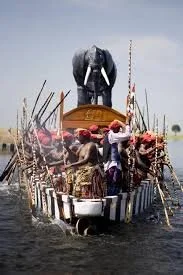
The ceremony begins when the maoma, or royal drums, are sounded at the Lealui Palace a day or two before the actual day of the ceremony. They play traditional ceremonial rhythms that announce the upcoming events. The sound of the drums is an anticipated event, as the people do not know exactly when it will happen; the exact date of the Kuomboka is decided by the King and is kept secret from commoners. It is only when the drums sound that the rest of the Lobi people know that the Kuomboka is coming. Upon hearing the drumbeats, men immediately put on their traditional siziba and lishushu, a red beret headdress. The women clothe themselves in the floral misisi. Traditional dress is extremely important - anyone wearing anything on their head other than the lishushu is offensive and may result in receiving a blow from the hippopotamus whip.
The Nalikwanda leads the procession and is followed by smaller boats and canoes. The King leads his people to the safety of the higher lands, while his musicians play the maoma drums and salimbas (xylophones). The crafts that follow the King's barge follow the music to higher ground.
The Kuomboka ceremony has become a very popular attraction for outsiders and tourists. Unfortunately, it is this popularity that is threatening the purity of the ceremony, as the media and government of Zambia are pressuring the Lobi King to change the aura of the Kuomboka to appease foreign tourists.
The Kuomboka is the one thing that brings in money in the region. Hotel owners rely on the popularity of this celebration to earn most of their profits for the year. More and more hotels are being built, as the demand for rooms has recently been huge. Taxi drivers hike up their fares during this time, and the boat trips that are necessary to reach the Lealui palace of the Lobi people suddenly jump 1000%. But the monetary benefits of hoards of tourists comes with a price, which is a lack of respect for traditional culture and protocol.
Outsiders can be seen wearing jeans and baseball caps. They sometimes behave disrespectfully and, knowingly or unknowingly, insult tradition and culture. The traditional leaders, who know the importance and value of keeping the culture and structures of the ceremony pure, treat these occurrences in the same manner as they would if it were a Lobi who did not follow protocol - whether it is a Lobi or an European tourist, the offending person is usually disciplined by the Royal Guards with a hippopotamus whip.
The government is pleading with traditional leaders to go easy on the tourists. "We appreciate the fact that traditional leaders must be respected, but whipping people who have spent money to come and celebrate with you because they have a non- traditional cap on can be very upsetting. We must exercise some restraint when we are dealing with foreign tourists..." Chief executive of the Zambia National Tourist Board Charity Lumpa commented to a reporter.
This is one example of the constant struggle between traditional culture and the colonial governments in Africa. While the traditional Kings, priests, healers and faithfuls struggle to keep their culture, spirituality and lifestyle pure and free from corruption, the government applies pressure to change tradition to be more suitable for Europeans and foreigners. But the fact of the matter is that the Lobi King and other leaders did not ask for foreigners to come watch their ceremonies - they did not invite outsider participation or witnesses. Why, then, should the very nature and respect of the ceremony be altered? A ritual or ceremony must not be changed to make outsiders, who have no esoteric understanding of the spiritual and cultural meaning and importance of the ceremony, feel more comfortable!