Restoring the Ancient from Obscurity
The Initiate: Restoring the Ancient from Obscurity
When many people think of hieroglyphics, the image that probably comes to mind is one of the scrawlings of a primitive people on the walls of caves, tombs, or temples erected to worship make-believe Gods. Not many people would call it a language, and still less, the mother of languages. To assume that the language is isolated to the Pharaonic era in "Old Egypt" is false. Few people realize that what is commonly referred to as the ancient hieroglyphics is still spoken, in various dialects, throughout Africa, and in indigenous cultures around the world.
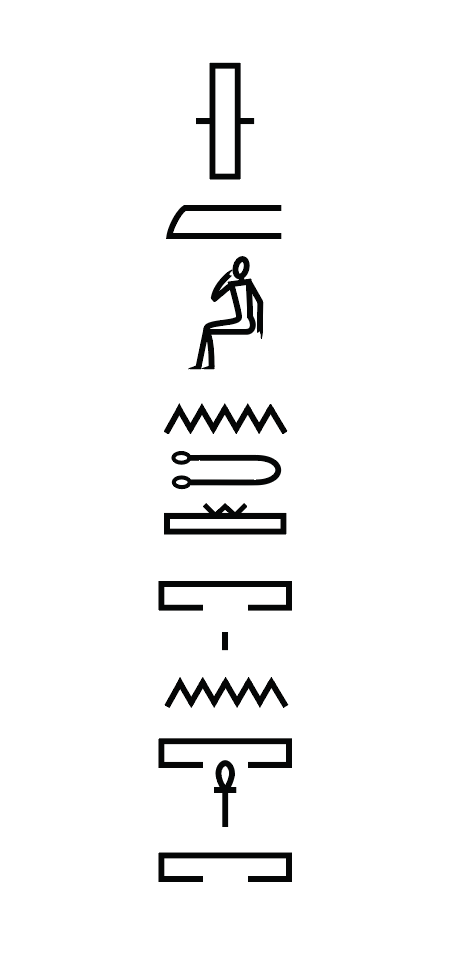
The dialect that Neb Naba teaches in the M'TAM School of Kemetic Philosophy and Spirituality is called the Medu Myeet. Medu meanslanguage, and Myeet means new, showing that the language has evolved over time while being preserved to the extent that, with a sound knowledge, one can comprehend the ancient temple inscriptions.
In one of our first classes, Neb Naba expressed the importance of knowing the Medu by telling an encounter he had with an African from Angola. The colonial languages of Burkina Faso (where Naba hails from) and Angola are French and Portuguese, respectively, Consequently, they could not communicate well with their colonial tongues. However, when they attempted to communicate using their native tongues, they were able to relate much better.
Most languages spoken today have their root in the Medu. The more ancient ones, such as Hebrew, Sanskrit and Mandarin, are more closely related to it than the European "modern" languages familiar to most of us. Thus, the Medu is important to anyone interested in the history of languages and their interrelationships.
There are over 400 letters in the Medu Myeet, each of which carries it's own meaning. There is literally a letter for every sound that can be produced using the vocal cords and tongue. For example, there is a letter for the sound "sh," different letters for the hard "a" and soft "a," there are even letters for the sounds nejem and mote. To me, this means that every word in every language has a translation in the Medu that may or may not make sense. The sound "frob" has no meaning in any language I know, but in the Medu, it might mean rock pudding, or air sits head. I say this not as a joke so much as to show the versatility of the language.
As my proficiency in the Medu increases, I am able to discern the esoteric meaning of many words and especially names. The Medu word for "I" is pronounced "ee." The word for "in" is pronounced "im." The Medu term pronounced "Meri" means I love, or beloved. Marry, merry, Mary (the virgin), the prefix meri- (merit, meridian) all have similar meanings.
The name of my friend Jasaiah can be translated as "my son crosses greatness." According to his mother, it is another name for Jesus. The parallel there is striking. These are but a few comparisons of which there are many.
The Medu is often referred to as the Medu Neter, meaning "Language of God." At The Earth Center, we say that it is literally the language spoken by the Neteru (Gods). Whether you, the reader, believe this or not is up to you. However, it should be understood that the Medu was developed to express, among other things, spiritual concepts. The Ihket, for instance, is an intelligence that governs a given thing, such as a hand, a chair, or a flame. There are many Medu words, like this, expressing concepts that have no place in English. For one on the spiritual path, such simple things can be of enormous value.
Each sound has a vibration, who's effect is harmoniously tied into the concept it conveys. Many people chant affirmations and prayers that are beneficial to their state of mind. Imagine if, while expressing the concept to your mind, the vibrations of the very words you speak resonate throughout your body, expressing the same concept to your brain. This is the power of the Medu.
The creators of this language were and are very sophisticated. These are the people who colonized the world peacefully thousands of years ago, building monumental structures wherever they went, that still cannot be duplicated by "modern technology." These are the people who mapped the stars, without telescopes, some of which cannot be seen with the naked eye. These are the people who developed mathematics, music, science and spirituality. They developed words to describe all of this.
In contrast, (this is not to insult anyone, rather to present a fact) many of the languages that dominate the world today were developed when their originators (to avoid going off on a tangent) had little or no knowledge of any of this. And they are still in the process of learning concepts (quantum physics, chaos theory) that they still don't have words for.
For those interested in the Medu, I highly recommend Neb Naba's class, for both the language as it has been preserved in Africa, and a proper understanding of the concepts. Barring that, your independent research will turn up much text on the subject (usually based on interpretations from the "Rosetta Stone") and a rare few people daring enough to teach from them. Whatever the source, I encourage you to learn what you can, because it is worth knowing.
For convenience sake, I'll continue to speak English, and will likely pick up one or two more European tongues, and probably others, but when it's all said and done, I'll be glad to hold the Medu Myeet as the key to unlocking them all.