Getting to the Root of People, Places and Things MusicalThe Historically Elusive Guitar
Root Tones: Getting to the Root of People, Places and Things Musical
The Historically Elusive Guitar
The guitar holds equal prominence with the piano in today's world of classical and popular music. The guitar also plays a predominant role in jazz and in African music, not to mention the music of Spain and Brazil. The importance of the guitar (like the piano) is due to it's polyphonic capability or the ability to play chords and melody simultaneously. Instruments with this ability naturally become master instruments in a group setting where all other instruments are of a monophonic nature (with the ability to play only one note at a time). For example, six horns with pre-arranged harmonic assignment would be required to play the chords that one six string guitarist could play. For this reason, the guitar and a piano are the primary instruments used by composers throughout history.
Most music historians concede that the history of the guitar is difficult to trace. Most place the beginnings of the guitar at 708 A.D. when the invading Moors brought it to Spain. This instrument is referred to as the Guitarra Morisca. We know that the Moors were simply transmitting the culture of Ancient Kemet to Spain (See article on the Moors in this issue). so the actual history of the guitar must have long predated this history.
This early evolutionary pre-history of the guitar is identical to that of the piano (see "The Piano" a two-part research in Root Tones TM in the first two issues of the Rising Firefly). That is, we determined that the piano is essentially a harp with keys. The harp was the predominant instrument in Ancient Kemet (Egypt). In ancient Kemetic depictions of musicians, we would often observe a harpist along with the player of another stringed instrument with a long neck. In the publication, Egypt, Temples, Men and Gods (1994) edited by Avaleria Manferto, such a photograph of an Ancient Kemetic drawing appears. The instrument with the long neck is defined as being a "lute".
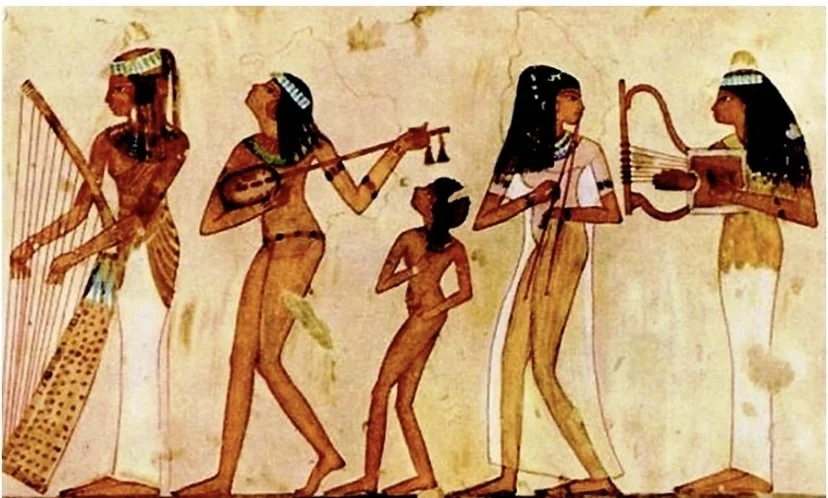
There is a tremendous amount of confusion concerning this instrument and its descendants. Let's examine these claims. The term lyre is said to have been the term used to describe the instrument that became known as the lute. However, there are claims that the so-called European lute was derived from the Arab ud (including the word "lute" itself being similar to the word "Oud"). None of the depictions of these instruments look like the Ancient Kemetic drawings in terms of size. The size and design of the Oud, the Lyre and the Lute as shown by historians are practically identical (see photograph). There are conflicting claims of Persian, Hungarian and European origins of this instrument. For example, it is stated that the lyre, also called the koboz, is an ancient Hungarian minstrel instrument of Central Asian origin. Another historian claims, "The transfer of terms for lyre and lute appears more subtly in the myth of the invention of the ud (oud) which has been handed down in two variants from the 9th and 10th centuries, the first being Iraqi and the second Iranian. These say that the 'ud was invented by Lamak, a direct descendant of Cain." There is claim of a Hellenistic lyre called a citharis or kithara from the 7th century BC that is mentioned by Plato and Aristotle. It is thought that the name "citharis" evolved into the word "guitar". However, the word seems more closely akin to "sitar" , another stringed instrument from India that is similar to the Kemetic Instrument. In the book Golden Age of the Moor, author Ivan Van Sertima shows a drawing of an instrument he calls the "tar" (p.301) but unfortunately, he does not include any history or explanation of the instrument's origin. I have not been able to find the "tar" anywhere during my research, nevertheless, the depiction bears the closest resemblance to today's guitar in that it has six-strings. All the previous instruments bore 4 strings. Van Sertima does however discuss the origin of the five-string lute(ud) created by the Moorish singer/musician Abu-I-Hasan also known as Ziryab (the Blackbird) in 822 A.D. (in Moorish Spain). Van Sertima explains, 'Before Ziryab the Lute (oud) was composed of four strings, which answered the four elementary principles of the body and expressed the four natural sounds. He added another red string and placed it in the middle, which considerably improved the sound and made it more harmonious." Modern day historians of the guitar do not attribute the addition of a fifth string on the guitar until the 16th century, and a sixth string until the 17th century.
From its appearance it seems that the Lyre/Oud/Lute is a direct predecessor of the guitar as we know it today. But wait...dating back to 1900 B.C. there appears a wall relief from the Kingdom of the Hittites that looks even more similar to today's guitar (see picture). The Hittites were neighbors of Ancient Egypt during Egypt's Middle Kingdom. They occupied the land that is modern day Turkey, just a short trip across the Mediterranean Sea. At the time Syria, which bordered Turkey, was controlled by Egypt. There was obviously a great deal of interaction between the Hittites and the Egyptians, including intermarriage. One interesting story states, "While Suppiluliumas (Hittite King) was encamped before Carchemish, a messenger arrived from the queen of Egypt with a proposal that he should send one of his sons to become her husband. Suppiluliumas agreed to her request and sent her one of his sons, but he was murdered when he reached Egypt. The identity of this queen is uncertain. She may have been Ankhesenamen (Ankhesenpaaten), the widow of Tutankhamen who was compelled to marry the ambitious courtier-priest Ay, thus legitimizing his usurpation of the throne." Historians have not been able to find the origins of the Hittites, but the fact is that the Ancient Egyptian Dynasties had certainly predated the Hittite existence and until subsequent wars, they lived as peaceful neighbors. During times of peace there was undoubtedly a cultural exchange that included music. The Hittite instrument is much closer to the Ancient Kemetic "lute" than the later instruments introduced by the Moors.
The elusive history of the guitar is yet more complicated by the complete omission of the kora (referred to as the African Harp) as part of the lineage of the guitar. This instrument, like the balaphone, was in existence in the 13th century Manding Empire (Mali/Dogons). The Kora is a 21- string instruments from the West African countries of the Gambia, Senegal, Mali and Guinea. It is an ancient instrument that is part of Africa's rich spiritual music tradition. The Kora is made out of a large gourd or calabash, which grows like a pumpkin. The body of the Kora is covered with a cowhide. The instrument has a long pole, which leather is attached to. Each of the 21 strings is attached to a leather ring on the pole. It is still played today by Griots (storytellers) and appears in many different forms with as few as six strings.
All in all, the guitar shares a similar history of mystery as that of the egg. Or is it the chicken? Until we get to the root of the matter, B natural and C# (see sharp).