Changing Their World: Young Volunteers for the Environment
Spotlight: Changing Their World: Young Volunteers for the Environment
Given Togo's atmosphere of political unrest and uncertain economy, it may come as a surprise that environmental and cultural preservation is an issue that young Togolease men and women take seriously. Anyone who has visited Togo will notice a world where economic depression couples with entreprenerual spirit and hard work, and where the seepage of the modern lifestyle into the young person's mind battles with traditional values, culture and honor. Togo's young people, however, are not complacent, and they are not only concerned with their social, political and environmental conditions, but are willing to take action to get what they want.
Togo is a small country on the coast of West Africa, bordered by Ghana, Burkina Faso and Benin. A former French colony, Togo became independent in 1960 and today faces many social and economic difficulties that are the result of their past colonialism and the continued neo-colonialism. France and other modern countries use their power to keep Togo (and Africa as a whole) supporting European objectives and needs while disregarding their own people, traditions, culture and development. An estimated 48% of the logolease population is under age fifteen, making youth a very strong upcoming social and political power.
Due to basic survival challenges, young people in Togo have many obstacles to overcome. While schooling is widely available, not all parents can afford to send their children to school. Meanwhile, most schools are promoting Western educational ideals rather than traditional systems of learning, initiation and values. Jobs are extremely difficult to find, and university graduates find themselves driving taxis or hustling on the street. The glamour of a "modern" lifestyle pulls youth from small towns and villages, and they flock to cities and more urban areas in search of jobs, money and material goods. Others strive to leave Togo altogether and pine for the "promised lands" of Europe or America. The traditional culture continues to erode; the environment becomes more polluted and abused, and people become more desperate. On the other hand, however, young people in Togo enjoy a rich cultural and traditional heritage with strong values and roots. Hospitality is law, and neighbors always aid each other whenever possible. A friendly smile, kind words, and help is never far away, and people genuinely care for each other. Honesty and love are expected, and laughter can be heard in every household. Traditional ceremonies, dances, gatherings and celebrations are extremely abundant, and everyone participates. The family structure is very strong, elders are shown extreme respect, and children are raised by family, friends and community alike. It is this atmosphere of economic desperation and cultural erosion married with strength of traditional values and honor that Jeunes Volontaires pour l'Environnement, or JVE (Joung Volunteers for the Environment) was formed.
"JVE began from the mountainous area of Togo as a small group of youth who were touched by the degradation of their land and the impoverishment of their people. They gathered weekly in the rural village of Tsiko (120 km North-East to Lomé) to discuss issues of environment and development," explained Sena Alouka, national youth coordinator of the organization. "The mission of JVE is to educate, empower, and support the youth of Togo in order to involve them in the sustainable development process, for they are the beneficiaries or victims of today's decisions." JVE has over 500 volunteers in ten operational branches throughout the country, and over 17 international volunteers have come to Togo to participate in JVE's objectives.
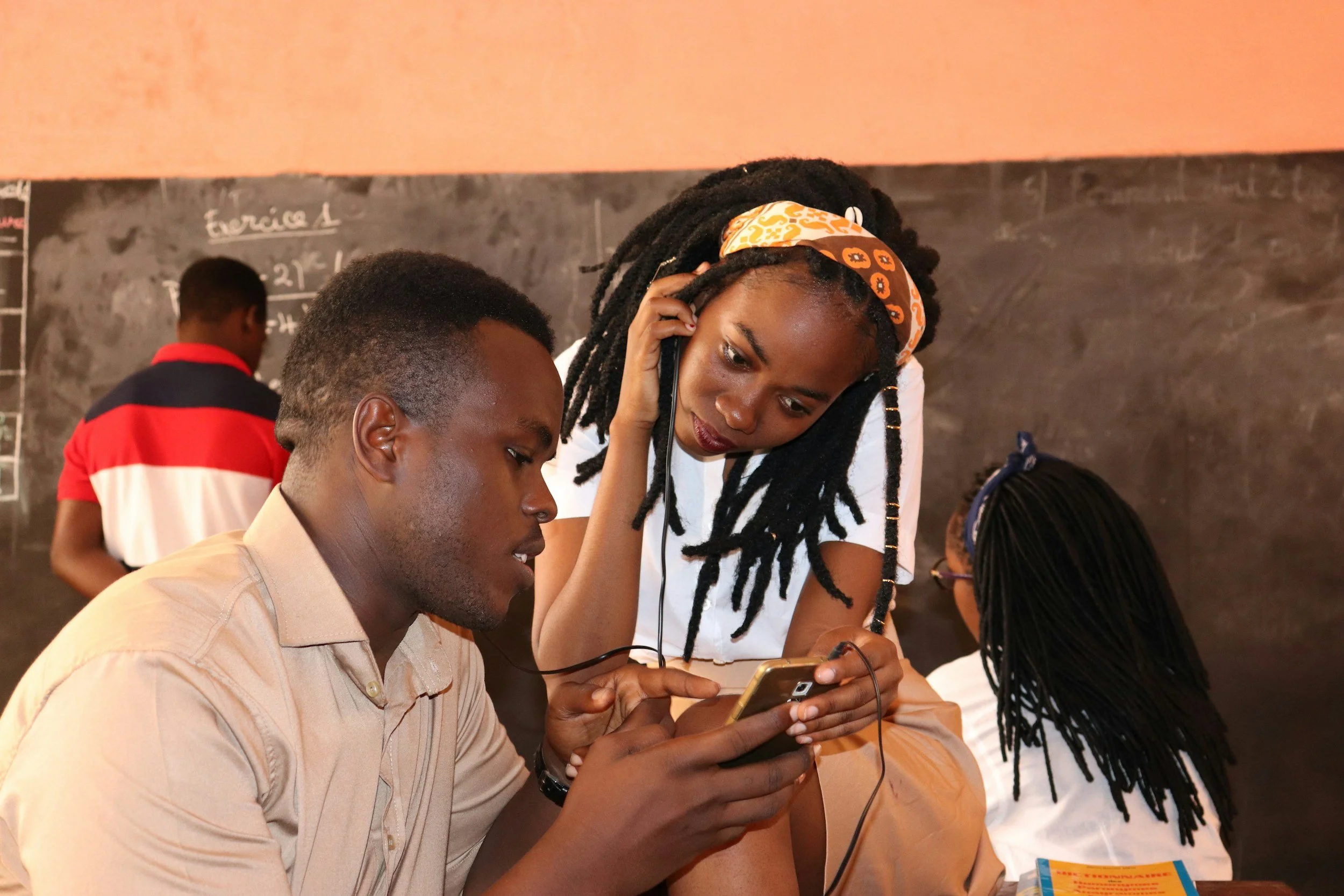
The activities of JVE are extensive and diverse, as are the issues that they address. Their primary objectives are raising the awareness of environmental and cultural concerns in youth and the public as a whole. Current ongoing projects include: environmental education in schools, a support center for people living with or affected by HIV/AIDS, a book on sustainable development that will be published in French and local languages, international summer youth camps, introducing computers and the internet into rural schools, water relief projects, cultural exchanges, and many more. Volunteers give lessons at schools, produce a TV-program, repair and construct water structures in water-stressed villages, and hold conferences on important issues.
JVE hosts a television show every Wednesday to help educate the public and arouse their interest in and support for sustainable development. The show is called Eco-Development and is shown on TV2, a popular private TV station in Togo. "This program is a cooperation between JVE and TV2, the second most popular TV station in Togo. Roughly, it reaches more than 500,000 people," Sena told us. Topics featured on Eco-Development include biodiversity,
forestation, genetic engineering, poverty reduction, land reforms, local agriculture, and volunteering, to name a few. The television show has provoked a large response from the public and plays an important role in reaching the goals of the organization. "Almost all of the environmental authorities have participated in this program, and it gives a voice to many youths to express their concerns on various issues. It is interesting to note feedback, positive and negative. Every time people or organizations feel harmed, they call and ask for a right to reply. In a country like Togo where people are very careful to speak out, this program is an important landmark in communication history," remarks Sena, who is integral in all of JVE's activities.
JVE Programs
Cultural Biodiversity Project: A program being implemented in the rural community with a goal of preserving Togolese cultural diversity. JVE hopes to use traditions to raise the awareness of people to environmental issues as well as cultural protection. Sena explains: "The purpose is to identify how best to protect our culture! We are sure that there is a close link between culture and biodiversity: we want to identify this connection more clearly in order to draft projects accordingly. We are going to organize various cultural events and public discussion throughout the year. We hope that this can be way of protecting our cultural identity: our personality and uniqueness. We appreciate openness and diversity but in no way, are we ready to loose our history, practices, and our being. In order to better preserve Togolese bicultural diversity, JVE is working on implementing a project into primary and secondary schools in Togo in which students will conduct research to explore and connect with their cultural traditions. An emphasis is being placed on learning the value of local environments to different cultures. It is based on a project that has been very successful in Ethiopia through the African Biodiversity Network. The framework to begin the project in Togo exists, but we have not yet received funding. We continue to search."
International Summer Youth Camps: Camps are organized during school breaks and include international volunteers from around the world. Three camps will be organized in 2004. Volunteers pay $150 for basic lodging and food and stay for three weeks. During this time, volunteers participate in social or capacity-building activities associated with JVE. All volunteers are welcome.
Campaigns on LMOs (Living modified organisms): JVE works with communities and organizations to encourage continuing traditional agricultural systems. Using radio and TV programs, JVE sends the message to traditional farmers to keep up their good work and to struggle against the courtship of modern agricultural technology that may not be positive in the long run. As members of the African Biodiversity Network and the International Pesticide Elimination Network, VE promotes relevant campaigns on important agricultural topics.
Water Relief Projects - JVE is currently in the organizational phase of two different water relief projects: one to eventually dig wells for ten of the most water-stressed villages in Togo, and the other to repair existing water structures in the village of Danyi-N'Digbe in response to urgent needs identified during the summer camp. Both projects will include education of villagers on issues of hygiene, water protection, and maintenance of water structures. Water Management Committees will be elected by the village, in cooperation with locally based NGOs, to take responsibility for the maintenance of water sources and the creation of a repairs fund.
Funding
All non-profit organizations struggle with funding, and JVE is no exception. Fundraising in itself is difficult, especially in an unstable economy. Despite the fact that JVE is run entirely by active and dedicated volunteers, money and materials are needed to get things done. JVE's work is done by the people and for the people, and board members are not relying on hand-outs from the government or foreign agencies; it is extremely difficult, however, to attain funding in Togo due to the economic ruin with which colonialism has left the country.
"Fundraising is 98% useless in Togo," explains Sena. JVE has no regular source of funding except for the minimal support that volunteers and board members are able to donate for basic expenses. JVE has received donations from some international organizations, but securing international funding is difficult because Togo is seen as extremely unstable. "Needless to say, this prevents us from being as effective and efficient as possible," Sena remarks.
Because JVE does accept donations from international organizations, the question of integrity must be raised. How does JVE ensure that the values, cultures, and traditions of their communities are not overshadowed or changed to suit the objectives and goals of NGO's of other countries? How does JVE prevent continuing colonialization through non-profit organizations and other governments that are working with and funding JVE activities? Sena explains: " JVE is very independent organization since we have no regular source of revenue. It happens, of course, that we work with many organizations, but we always inquire about the objective and mission of our partners. The board usually makes sure that we do nothing against our objectives. For instance, for some reasons we cannot be involved in any political activity (be it to promote democracy or protest against a political decision). It is not possible for the organization to receive money from lottery, oil, or cigarette companies. In every network, we insist on the preservation of our cultural identity. We clearly perceive the trick and complexity of international NGOs, and so we pay attention to our international cooperation and take necessary measures in order to avoid being involved in anti-development activities. When funded, we draft the project ourselves and use it according to local realities.”
Biotechnology and Globalization
During our correspondence with Sena, he mentioned that JVE is not necessarily against bio-technology genetic engineering or globalization. Because these issues do not seem to fit with conscious and holistic approach and objectives, further explanation was necessary.
Firefly: You said that you do not necessarily disagree with biotechnology. Please explain your position. Genetically altered foods are not compatible with organic farming, sound ecosystems and sustainable agriculture and have been shown to cross-pollinate. Their health effects are not known. How does biotechnology fit with your agenda and how does it help Togolese people?
Sena: In a TV documentary that I produced on genetic engineering, I clearly showed the wonderful “potential” that GE can bring to the world, but the other side of the coin shows a gigantic long-term risk. We have good and sound reasons to be very cautious: unfulfilled promises and worse, scandals related to GM-seeds such “Starlink” and the “Golden Rice”, give us more reason to stick to the precautionary principle and the informed consent principles. Africa and Togo particulary have neither technical equipment nor qualified human resource for this tricky exercise. We are afraid of the dependency of our farmers regarding multinational companies which will start claiming for an alleged royalty of patent. One big issue for us is the possible disappearance of our TEK (traditional ecological knowledge) and our natural heritage.
Togo is currently in the process of drafting its national biosafety framework intended at controlling fabrication, transfer, import, trade risk and responsibility. We are aware of the $46 billion that this trade generates each year, and I can see that no poor country would like to stay outside of the game. I can also understand the big hand of European Union pushing African countries to reject every GM food or product. Still, it is clear that no human activity is 100% safe, and in this case, the best position we can adopt is to ask for the respect of the prior informed consent and precautionary principles.
We simply do not agree with affirmations like this one of a US official that "beggars can't be choosers". We think it is simply undemocratic, inhumane and wicked to play with hunger like a football. As you said, we are aware of all the risk of cross pollination, health threats (allergies and resistance to antibiotics) and the lost of organic farming, but it is not intelligent to be on the bench while the game is being played! Burkina Faso, our northern neighbor, has accepted GM farm trials on its land, and this poses a serious threat to our land as well. Consequently, then, it is important to reinforce our institutional machine that is liable to notice any possible entry of these seeds into our country: You can believe me, I am sure that the populations have already exchanged this miraculous seeds among them.
We are, to the best of our abilities, trying to persuade populations to continue the local organic and ecologically-sustainable agriculture. We impart the information on the risks linked to some "western-made" seeds that are supposed to solve the food security challenge. But GMO will do nothing to the world's food problem. Education, on the other hand, can change mentalities and then habits and finally our everyday life. So to say no or yes to GMO is not the debate: it is about understanding the whole system while ensuring that we do not become tools for experiments for those big companies: Mon-santo, Dupont, Bayer and so on.
Firefly: You also say that you are not against globalisation. How does globalisation improve your conditions in Togo, and how does it hurt it? How do you propose to protect indigenous knowledge and culture in the face of massive globalisation that aims to destroy indigenous culture and values and usurp them with “Western” values, culture, lifestyle and trends? Many Togo youth only want to leave Togo for Germany, France, USA or other countries, and this is largely due to globalization and colonialism. With globalization, what is the future for Togo?
Sena: I can take days expanding on this issue as it one of my best. Globalization: earthification: uniqueness: uniformity: blind-mindedness: dictatorship: terror: tragedy: Armageddon! This is how globalization is perceived world-wide for its countless negative impacts. You can tell by yourself how we are always affected by globalization: loss of cultural identity (my worst enemy), the over-powerfulness of international companies, and the continuous impoverishment of the poor. Still, thanks to globalization, you can read an email from me, and we are grateful for that. All that we are asking for is a more just and equitable world. We are asking for a fairer share of our natural resources. A world wherein intra and intergenerational equity are guaranteed. Every day, we feel the heavy power of globalization.
Globalisation does not play a big role in the massive departure of Togolese youths. I think poverty and the uncertainty of tomorrow are mainly the causes. Globalization is definitely attracting a group of the youth, but in general, hard living conditions are the main causes. Indirectly, globalization is the grandmother of poverty. With this, I am very afraid of tomorrow too. It is terrible to see hundreds of youths flying most towards the US. I am happy to stay and help as many people as possible that I can. Just know that the political problem has a lot to do in this. So far that the politicians would have not solved their eternal and complicated struggle for power (what I seriously doubt), the situation is not liable to change soon.
JVE Impact on the Public
Firefly: How have JVE activities been perceived by the public? What differences have your activities made?
Sena: Apparently, the public in Togo is very interested in environmental issues. Every day someone passing by our tiny office comes to ask information of what we are doing in our association.
The changes we have made may be small in the world scale, but for the individuals touched by them, the changes are great. For example, our project to repair wells in the village of Danyi N'igbe enable the people to cope with everyday life. With our TV program we reach a great number of Togolese every week, and in that way we raise peoples awareness on environmental issues. The concrete actions, like cleaning up public places in Lomé, have had instant affect on the community. Teaching children in schools is making a wonderful impact in families. Many children always come to the office for more information. Our branches throughout the country helps in involving many youths in the sustainable development process. Drafting a Local Agenda 21 for a local community is a unique experience in the whole sub-region and once completed will help in enhancing local democratic governance.
Despite its young age the organization has already received international prizes. JVE was presented with the International Award of Excellence for Best Performance 2001-2002 by the Council of International Awards. The Executive Director was given in Washington the Award for
Environmental Press 2002 by Reuters and IUCN (International Union for the Conservation of Nature). JVE is also widely known in the international screen as the association has successfully participated in more than 20 international conferences (World Summit on Sustainable Development in Johannesburg, Ministerial Conference on Sustainable Development in Indonesia, Dam-Affected People Summit Thailand, International Youth Summits, Globalisation and Biodiversity Workshop in Ethiopia...)
As Gandhi said: 'No one should minimise the capacity of individuals to change the world'. Far from being pretentious to change the world, we believe in the good impact of our activities on local communities and on individuals. The youth (international and national) working in the executive staff get a wonderful experience and are happy for being so useful to the community. The whole NGO is a proof that another world is not only possible, but at hand. While decided in helping to make changes internationally, we make of this sentence our motto: "think global, act local"
Our vision for the world is a society in which no man or woman, regardless of tribe, creed, social status, gender, race, religion etc., will be abused, insulted, or deprived of means to earn their livelihood. We have the moral obligation to render service to humanity and ensure a good future for our youth. We believe that meaningful acheivement cannot be made in the world without the full support of the youth who are leaders of today, tomorrow, and the future.
The youth of Togo refuse to sit back and watch as their country, culture and environment are affected negatively by big business and unconscious living. They will not remain passive as their resources are exploited and used. They will not be silent about their economic plight, and they are not looking for other countries to take care of them. No, the youth of Togo are taking a stand, and they are actively working to change their conditions, not only for them, but for those who have yet to come.
Perhaps the youth of "modern" countries will benefit from the example set by JVE. Young people can make a difference, and they can change not only their own situation, but the entire world. It is possible, but it takes courage, determination, persistance and integrity. The members of JVE possess all of these qualities, and they are making a difference.
Picture 1
Togo has a rich traditional culture that is at risk of exploitation and change through colonialism and modernization.
Picture 2
Togo’s landscape is vast and beautiful, with traditional plants and foliage.
Picture 3 - map
Picture 4 - Sena