
Getting to the Root of People, Places, and Things Musical
Root Tones: Getting to the Root of People, Places and Things Musical

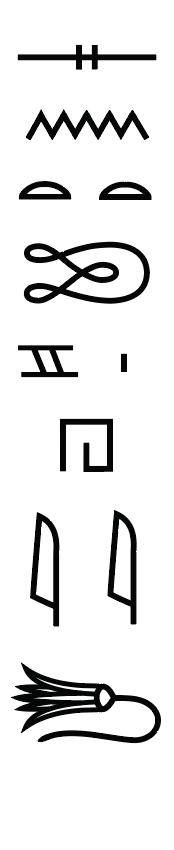
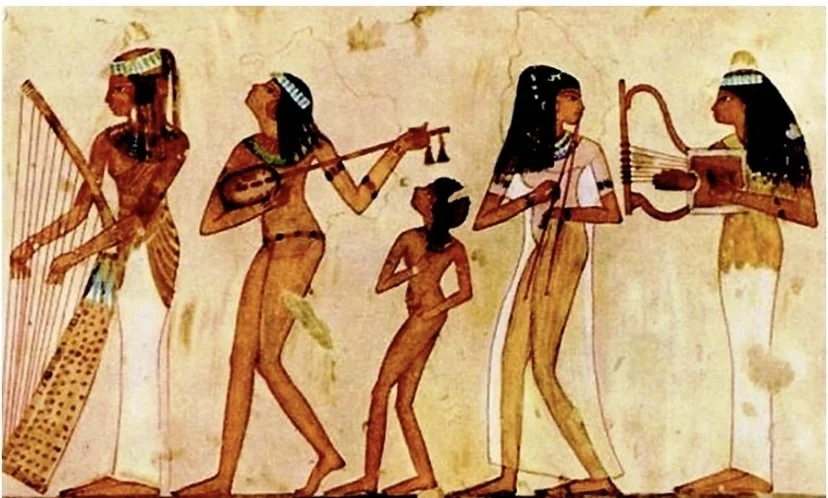
This is the conclusion from the last issue, which explored the roots of the piano as it evolved from ancient instruments. Along the way we have endeavored to utilize relevant historical references to set the contextual backdrop for the times in which these instruments appeared. In the last issue, we began to trace the "stringed' part of the modern day piano's design form to the harp in Ancient Kemet (Egypt). We established that the piano is essentially a "harp" horizontally secured in a wooden encasement. The strings are struck with "hammers" when wooden keys on a keyboard are struck or depressed. Historians do know the succession of keyboards, which preceded the piano, however, there is no clear documentation as to the origin of the keyboard portion of the piano's design form. In the last issue, we journeyed through history to examine the historical documentation on the origin and uses of the harp in Ancient Kemet. We also, un- expectantly, found discrepancies in the historical time-line with regards to Biblical documentation of the harp and the organ.
Let's examine the historical backdrop at the time of Kemet's demise as a sovereign world power and how music was probably affected. With the death of each of Kemet's great Pharaohs, the country became vulnerable to foreign invasion as the mourning period lasted a year and the people were without a strong leader. As a vast empire with cultural prominence throughout what later became known as Africa; Kemet now found itself in a rapidly changing world that was becoming increasingly hostile. The last great Kemetic Dynasty of Pharaoh Tarhaga (the 25th Dynasty from 717- 653 BC) ended in about 650 BC with an invasion and occupation by the Assyrians (who are now without a homeland living in Northern Iraq, North-western Iran, South-easten Turkey and North-eastern Syria). This occupation lasted 125 years or about 3 generations. In 525 BC the Persians under Cambyses expelled the Assyrians and took over the occupation of Kemet for almost two centuries. Their rule was so brutal that Kemetians reportedly prayed for a more compassionate conqueror if they could not have total liberation. This prayer was answered when the Greeks by way of Alexander, who, in about 332 BC, defeated and replaced the excessively cruel Persian rulers. Alexander's General Soter took on an African name and declared himself Ptolemy I, the first in a line of Greek Ptolemeic rulers. Kemet (now renamed Egypt by the Greeks) holds the distinction of being the only country in which the conquerors completely assimilated the culture, religion and language of the people who were conquered rather than the antithesis. This means the Kemetic culture and music was able to stay intact throughout its occupation by foreigners. It is commonly known that Greek mythology's gods and goddesses mirrored the Egyptians deities with precision. It was at this time that the great Greek philosophers "emerged". Prior to this Greeks had traveled just across the Mediterranean Sea to Ancient Kemet to study at the Temple of Waset (later called Thebes by the Greeks and Luxor by the Arabs). This was the location of the largest library known to man. It was also the location of the first clock tower. In his book, A Lost Tradition: African Portative Organ Philosophy in World History, (1995), Dr. Theophile Obenga states "the ancient Greeks traced all human inventions to the Egyptians, from Calculus, Geometry, Astronomy and Dice Games to Writing...Since the time of Homer, Egyptian antiquity functioned strictly as a highly memorialized component of Greek history. Herodotus said it, Plato confirmed it, and Aristotle never denied it." The Greeks (Pythagoras) are thusly credited with the "discovery" of musical modes. Greece, being the first European country, has no recorded history of music or musical instruments prior to its occupation of Kemet. Two of the Greek philosophers mentioned above each made commentaries on musical modes now called Greek modes. They stated that these modes (which musicians and music theorists use today) had distinct emotive qualities (as major modes sound happy and minor scales sound sad). Plato stated that the "Dorian mode is flexible and sounds sincere.... while the Ionian mode is relaxing...". Conversely, Aristotle said that "Dorian avoids extremes" and that "the Ionian mode makes people stupid". Clearly, these philosophers were observing and analyzing the music played by Kemetic musicians. Again, it is unclear as to whether or not Ancient Kemetians had developed a system of writing or if they had analyzed their own music, nevertheless it is clear that they had developed a system of modes and scales which, by today's musical standard, can be called advanced.
Concurrently, The Greek Byzantine Civilization flourished from 284 to 1453. By about the 13th century a small two octave organ called the portative organ appeared in Byzantine. This small pipe organ was placed on the lap, pumped with one hand and played with the other. This instrument was probably the very first keyboard instrument. The keyboard was comparable to a piano with large wooden keys but without accidental keys (now known as black keys). This instrument later appears in numerous paintings being played by angels. These paintings, created during the 1500's show the portative organ with smaller keys than the original instrument was reported to have in earlier description. No actual portative organ has survived. The original instrument bore a striking resemblance to another instrument existing in the Manding Empire. This Empire which rose to power also, early in the 13th century with the ascendance of its first king, Sunjata Keita. Certainly the rulers of the Greek Byzantine Empire were aware of the rising Manding Empire and no doubt had scouts or spies inside any empire that could have posed a potential threat. Such spies could easily double as procurers of cultural objects such as the dominant musical instrument of the Manding people. The instrument to which I refer is the Balafon (also spelled balaphone, balafone, and balafo; balan" refers to the instrument and "fô" means to play; balafon thus means "playing the balafon) which is constructed from "17" "21" rectangular wooden slats, arranged in an array from low to high notes.
The slats are generally made from béné wood, and are carefully dried over a low flame to achieve their sonorous resonance. The ends of each slat are burned black with an iron to seal them. The instrument builder tunes each slat by shaving its underbelly. Iwo rows of open calabashes positioned below the "keys" provide natural amplifiers for the balafon. This is the first known melodic percussion instrument from which the xylophone and marimba and the vibraphone was developed. Given the chronological window of exposure of the balafon to the dominating Greek Byzantine culture and its similarity to the portative organ in size, color, construction, is a plausible assumption that the former influenced the design form of the later.
The legend of balafon states, "Sunjata's chief adversary in this epic is Soumaoro Kante, the Sosso king, whose kingdom lay within the region we now call Guinea. Soumaoro was a sorcerer of fearsome power. He ruled with an iron hand, and kept tight controls on his people. As the story goes, spirits gave Soumaoro the first balaphone, and he kept it for his own pleasure. No one else dared play it. During his wars with Sunjata, Soumaoro managed to capture Sunjata's close friend and griot. As a prisoner in the Sosso king's home, the griot came upon the coveted balaphone, and ventured to play it. Though off on a hunting trip at the time, Soumoro instantly heard the sound and returned to confront the griot. But instead of killing him, Soumaoro found himself deeply moved by the griots performance and ceremoniously authorized him alone to play the magical instrument. Soumaoro dubbed the griot Bala Faséké - balaphone player and Faséké became the first public balaphonist. He continued to play at high ceremonies even after Soumaoro's defeat and the rise of Sunjata. After Faséké's death, the Kouyaté family, in what is now Guinea, became the official keepers of the original instrument, and there is an elaborate ritual for passing along the relic to the next "keeper" or Balatigui. The instrument has reportedly survived with only minor modifications."
A recent publication states, "A Manding balaphonists of recent years is Keletigui Diabaté. Keletigui began playing balaphone as a boy in his hometown of Kita, Mali, in the "1930"s. He went on to play many other instruments; including guitar, violin and banjo, but years later, he made his worldwide reputation with the balaphone. After all that experience with other styles of music, Keletigui was no longer satisfied with the traditional limitations of his instrument. His experience with the jazz vibraphonist Lionel Hampton gave him an idea, and some years back, Keletigui began playing two balafons at once, each tuned a half step away from the other. This, in effect, gave him the black keys on the piano, and so, the ability to play chromatic music, like jazz." This description of the tuning system of the balafon gives us the strongest clue of the link between the portative organ and the balafon: their similar 7 tone diatonic tuning systems. The portative organ combined the technical aspects of the flute (which had long been in existence in Kemet), as a wind instrument, with the keyboard type style of the balafon. While the balafon uses open gourds as resonators of sound while the size of the keys provide tonal variation, the portative organ uses a hand pump to generate sound as the depressed keys allowed the pumped air "blow" the "flutes" which were calibrated for the same relative tonality as the balafon.
Once the keyboard was established conceptually, the next logical stage in its 60 development involved finding a way to use the depressed key "technology" to sound the strings of the harp. We previously established the fact that the harp was the master polyphony instrument in Kemetic ensembles, so that all other instruments would tune to the harp. Another harp-like instrument that had also been mentioned in Biblical was the Psaltery. It was a small hand held instrument, which was played with a plectrum (a plucking device) held in one hand, and the strings damped by the other hand. The psaltery was also played flat on the lap of the musician. I purport that it was no coincidence that during the same century that the balafon appeared and evolved into the portative organ (late 1300s), a keyboard was added to the psaltery, at right angles to the soundboard in a manner similar to portative organs of the time. It remained a small hand- held instrument, which bore the Latin name, Clavicytherium and was referred1387 as "an instrument like an organ which sounds by means of strings". These instruments were still portable as, undoubtedly, influenced by the size tuning and octave range of the balafon. So, the next obvious stage of keyboard evolution must have necessitated the expansion of the keyboard to eventually accommodate the entire range of the harp. The system of black and white keys had to be developed to accommodate the five chromatic tones needed to complete the 12- tone system (represented in the 7 white keys plus 5 black keys). This was achieved with the Clavichord, which was a rectangular box with a keyboard set in one long side. The keys were actually levers with a fulcrum near the center. Depressing the end of a key raised the opposite end, where a small metal wedge or tangent would strike a metal string. The clavichord evolved into the harpsichord. The name gives credit to its relationship to the harp. The harpsichord is mechanistically similar to the clavichord except that when a key is depressed, it lifts a shim (called a jack) at its far end. Each jack contains a small plectrum, which literally plucks a string. Thus, harpsichords produce a "plucked" sound, distinct from both the clavichord's and the piano's more percussive "struck" quality.
The music of the harpsichord became the dominant choice for symphonic composers for about 300 years. It is an interesting fact the there are numerous J.S. Bach pieces played on piano today. However, Bach himself, never even saw or heard a piano. It was not created until 1700 by Bartholomew Cristofori, a harpsichord maker who lived in Florence, Italy. He called it Gravicembalo col Piano e Forte ( harpsichord with sweet and strong sounds). While the harpsichord's strings are plucked, the piano strings are struck by hammers. This allows the pianist to play with sensitivity due to a large dynamic range (loudness and softness). Early pianos were thus call Pianoforte or Fortepiano. (forte-loud, piano-soft in the Italian language).
Today most of our musical terminology comes from the Italian language. Historically this is interesting as the Romans had eventually overtaken Egypt from the Greeks before they themselves were conquered by the Arabs and Europe was plunged into the Dark Ages. During this so-called Dark Ages of Europe, Africa flourished with a myriad of Universities and cultural development until the subsequent resurgence of European dominance and the ensuing of the French, British and Dutch colonialism of Africa.
One cannot help but to wonder: What if Kemet and the rest of Africa had been allowed to evolve and flourish, musically, culturally, spiritually, intellectually without the barbaric intervention of outsiders?.. How much more intelligent, peaceful and spiritual would the societies of the world be?... and how much more functionally efficient would we be technologically? Considering the fact that a vast amount of our modern economic and legal systems, architecture, art, medicine, music, philosophy and "advanced" technology is directly derived from or inspired by Ancient Kemet, it would be safe to assume that we would have evolved light years beyond where we are now had this cultural "golden goose" survived. Kemet's treasures, knowledge and wisdom have been seized, bought, sold, exhibited, analyzed and often misinterpreted by those whose motives have ranged from genuine fascination to greed and/or the need for power and control over something that obviously possesses timeless intrinsic value. On the other hand, adaptation and integration of another culture can often inspire new innovation and evolution that may not have otherwise occurred. I would have to say that I am glad that the piano was created by its Italian inventor, and improved on by the Germans (Steinway) and the Japanese (Yamaha). Playing the piano is relaxing, inspiring and therapeutic. It has become the dominant musical instrument in Western society; particularly in the performance of Jazz, Classical and Popular music. Nevertheless, I cannot again hear the tone of the piano, without remembering its roots. Stay tuned and C# (see sharp).