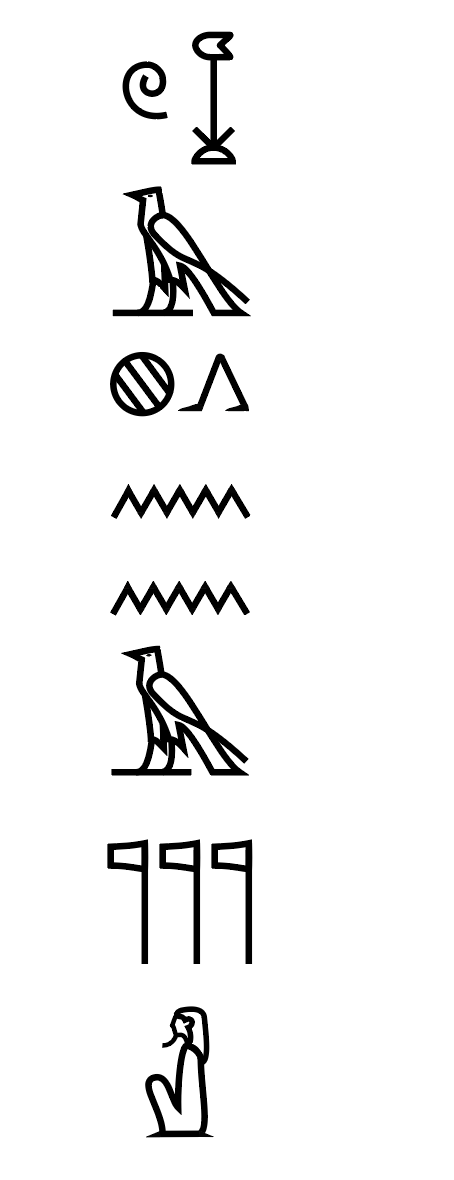
Ancestors and Us
In Search of the Gods: Ancestors and Us
Just look at them!... Even in traditional hospitality on the continent, what kind of a mother exposes her infant and herself to life-threatening danger in order to protect total strangers?...
Good things, good lives, good places, good neighbours, a good world... our attraction to these goods nudges us towards the world of the Gods, the perfect model for our world. This search is Earth- wide, and it is well known to be difficult. Now, rebel groups exist that oppose this search: (1) they promote barbaric pleasures; and (2) they demote devotion to our Ancestors. In this article we focus on just one assistive aspect of our Ancestors.
When we do not know the reason something happened, we can turn to a tradition that says “Think to find its history”. One advantage of thinking is that it leaves control of an individual’s destiny to that individual, as in self-control. Self-control protects an individual from control by individuals or groups which could be capricious.
When we do not know the history of something unfamiliar, we can also consult a rebel tradition that replaces self-control with remote control - control of you by other entities. When emotions, feelings, belief, faith, and “Amens” overrun the brain nowadays, we get the deafening “No-need-to-think. Just-believe. Have-faith. Listen-to-your-heart” advice that’s audible in every wind.
And yet... as one recent and wildly popular American presidential candidate told Faith Groups in Philadelphia, doubt and Faith are not separable, which is the reason we don’t call Faith science.
Humans already possess reliable methods for investigating our reality. When thinking doesn’t yield us a reliable explanation, the tradition advises us to examine our thinking and think better. To this day, rebel groups - like those we mentioned - continue to advise us to leap to faith in order to explain “extraordinary” happenings, those which Faith alone cannot explain.
Because science is designed to not exceed speculating (guessing, trying and erring), it calls “extraordinary” happenings, anomalies, coincidences or accidents. Partner rebel groups agree but baptise the same happenings “miracles or mysteries”. Both science and the religions of today promote these emotional responses instead of thinking.
There are no miracles or mysteries in the stories we are about to tell you. The underlying pattern is identical and observable way back into our collective past. And it is a pattern of Ancestors intervening in individual searches for the Gods.
CHICAGO
retold by Zaqhau Washhek
I moved from Abakwa in Meritah and settled in Chicago. One afternoon during lunch break I was walking back to work. Suddenly a pedestrian stopped me with a gun.
“Give me all your money! Now!”
Immediately, I said “Put that gun away or I’ll snatch it and shoot you so fast you won’t have time to regret!”
Still standing one step away, he shouted: “I jess told you - give me your money! Mother fucker!”
“Now listen to me. I won’t repeat. Put that gun away or I’ll seize it and shoot you so fast you ain’t gonna believe it.”
Strangely, he didn’t move. Just stood. One step away. Gun pointing at my chest. But... on his face, I saw a mix of surprise? fear? horror? regret? terror? Despair...
“What the fuck!” he shouted, but now he was shaking. Then he spun around and ran off.
He disappeared past pedestrians ahead on the sidewalk. I remained frozen, wondering. Why had there been no people near us? What had prompted me to threaten a man pointing a gun at me?
Above all, what had he seen while looking where I stood threatening to kill him, the one with the gun. Clearly, whatever he had seen stopped him by means only he experienced.
NEW YORK CITY
by Wawa Ngenge
After many years groping in American Universities, I headed back home, eager to see the village again, to eat fufu and njabnsv, and to visit the family and elders whom I had missed. Memories of palm wine and kola nut stirred in my mind.
Outside my hotel, I waved to catch a taxi to the airport. None stopped. I didn’t know to ask hotel staff to call me one. That is why passing pedestrians looked at me the way they did.
I waited a long time before a taxi slowed down and stopped. A woman in the back seat waved me in. After we exchanged greetings, no one spoke again until we reached the airport. I tried to pay the driver; the woman stopped me; and the driver nodded OK. So I said “Thank you” and headed for a check-in desk wondering whether I really was still in New York City, the capital of evil, where bad things happen to unwary travelers. But looking back at this incident, I recognise ancestral intervention.
ENUGU
by Kevin Cheo
I arrived at a bus stop in Enugu at about 4:30 pm after an eighteen-hour journey. I was exhausted and hungry and looked forward to a restful night before traveling to Ibadan.
I stood at a street corner and began hailing taxis to take me to the nearest motel or hotel. The first one pulled up but drove off after I told the driver where I was going. For over an hour, other cab drivers did the same thing.
The red glowing ball of the setting sun was steadily dropping into the West to soon disappear over the horizon, signaling nightfall and darkness. The thought of remaining stranded at a street corner in the dark in an unfamiliar city raised fears for my safety. Thoughts of food and sleep vanished from my mind.
After an eternity, another cab pulled up and the driver started to drive off as soon as I told him my destination. This time, to my surprise, a male passenger in the front seat asked the driver to stop. He turned toward me and asked me if I really wanted to go to a motel. I told him I just needed a place to spend the night. He then said, “If you don’t mind I shall put you up for the night”. I gladly accepted his offer and rode with him to his home.
Chris, my host, set me up in his guest room and started cooking us dinner while I washed. After dinner, we talked and got to know each other. From our conversation, I observed that he was a very refined and caring person.
Chris got up earlier the next morning and prepared breakfast before I woke up. After breakfast, he went to the bus terminal, paid my fare to Ibadan, and returned to say that my bus would soon arrive to pick me up. He said the fare to Ibadan would be higher if the ticket seller sensed that I was not a local resident. Soon enough a bus honked outside. Chris and I said our goodbyes and I was off to Ibadan.
LAGOS
by Kevin Cheo
I left Ibadan before sunrise and arrived at the US embassy in Lagos a little after 8 a.m. More than 300 people were already in line ahead of me also waiting to apply for entry visas. The embassy could attend to just 100 people per day. Feeling dejected, I started walking away to hail a taxi to the Ibadan bus station.
A moment later I noticed someone behind me who had also stood in line at the embassy. I did not pay much attention to him. He caught up and struck up a conversation. He said he had seen me at the embassy and knew I too had been turned away. I told him I had come from Ibadan that morning and that I was on my way to catch the bus back to Ibadan. He said I would not be able to make it in time from Ibadan, and offered to host me for the night. Not knowing him, I accepted his offer reluctantly.
We took a cab to his home; and he left me in the living room and ran upstairs. He soon returned with his parents, brothers and sisters behind him, all of them rushing down the stairs with great excitement. I was befuddled by the excitement. They stopped in front of me and with heightened excitement, one by one, they offered me the traditional Yoruba greetings. They behaved like a family receiving a long-lost member who made it back home.
Later that evening my friend knocked on my bedroom door and announced dinner. The entire family of eight or nine was waiting for me. Dinner was an elaborate spread befitting a special occasion, not an everyday dinner. The outpouring of joy and love to me, deeply touched and humbled me. They shared the same response next day as I was leaving for Ibadan. A bit muted as we knew we were separating again, but this time there was also present a hope to reunite lives forever.
They reminded me of an earlier gathering with my family the day before I left West Cameroon for North America. At that time, my uncle had said to me: “The ancestors will be with you at every step in every day of your life as they have been up to now. Keep your mind and heart pure; and there will be nothing to fear”. At the time he was speaking, I had no idea my Ancestors would assume physical forms.
IBADAN AND IFE
by Zaqhau Washhek & Kevin Cheo
We were travelling to Lagos one Saturday and met Samson on the bus. He said he was a second-year mathematics student at the University of Ife. He offered to show us around the university on Tuesday and - even better - to lodge us in a hotel that night in Ibadan.
It turned out to belong to his sister. After they finished talking in Yoruba, he dictated and we wrote down the name of his dormitory and his room number and he left, reminding us to meet him there three days later.
Samson’s sister carried an infant on her back like other village women throughout Meritah. We noted that she was highly refined. After showing us our room, she said good night.
I slept right through the night. In the morning, my friend said that he had got up in the night to urinate. When he opened our door he stumbled on a body lying across the entrance. It was Samson’s sister asleep on a mat with her infant in her arms.
What a bodyguard! we thought.... After we showered, Samson’s sister served us fried eggs, dodokido (aloco), bread, puff-puff and tea. She refused payment for our room and breakfast and wouldn’t accept a tip, saying her brother had paid for everything.
When goodbye time came, my friend gave her an envelope in which we had put four times our estimate of our costs. He said: “Mama, dis na small ting for your pikin (child). We tank wuna plenty.” This time, tradition required her to *not* refuse.
Early on Tuesday, we took a bus to Ife University campus and had memorable reunions with other people from our homes in Buea, Mamfe, Bamenda, Kumba, Nkor and other places in Adamawa province. We told them we were looking for Samson, a mathematics student there. We showed them his dormitory and room number.
They said they didn’t know him and hadn’t heard of him. Together we walked to his room, but the students living there said they did not know any Samson to be living in their dormitory. We did not know the road back to Samson’s sister’s hotel; so we could not find Samson through her.
Years and years later, we shrugged off the mud fence hotel, Samson, his Sister and her infant son whose hospitality protected us unforgettably one night in Yoruba land. Either this family did not exist, or our ancestors had temporarily “taken” their forms to safeguard us that night.
Just look at them!
Even in traditional hospitality on the continent, what kind of a mother exposes her infant and herself to danger in order to protect strangers?
Naba Lamoussa Morodenibig taught that the border between the visible and invisible worlds, between the living-on-this-side (us) and the living-on-the-other-side (our Ancestors) is not solid. It is porous like the border between two lumps in a soup, or the border between the albumin and the yolk in an egg. To find our Ancestors, we need to replace speculations about this border with traditional methods that are already known to just work.