
Life of a Kem
Life of a Kem
“Patience and time do more than strength and rage.”
This ancient wisdom embodies the response of many in- digenous cultures to the onslaught of the modern political and religious ideologies that have swept the world for over 2000 years. And so generations have come and gone and the stewards of indigenous wisdom have watched and waited as those who were eager to prove their superiority and their ability to lead the world have instead proven their ineptitude. As the people of the world have cried under the weight of the oppression and genocide, patience has been the response, not because the suffering of humanity and the destruction of nature is not significant, but because the survival of human wisdom and genius is paramount.
”If a donkey kicks you, what will you do, kick it back? You will be the one seen kicking a donkey!”
As the leaders of the modern world boast the superiority of their governments, sciences, religion, etc. indigenous leaders have smiled humbly while keeping the wisdom of their culture secret. Kemetic wisdom teaches that evil is the most powerful force. If you succeed in killing the devil, you just proved that you’re worse than him. So who is the devil? There can be no victory for the forces of good if the good must resort to the tactics of evil to achieve victory. Our elders, priests and kings have maintained their patience as the appropriate time to fight back had not yet arrived.
The Kemetic Holy Drama teaches that the forces of evil and destruction are represented by the God Seth while the forces of good and preservation are represented by the God Heru. Heru and Seth are locked in an eternal duel in which Heru seems to be outmatched in every way. Heru represents every human being, and like every human being, he is born into a world where the forces of evil have prepared for his arrival and laid all sorts of traps with the intention of destroying him or recruiting him to join their ranks. Heru is vulnerable against a foe that is both immortal and invincible while also being a master of disguise and deception. Against all these disadvantages, Heru has one advantage to level to battlefield: the ability to resurrect.
In a time when the forces of evil seem to hold every advantage, the people of the world desperately seek some relief. For hundreds of years, we have turned to our oppressors for protection, education, medicine, spirituality and even justice. All this time, seeing no alternative than to submit to the force that has dominated our parents and Ancestors, we have continued to serve them. We have even learned to take pride in our achievements within their religious, political, educational and business institutions that have always been symbols of our enslavement. It would seem that, after killing Heru’s father, Seth has succeeded in convincing Heru that he is now better off! How many of us have now turned our backs on the wisdom of our ancient forefathers to serve the ones who destroyed them?
Good must resurrect within humanity. Human beings must see ourselves as the resurrection of good in the world instead of making excuses for being less than our best. However, this requires that we understand what good is. If the ones now destroying the world have convinced themselves that they are serving some greater good, we must not take for granted that we know what good is. Humans must be taught the knowledge of good and evil or else how will we know?
It is in this context that the authorities of ancient spiritual knowledge in West Africa gave their permission for Prophet Naba Lamoussa Morodenibig to travel to the United States and open The Earth Center and the M’TAM School of Kemetic Philosophy and Spirituality. The work of Prophet Naba has given humanity a bridge to return to our original and most advanced traditions: Kemet (Ancient Egypt and Traditional Africa), humanity’s first global civilization. Propet Naba has reintroduced the culture of the Kem. A Kem is a Kemetic person. It must be understood that being a Kem is not the result of one’s place of birth, nor the ethnicity or nationality of one’s parents, nor a pledge of allegiance to a particular group, but the adherence to the Kemetic principles, the Requirements of Being a Kem.
It is by living according to these principles that humanity spent most of the last 100,000 years preserving the world. When the leaders of this modern world, meaning the Greco-Roman empires and their heirs in the Vatican, began their reign, they saw before them a world in good condition. The air, water and earth was clean. Human cultures were humble and civil towards each other. Humans functioned in harmony with nature and Gods. Amazing natural and man-made wonders could be found throughout the world. In the past 500 years, all this has been turned to ruin: poisoned waterways, polluted air and soil, frankenstein plants and animals, abandoned temples and monuments. What has the modern system brought us as an advancement that is not also linked to the destruction of the world?
The temples of Kemet have been made accessible once again because the time is right. We now have the opportunity to change the direction humanity is headed. Let’s keep in mind that all the strategies we’ve used until now have not worked. We only seem to be succeeding in digging ourselves deeper into a hole that will ultimately serve as our mass grave. However, considering the nature of the problems we are now facing, many seem skeptical that a solution can come from what is now considered antiquated. Ironically, if we knew what the solution should be, maybe we would have found it long ago;
“Patience and time do more than strength and rage.” We seem to be desperate for something or someone to fix our problems right away. We think our anger and passion in response to injustice and destruction will fuel us to victory. The reality is there is no magic pill that will cure humanity of our collective disease. We all want safety, stability, justice, good health, positiv- ity, etc. We want our society to provide these things for us, but our society is made up of humans, which means actually, we have to provide them for ourselves and each other. If we want all that can be considered good in humanity, but we aren’t producing it now, ap- parently we will have to learn how to do that before it will be possible.
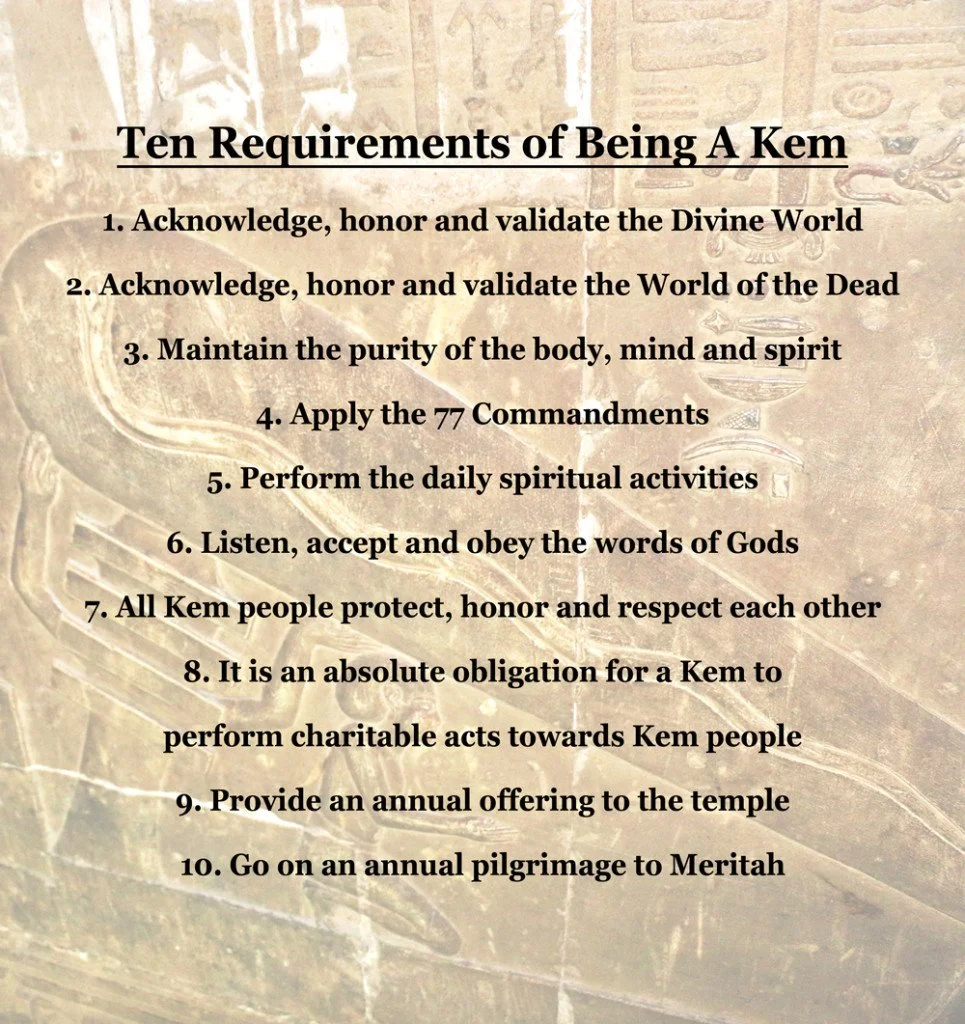
This is why Prophet Naba put education as his fo- cus. We will have to be taught how to be good, how to preserve life, etc. This is what the Requirements of a Kem are for. A human being needs guiding principles in life; if not, we can be led in any direction, as we can clearly see today. To become a Kem, one must make a commitment to be good based on Kemetic principles. Moveover, one must build the strength of character to maintain that goodness no matter what challenges, adversity or suffering one must endure. There are 10 requirements for being a Kem:
Acknowledge, honor and validate the Divine World.
Acknowledge, honor and validate the world of the dead.
Maintain the purity of the body, mind and spirit.
Apply the Seventy-seven Commandments.
Perform the daily spiritual activities.
Listen, accept, and follow the word of the Gods.
All Kem people protect, honor and respect each other.
It is an absolute obligation for a Kem to perform charitable acts towards Kem people.
Provide an annual offering to a temple.
Go on an annual pilgrimage to Meritah.
These requirements impose on the Kem a lifetime of rigors, but it is these very challenges that force us to evolve into bet- ter, more capable human beings. To support any human being seeking to be a part of the resurrection of good within humanity, The Earth Center has provided additional guidance for those who wish to become Kem but aren’t yet able to join the M’TAM initiation. Visit theearthcenter.org