The Path of the Sangoma
Our Mother’s Light: The Path of the Sangoma
The culture of Kemet is not confined to its capital, the Nile Valley, but actually encompasses all of the continent of Meritah (Africa), including Egypt, parts of Europe, Asia, the Americas and Australia. Within these regions, considering the aggressive nature of colonialism, it is still possible to find pieces, whether big or small, of the Kemetic culture embedded in the history of these lands. A huge aspect of Kemetic culture includes the acknowledgment and validation of the Divine and Ancestral realms, in addition to advancing our understanding of our roles as human beings within all that exists. Our human experiences within the Kemetic culture would include accessibility to traditional priests, healers, drummers, harvesters, etc., who all work together with the goal of preserving life. People who hold these titles possess an ability to communicate with the Ancestral and Divine realms for guidance on how to heal the sick. From the M’TAM priests in Western Meritah, to the Wu in Asia, to the Machi in South America, to the Sangoma in Southern Meritah, for example, we can observe many commonalities with their approach to healing. Although these names may not be the original names of the people in these regions, they all still agree that the Divine and Ancestral realms are extremely powerful and affect the realm of humans. As human beings, at some point in our lives, we all experience health challenges and sickness. Although some of our health challenges may stem from something as simple as changing our diet or environment, in more severe health cases, traditional healers give consideration to the the fact that there is often a spiritual issue associated with a person’s illness. In these cases, traditional healers and priests consult with Divinities and Ancestors for answers.
The healing practices of the sangoma (traditional healers in Southern Meritah) are very similar to the original Kemetic healing practices taught in the Nile Valley. Sangoma translates to, “from the drum”. Although some men have been involved, the sangoma are typically women, and they are well known for their ability to communicate with what is unseen by most humans, namely Divinities, Ancestors and other entities. Within this group lies the inyanga, the women who collect herbs and prepare recipes for healing purposes. These remedies can include one or more plants, parts/essence of animals and minerals from the Earth. These concoctions of healing herbs/materials are dictated by the Divine and Ancestral realms.
The sangoma, known as the ithwasa in this case, must go through an initiation process in order to receive the blessings of their Ancestors and Divinities, including the Ancestors and Divinities of the region in which they live. Ithwasa are chosen for initiation by experiencing a sickness themselves. According to their culture, when a person becomes very sick and can only be healed through the sangoma, by way of calling Ancestors to speak of a solution, this person has the destiny to become a sangoma herself. If she ignores her illness and does not seek the assistance of a sangoma, her illness will only worsen over time until she submits to what has now been revealed to be her destiny. The initiation process can take many years.
The first assignment within the initiation is to let go of one’s ego and embrace humility. For anyone of us walking a spiritual path, we will find that our ego issues, false pride and illusions that we harbour within ourselves are the first behaviors we must rid ourselves of. To have the idea that we know more than those who created this world, who created us, our spirit guides and human mentors is disrespectful and lacks the humility necessary in accessing the unseen world. The initiate must also experience water purification ceremonies, and bathe numerous times in spiritual herbs. Cleansing the body and mind are very necessary in order to become a healer.
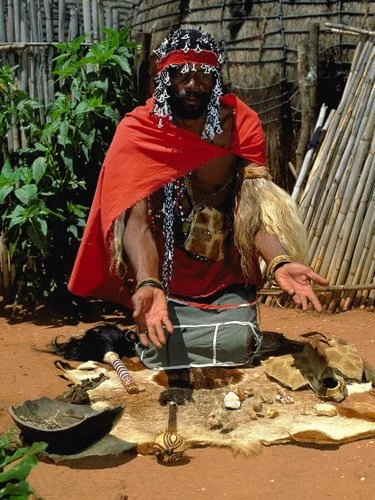
Once the ithwasa has completed initiation, a ceremony commences. This ceremony involves drumming, dancing, offerings to Divinities and Ancestors (including incense offerings), as well as invoking the Ancestors to speak and offer their blessings upon the newly initiated. During the animal offerings, the elder sangoma will hide the organs of these animals. The newly initiated will have to utilize their new “sight” given to them by Divinities, to find these organs. If they can prove their sight by finding and placing these organs into the hands of the sangoma who hid them, the initiate has completed the last step within her initiation in order to begin her work as a healer. This act signifies that they now have the guidance and support of the unseen world. This newly initiated sangoma must also take an oath, that she will only utilize her gift to do good and not to harm anyone or anything.
Dreams are another major connection between the seen and unseen worlds. A sangoma has the capability to dream of particular herbs that one may need for healing, or they may dream of the exact place in a person’s body where the sickness is stemming from. These dreams are influenced by the spiritual realm in order to communicate with the sangoma healer, and are also considered their “sight”. For verification, the sangoma will perform spiritual readings using animal bones, coins and shells. These healers call on the spirit guides for readings. These spirit guides communicate by positioning these special objects a particular way, once thrown in the air and landing on the ground. It is these professional healers who have the privilege of reading these selected objects which aid them in finding a solution to heal an individual from a sickness, misfortune, negativity, sorcery, etc. The sangoma are also responsible for performing offerings to assist with the energetic harmony within their tribes.
Sangoma are mostly respected for their ability to lend their bodies to Divinities and Ancestors. We can call this an “Ancestral calling” or “body borrowing”. First these spirits must find this particular woman’s body favorable, meaning, there is something about her character, energetically, that these spirits like, considering every Ancestor and Divinity has their own specific preferences. Although this practice has been demonized by modern religion and colonization, body borrowing can be an intriguing phenomenon, especially for those of us who were not raised in a culture that practices these traditions. For those of us who respect and honor the Ancestral spirits, we find ourselves in the most fortunate position, having the ability to get to the root of the blockages and sickness that exist within us and our family members. During a body borrowing ceremony, with the beat of the drums, Divinities and Ancestors communicate in their traditional tongues. They pinpoint spiritual problems and offer solutions that are necessary in bringing harmony and healing to a person’s life. Sometimes, in body borrowing ceremonies, a specific Ancestor of the person who is sick will present themselves to also provide solutions.
Those cultures, including the sangomas, who still practice their Ancestral traditions, are aware that the spirits of one’s Ancestors are extremely powerful when these Ancestors are properly taken care of. There is no such thing as having “Ancestors” if a person refuses to feed them and supply whatever it is that they request in order to strengthen them. If a person doesn’t take care of these types of important obligations, all this person has are “dead relatives”. Sickness and misfortune typically occur when the Ancestors or dead relatives are upset, and are not being acknowledged nor properly cared for. Unfortunate circumstances can manifest in one’s life because his/her Ancestors are trying to push them in the direction to seek spiritual guidance, which benefits both that person and their Ancestors.
Healing practices by the sangoma have been known to be extremely effective. Offerings to one’s Ancestors, including drumming and dance ceremonies with incense seem to be the most necessary in sangoma healing. The spirits must be appeased first, before the physical healing can begin. In addition to the spiritual aspects, the physical healing of the sangoma is very similar to what I have either witnessed or personally experienced with the M’TAM priests. The sangoma heals through administering herbs to drink as a tea, others to steam and inhale, while others still can be introduced to the body through tiny incisions. The herbs used for inhalation are boiled first, then poured into a big calabash and then the person and the calabash are covered with a blanket. It becomes steaming hot under this blanket, while the person sweats and inhales the herbs, the pores open, also allowing medicine into the body. There are also herbs which can induce vomiting, which rids the body of sickness and negativity. One healing method that is unfamiliar to me is their usage of porcupine quills. These quills are used to poke into a person’s arm in order to rid them of illness stemming from evil spirits inhabiting the body.
The sangoma have their own set of rules, like every tradition, regarding the usage and handling of the herbs. These rules are what some may consider superstitions, as many of us have been disconnected from our traditional knowledge and culture. However, anytime traditional healers are working and giving instructions, people must remember where these rules are actually coming from. Traditional healers never forget that the power of the herbs are guaranteed by the Divine realm and that every Divinity has their rules which preserve the power and potency of the herbs. For the sangoma, it is unfavorable for anyone to point their finger at the herbs, especially the sick, because the herb will then lose power. When the healed are ready to leave a sangoma, he/she must walk away and not look back until they have arrived to their next destination.
The sangoma, like many other traditional healing cultures, are continuing to fight for the preservation of this sacred knowledge. Nowadays, we can also find stories that attempt to condemn the original practices of the sangoma, however, every story deserves to be investigated. What we are witnessing, what we can see is a world preparing us for early deaths; dialysis centers are being constructed, new pharmaceutical drugs being tested, additional hospitals being built. What is this world planning for us?? Could the construction of more medical institutions be a clue that modern medicine actually does not have cures for our ailments and does not plan to? Since there are so many illnesses plaguing the world, both natural and manmade, natural healing is worth researching. Natural healing is not accompanied by negative side effects and possible death like pharmaceutical drugs. The effectiveness of the healing wisdom of our Ancestors who survived in a natural environment does not deserve to be overlooked.
Spiritual healing is a very big aspect of all traditional cultures, though there may be some variations. It is impossible to separate ourselves from nature because we depend on nature for our survival. It is impossible to separate ourselves from the Divine realm, as this realm is responsible for creating everything that exists, even humanity. It is impossible to separate ourselves from our Ancestors or dead relatives because we share the same blood. Spirituality exists and the sangoma, like other traditional healers, are just servants to the calling of the Divine and Ancestral realms. These realms favor order, harmony and balance. And the sangoma, by way of their practices in honoring and validating Divinities and Ancestors, reveal that they do not forget where life comes from or where to find the answers to assist in preserving it.