Readers & Healers in Mboq Tang
In Search of the Gods: Readers & Healers in Mboq Tang
In healing today a colonial agenda keeps in place the widespread belief that physical work is enough to return a person from a state of imbalance (insufficient health) to a state of balance (health). So it is fitting that its practitioners call themselves physicians, and they limit diagnoses to looking for what to add or remove from the body of the person who is in a state of imbalance. Isn’t it interesting that in order to accept this view, we must overlook two contradictions? (I) Many well known drugs do not reverse imbalances, and (II) many of these drugs that fail also leave patients with “side effects” or “adverse effects” which expose such medicines as poisons. Continuing to use these poisons shows inexperience with diagnostic and the healing phases of rebalancing a client. Below, I shall discuss the healing practises of the Wimbum people of Mboq Tang in Meritah in order to bring out the nonphysical component that is missing in colonial medical practises but that has remained a standard feature of traditional healing, our world’s medical authority.
In the Wimbum view, imbalances tell the priests to diagnose the nonphysical dimension/side of the entity to be balanced/healed. That diagnosis is called sehng (plural psehng) and performed by nweh sehng or nweh psehng (both singular). Sehng is the component missing in societies overwhelmed by side effects and adverse effects. In Mboq Tang, the community relies on sehng for a guarantee to the priest who performs the healing work that the healing will succeed. This guarantee is critically important in Mboq Tang because, if the patient is not healed (cured), he does not pay the healer. Before I continue, here is some background of Mboq Tang.
Geography - Mboq Tang lies in the savannah regions of central Meritah. The name means the valley of Tang. It is surrounded by a ring of mountains around a vast, flat and perennially fertile floor. From the time our ancestors arrived there, they reserved the plain for farms and the stony mountain ring for housing. But beginning in the 1960s, my parents’ generation started the transfer of houses onto their farming plots on the plain. Their thinking was that it was good to show off Mboq Tang’s prosperity along the new motor road that the colonial authorities had built across their farm lands to connect the valley to nearby towns and villages on the surrounding mountains.
History - The people of Mboq Tang are part of the Wimbum people and speak Limbum, which is said to be a Tikar language. Tikars are speakers of closely related languages originating somewhere in the Chad basin generations ago in a place most call Tikari and some call Kimi. During the Arab invasion, Usman dan Fodio’s troops pushed Tikars away from the sahel belt into the savannah regions where we are located today, between Chad and the tropical belt on the Bight of Biafra on the Atlantic sea. The fleeing Tikars displaced residents who sometimes were other Tikars who had got there first. That is what happened when the ancestors of Mboq Tang arrived and displaced the Bum people. Battles for the mboq (valley) had been fought using juju (super technologies based on super-science). Tang’s group eventually won and the Bum moved to settle in Bum south of the valley that was renamed Mboq Tang. Bum and Mboq Tang are peaceful neighbours speaking the same language they had always shared - Limbum.
It is here that Tang settled his daughter Ntalaq and his five sons Du, Jaq, Ndeq, Njong, and Yabei. Their clans are named after them like this: Bei Yabei, Bei Ndeq, Bei Du, Bei Jaq, Bei Njong, and Bei Ntala, “bei” meaning people. In each clan descendants identify themselves by their paternal families. Thus, in the Yabei clan, the children of Ndunduq call themselves “Bo’o Ndunduq” meaning children of Ndunduq. There is some confusion here in Mboq Tang as some say that Tang’s kingdom is matriarchal. However, there is no disagreement that the name “Ndunduq” means the husband of Nduq, who must have been a remarkable woman, but her descendants are named after her (unnamed!) husband. I am his descendant, a mondunduq and no one would call me a monduq.
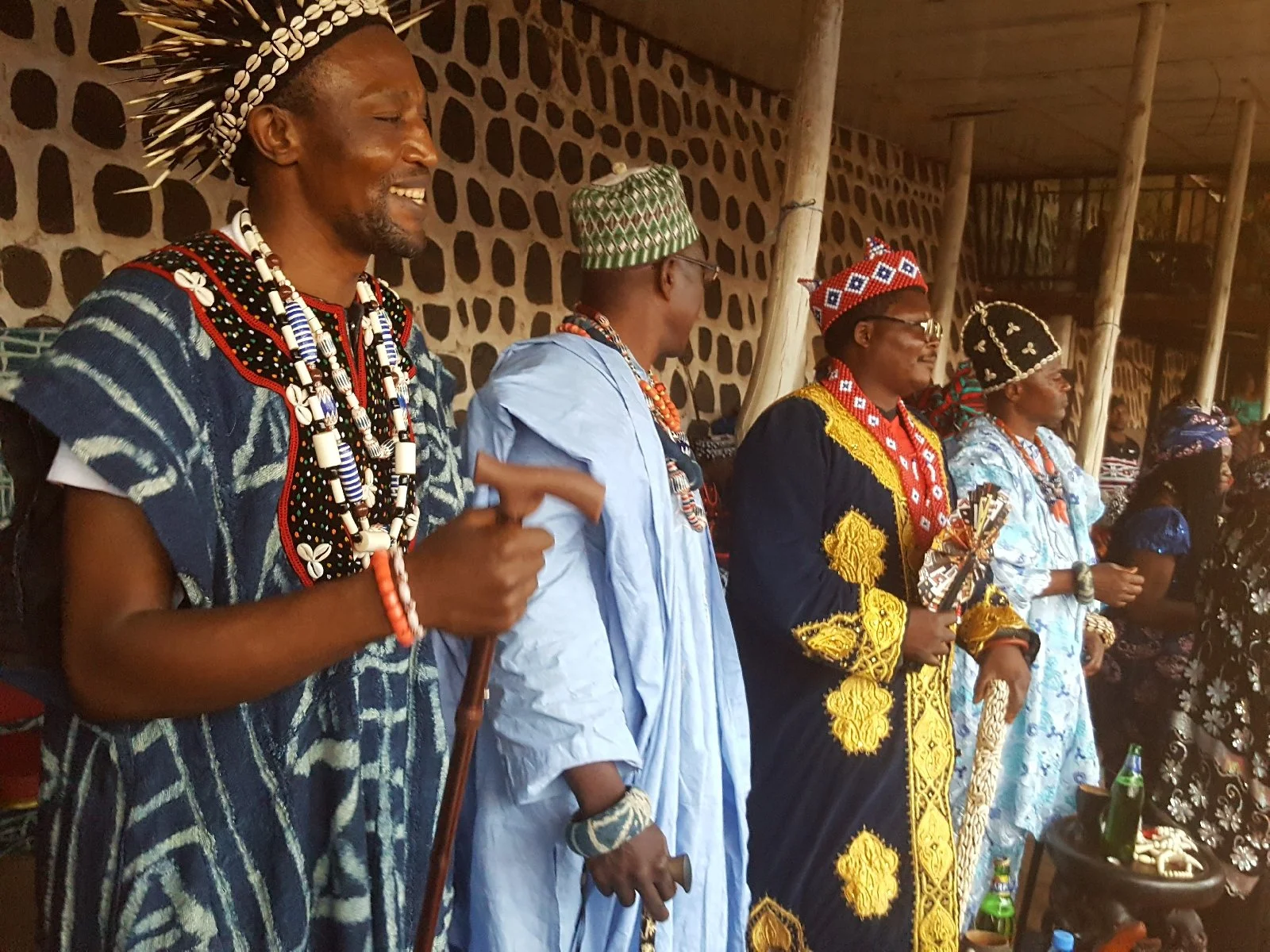
Psehng - To continue with Readers and Healers, I need to introduce some terms. Li means language as in Limbum (the language of Wimbum or Mbum people). Sehng means the collection of energies priests read (much like Bayuali in the pages of this magazine). The plural psehng means the repeated acts of reading world energies. Now, Sehng is also a verb that means “to read world energies” as in statements like Sei du sehng sehng ku’u msaq che nah meaning “Let’s go and read world energies about this dispute”. A sehng priest is called nweh sehng. Many who can also read these energies are called nga tfvq instead because their goal is to destroy or to help their clients destroy something or someone. Wimbum readers say they are reading worlds because they read (consult) specific regions of the earth and space (energies) that change according to the problems they wish to resolve.
World View - In Limbum, learning, seeing, being well all represent the concept of receiving good things from the universe through the Ancestors. The Wimbum world view is one we share with others across Meritah. There is the physical world (where you are reading these words) and there are the worlds of the Ancestors, of the deities, of the Gods, and of nonphysical entities who affect us because our energies connect us with them. Before undertaking any important project, we Wimbum consult all affected entities through the sehng. And for that, our tools are Nga psehng, priest-engineers who know how to explore both physical and nonphysical worlds. Now, nga psehng are opposed by nga twvq who also know how to read energies and explore the same worlds, but their purpose is to harm or destroy people in the physical world. Nga tvq are the reason Wimbum get mchep (protective juju).
Colonial conditioning has produced some Wimbum who pose as sceptics during the day only to be seen at night going to consult psehng priests for assistance with problems they cannot take anywhere else in the colonial world. Most Wimbum I know take it for granted that all Wimbum already have some protection against the destructive nga twvq. We who cannot read the energies of the worlds resort to psehng priests to expose nga twvq so that the entire village will know them, distance them from their human targets, and protect those targets.
The Wimbum mindset (paradigm) views staying alive as an act of exchanging nonphysical energies. These exchanges connect us to everything else in the existence. When difficulties block our paths, even city dwellers head for the nearest nweh psengh to reconnect with the nonphysical world in order to clear up the difficulties and regain balance. In the bush, our go-between is the psehng priest.
When Wimbum go to the shrines of their Ancestors, they take the same steps. The first step is to consult a sehng reader who will interrogate the worlds. Priests do this by various methods - casting kola nut shells, cowrie shells, or other objects. Then they observe the objects for information which their training enables them to read. Some castings give either no answers or unintelligible answers. So the priests cast again, stopping to ponder the answers, report an answer, or sometimes report a question. Then the priest may throw again and again and perhaps again before reporting any answer.
At other times priests read the necessary information right from the air! At yet other times, instead of casting any objects, priests offer chickens, pigeons, goats or other animals to the Ancestors. Again they observe how the animal behaves during the moments after it is slaughtered - its struggles and the way in which it finally lies dead. From those observations priests get information and use it to advise the client who requested the reading. Priests can also get information from the sand or dust. They write in patterns in the sand that generate a result which they stack to one side. They eventually pass the stack through other processes until they get the answer that resolves the issues. These answers may come in Limbum or in a language only the reader understands. Even when answers come in Limbum, non-readers may not be able to understand them, usually because of the advance proverbs in which the answers may be encapsulated.
Read or Heal - The Wimbum separate the tasks of reading and resolving energetic imbalances that affect an entire family or the whole village from those of healing physical ailments in individuals or the community. So when a person brings a serious personal physical health problem to a healer, the healer will send that person to a reader. The person will bring back the reader’s reading (findings) and the healer will use that information to identify the specific nature of the physical ailment that needs to be healed and the method and tools to use in the healing process. The understanding here is that the reader already reestablished balance in the world energies, without which physical healing is not possible.
If a person who suffers from a physical ailment approaches a reader first, the reader will limit himself or herself to giving just the reading (findings and possibly prescription) and may also point the person towards a specific healer or just ask them to see any healer of their choice. I have not heard a reliable explanation for this separation of reading and balancing world energies (done by nga psehng) and healing of physical ailments (done by nga mchep) when the goal is to heal an individual.
When the goal to rebalance an entity larger than an individual (like a village or clan), readers and healers are not rigidly separated, and the sehng priest may also perform the mchep priest’s role.