The Initiation of Heru
The Pilgrim’s Walking Stick: The Initiation of Heru
he Holy Drama gives insight to every aspect of the human experience. This holy text presents an account of the first Divine human beings - the first two human couples: Wsr and Aishat (Osiris and Isis) and Seth and Nebfest (Typhon and Nephtys). These original human couples help us to understand the nature of Divinity in a context that fits our human consciousness. It has provided the model to human civilization that our Ancestors mimicked as they laid the foundation for our society. The Holy Drama is made up of many chapters, and it has been preserved in Africa’s temple initiations or “mystery schools” for millennia. In the chapter presenting Heru’s (or Horus, the God-Son of Wsr and Aishat) initiation, there is a lot to learn, not only concerning the education of a human being, but also the mission or reason that he/she is educated.
Every human being is born weak, just as the original God-Son Heru, our Divine Ancestor before us. We are totally dependent on our surroundings. To put it plainly, we are a victim to our surroundings, we will learn what they bring us, and suffer when they wish to sting us. To compensate for such weakness, such human vulnerability -- our Ancestors have built societies. Our societies represent formal institutions, which provide individuals with a context to gain the education, support and blessings of the cultural traditions that have preceded him/her. These traditions have hopefully proven themselves by maintaining society’s members.
Today, unfortunately, society seems to eat its young and yet we still blindly hand over our offspring. But before us, and around the world, we can see the offshoots of Kemetic culture with the social customs that have developed out of this understanding which aim us even unknowingly towards approaching the World of the Gods. Individuals will be educated into their responsibility to themselves that extends out to their people and planet. Every adult living up to that responsibility will therefore be obliged to see every child as their own. Every success becomes a success for the culture and the culture is strengthened and better prepared to receive the next child.
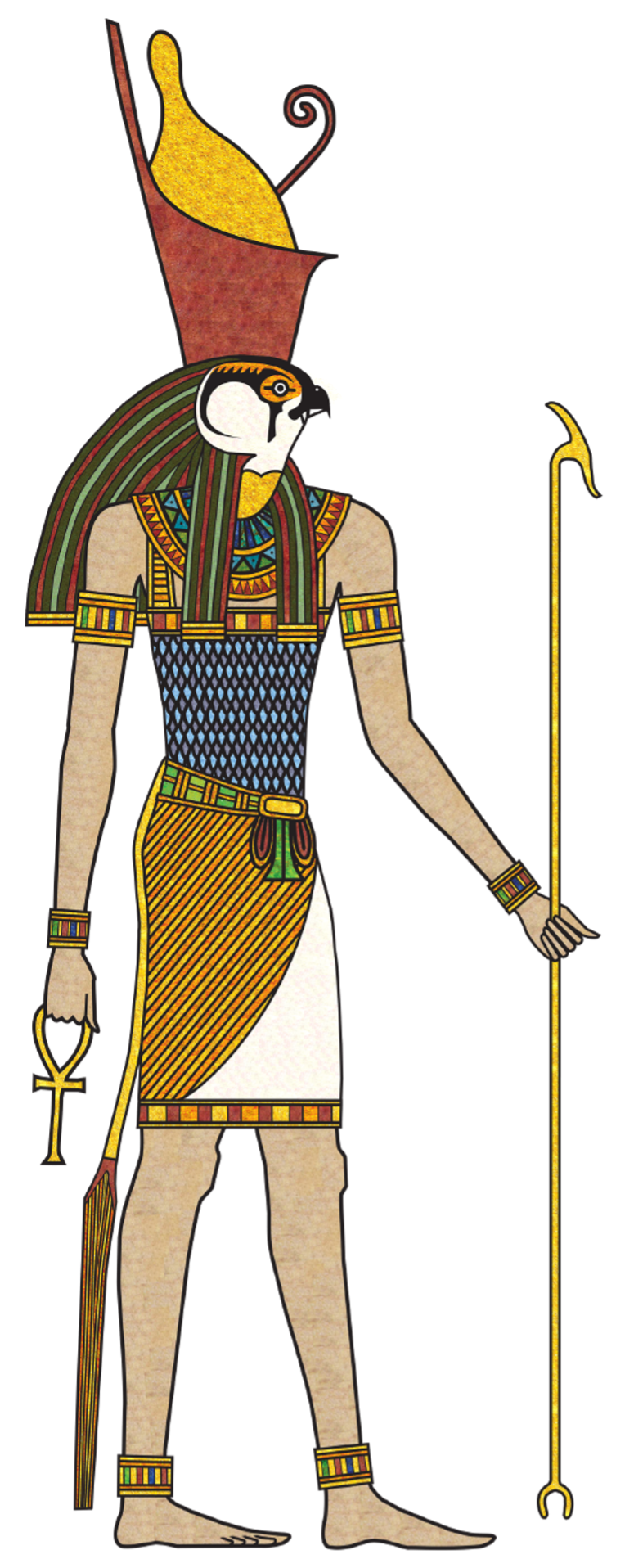
Like Heru, every human being who arrives to Earth has a pre-existing mission and place that awaits him/her. The individual in life is a part of a bigger whole and his/her initiation is actually an initiation into life, a doorway through which he enters/exits to that mission.
In the story of Heru’s initiation, before the God-Father Wsr can give his final blessing to his son Heru, He must test the knowledge that Heru has accumulated in his young life. This test, in the form of questions, serves as the door or portal through which He enters the true cultural legacy or heritage of his Father. Therefore the quality of the upbringing and exposure that Heru has received from his mothers is key to his success. Consequently, a process that has been designated by the Ancestors to ensure that a human being has a proper perspective of the world and their place within it is necessary before the culture can stand behind him/her totally, and give him/her its final blessings.
The first question Wsr asks the God Son Heru is “What is the most important mission the human has in life?” In Heru’s case his mission is clear: to avenge the evil that has been done against his father, to clean the insults that have been thrown on his father. Heru did not ask to be born. He has found himself in life born to a dead father and a widowed mother who are already fighting a battle, fighting to achieve a certain aim. Wsr has chosen to perpetuate life. He has chosen to produce descendants and live his mission through those children. In doing so, he must serve and strengthen his community. For if he does, he ensures the environment to which his descendants are raised and educated in supports them in being successful within the mission he has chosen for himself. For in that mission, they must work to improve their quality in order to preserve their history, future and the environment in which they live and return to. In receiving this heritage, this identity, HERU already is placed on this path.
His main focus then becomes not stepping off the path of avenging his father. From birth, he will be under attack from the God Seth who will try to distract him from his mission through cunning and deception. If he can remain focused and not be led into fighting Seth’s battles instead of his own, he will be guided to continue cleanly down the path already set for him, a path on which really he has no choice but to persist.
Kem (adherents of the Kemetic spiritual system from which the Holy Drama comes) must widen the perspective of the self to go past simply the physical body of the individual. If we realize that the perspective of the self has no boundaries, we not only see the connection that Wsr has given us to all life on the planet, but also to all life that has existed before us in the cycle of life that is descending from the God Wsr. We are the physical manifestation of our bloodline, if we represent our bloodline and Ancestry into antiquity, we must know that we have already identified our mission, our current mission in our physical life is to clean the evil that we have accumulated through our greater existence and in doing so push our collective mission forward.
To strengthen the heritage Heru embodies, he must be confident. And as is said in Kemet, confidence comes with doing the right thing. He must stand tall sure of his identity and the life/mission he has received from his father and mother. His father was in a battle with Seth. For Wsr, the battle is not one that exists on the battlefield. It is one that exists within the self. The only times that Seth and Wsr even meet in the Holy Drama was when Wsr was shut into the coffin and when his body was removed and he was cut into pieces. Yet, Wsr was still successful in perpetuating life and being good. Even his apparent loss in the first battle was a victory considering that he didn’t fall to suspicion, judgement or impurity. For Wsr had ensured his success through his behavior and the service he put himself in around the world. All of those whom he served saw the value of his life and would therefore work hard for his mission to be completed. His wife and the Byblos Royalty are a few examples.
To the second question, “What animal would you like to take into battle?” Heru responds a horse. On a horse Heru can stand tall and confident because he knows he has put the necessary work into the battle inside. Confidence comes from doing the right thing. Outside of himself, if he has done what is necessary inside, he will only be dispersing his defeated enemies. Therefore his power is all dependent on himself if his education is secure. If he knows that he had received a strong foundation from his mother’s and the legacy of his father, he knows that it is only he who can defeat himself.
His victory will depend on his consistent fortification of his connection to his Ancestral legacy and the heritage coming from his father. This heritage includes the First Trinity of Gods, the Divine Elements and his parents (Wsr and Aishat), in other words his origins. However his legacy is unseen, it is a spiritual legacy and the rules that he has been given to fit appropriately into that legacy is represented by the Book of Divine Ordinances. The Ancestors he owes his life to, he acknowledges and reconnects with in the ritual of daily spiritual activity. By renewing his commitment to them daily, he will ensure his success and resist the world’s distractions. His father knows that his knowledge of this is all he needs. It will now only depend on Heru, to follow through with the knowledge that he knows, to uphold these obligations that Wsr is now positive of his knowledge.
The initiate of M’TAM is in a similar position. The strength of the Ancestral education that the Prophet Neb Naba has brought to the children of the diaspora by the end of the first year is enough. If we have made it through overcoming the trials and tests that the first year of M’TAM initiation revealed we are clear on what is expected of us. We are clear on where we fit in the existence and that who we are is much greater than our physical boundaries, but our legacy reaches into the past as far as this very story. Our success in the internal battle that we are fighting will depend on our ability to remain spiritually and intellectually honest, and our discipline to always remember that that is where our only true battle exists.