The Origins of Dance Part II
Benben: The Origins of Dance Part II
The traditional or spiritual principles that lay the foundation for dance have become somewhat of a sensitive topic in the modern world. This is because if we take the time to investigate humanity’s history, we cannot ignore the fact that the purpose of dance doesn’t surround physicality, trends or the empty amusement encouraged by the world today. What becomes a very important aspect to consider is that if we aren’t provided a foundational knowledge of where our values and understandings of everyday influences come from, we remain limited in how we interact with the world we perceive around us. And if this knowledge doesn’t come from our culture, it is no longer our culture that is defining who we are. If our reservation for this topic stems from what our colonizer has labeled to be, ‘evil’ or ‘taboo’, then we have surrendered our system of survival to serve a system that has made the tireless effort to omit spirituality from our lives for centuries.
We began to uncover the reality behind the principals involved with dance from a spiritual perspective and the contrast to how dance is approached in the modern world. Within traditional societies, dance is not a profession, but an integral part of how a society functions and honors their Ancestors and Deities. In our last discussion, we began to realize how seeking to perform or participate in any form of traditional dance here in this [modern] society can only be done from an outside perspective because those who teach their dances from home know how to protect everything that comes with it. This is because the meaning behind dance and its various movements are introduced within the process of initiation. Every village has a dance that identifies them. Within these dances the nature and disposition of a people are expressed and communicated to the existence.
Depending on the ceremony, the dances may vary. There are many types of dances in a variety of different cultures/tribes across the world. In a traditional context, each ceremony is often accompanied with dance as a form of acknowledgement or celebration. Spiritual harmony and recognition of the order in existence is at the root of any ceremony. The context for dance involves a spiritual transition or transformation that takes place throughout our lives. From birth to death a human being shifts from one level to the next, along the way indicating to Ancestors and the Divine World each step that is made in his or her lifetime. These passages into various arenas of our life include initiation, weddings, death and a variety of spiritual works or gather- ings to express gratitude for the influence Ancestors and the Divine World have on our lives. There are also collective celebrations such as full moon ceremonies, honoring guests, greeting neighboring villages, and the list goes on. There are even dances that are reserved for various generations.
Dances that are done by children have a different nature than those done by adults or elders. For example, in some Wolof cultures, when everyone gathers together to dance Sabar, after the drums establish a rhythm, the elders will come before the youth and dance Yaba, which is a slower rhythm. Afterwards it is usually followed by Kaolak (a dance named after the city), which is slightly more up beat and then Theibou Jiene (name shared by the national dish of Senegal), which is much faster and typically dominated by the youth or the younger generations.
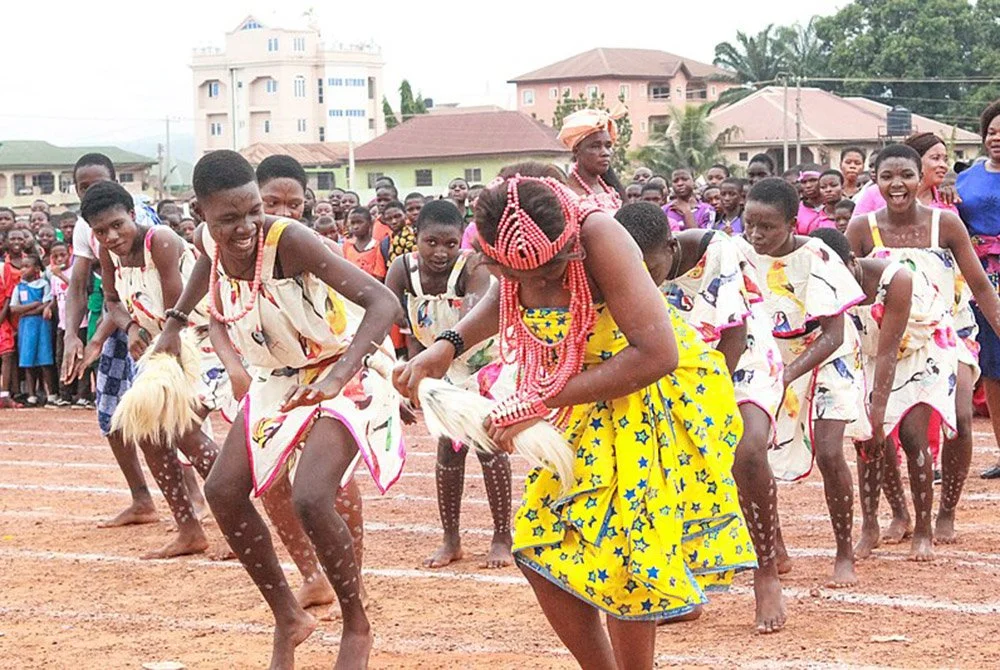
Contrary to social propaganda, many of the tribes throughout the continent of Meritah have maintained their integrity by preserving their initiations and spiritual nomes. Several individuals have made a living by displaying the dances from their tribes and various traditional ceremonies on stages, touring throughout the world. Several styles of dance have been made popular throughout the years ever since the National Ballets of Senegal and Guinea started their international tours in the late 60’s and continued throughout the later part of the century. In this context of entertainment, one isn’t able to truly perceive (in just observing or taking a dance class) the true essence of what the individual is carrying as they teach or express themselves in their dance. These dances go far beyond the steps that are taught in class. Even those who come to teach it for a living can’t provide the authentic experience that comes with embodying every aspect of the culture. The principles of spirituality or the value of one’s culture isn’t something that can be educated or understood in a 2-hour dance class or a 45-minute performance. However, there are some teachers who do emphasize the importance of returning home and share more of the cultural values and perspectives when teaching particular rhythms, songs and dances.
Mouminatou “Moumi” Camara, a Fulani dancer, originally from Guinea and the director and founder of Seewa African Dance Company in New York is well known in the dance community. After performing around the world as a principal dancer with Les Ballet Africans, she established her own company in 2005. Aside from being known for having a very unique and energetic style and technique, she also makes a habit of ensuring that those who come to take class have an understanding of the history and purpose of each style. “People come (to dance) for fun, most people come for story. We don’t do (it) for fun. Not only in Guinea, everywhere. Every dance means something, baby shower, wedding, initiation...” In a society where much of our time and effort is spent seeking fun and amusement, it is refreshing to come across teachers like this who still discuss and display the value of traditional ceremonies.
Marie Basse Wiles, artistic director of the largest and longest lasting African Dance Company in the U.S., co-founded Maimouna Keita Dance Company in 1983. She is well known for the annual conferences that she hosts during the spring in NYC, cooperated by local and international master dancers and drummers from West Africa. She is one of the few people since the National African Ballets stopped touring to put the ballets on stage recently. These ballets are a depiction of stories or events from traditional history through dance and music on stage. For example, one might observe in a ‘ballet’ all the various dances that are done to pay homage before or after a ceremonial event such as weddings, harvest, initiation/rites of passage, etc.. Her most recent produc- tion was a performance highlighting a segment of the life of Sundiata Keita, a king of the Malian Empire. Originally from Dakar, Marie Basse’s roots stem from Mali, as do most people coming from the region of Senegal and Gambia. She is one of the few who also make it a point to let people understand that these dances are coming from somewhere and the people, their culture, their food, clothing, values are all encompassed in their dance. She’s considered an elder in the African Dance community with the most experience doing the work she is doing in this part of the world: over 25 years. With over 25 years experience of work in this part of the world, she is considered an elder in the African Dance community.
Some teachers/choreographers such as Malang Bayo (Senegal) and Youssef Koumbassa (Guinea), who traveled to the U.S. to make a living teaching dance, put more focus on bringing their students back home to their villages by organizing cultural tours that allow students a first hand experience of what it is like not only to live, but also to learn in the environment of the culture these dances represent.
Initiation ceremonies are regarded very highly in traditional cultures around the continent. From an early age, children leave their compounds and travel deep into the bush or forest to learn all the skills and knowledge they will need in order to survive and fulfill their destinies as men or women in the world. Children will often leave their homes and families for long periods of time, and upon their return, are reintroduced to their society, no longer as children, but as young men and women. Among the Baga people (Fulani tribe in Guinea), initiation dances are done for young girls who have completed their initiation process and return to their families in the village. These dances are done with masks and symbolize protection as the children return home.
One of many ceremonies that are/is celebrated with dance in various tribes is the occasion of marriage, it is very significant for not just the individuals getting married, but for the whole village and for the bloodlines of both families. Marriage signifies the unification of families before the Ancestors and Deities of the families and of the village, affirming that both families are in support of this union and the future children to come. With all of the families, elders and community present, and after all of the necessary offerings and spiritual works are complete, the drums are played and the dancing commences. In some Fula tribes, such as the Toucouleur, the married couple sits as the whole village dances for them in commemoration of the union, then the couple dances afterward.
In the Maane and Susu tribes throughout Guinea, the night before the wedding ceremonies take place, it is tradition to dance a style known as Nyoqui. Nyoqui, in the Susu language, is a kind of bird that is emulated in the technique of this particular style by extending the arms and body very elegantly. There are slower and faster steps within the rhythm that is produced by a combination of the Balafone (the traditional instrument that inspired the xylophone), Bote’ (a traditional drum that is closed at the bottom with an attached bell) and the krin (pronounced ‘kreen’ is an instrument made of wood with carved slats at the top to produce variation in sound). This rhythm is danced as a commemoration of good luck and success for the marriage and the union of families.
Another commonly celebrated event is the occurrence of a full moon. The full moon is recognized as an energetically significant and spiritually favorable occasion and accompanied by a wide variety of dance styles in many different tribes. It is also the brightest night during the period and in the Meritahan bush the moon illuminates everything. That is why, on these occasions, among the Fula tribes throughout Guinea, the village gathers, dressed in their finest attire and court one another with the dances Yankdi and Makuru. Women, adorned with scarves with which they playfully use to indicate their love interest, dance Yankadi. The dancers of this technique exude femininity and grace. Afterwards, the couples come together to dance Makuru, an up tempo rhythm accompanied by quicker movements and turns and played by the Djembe.
The Mandinka or Malinke people have even made their influence throughout the dance communities in America sharing their djembe styles such as Lamba, coming from the Malian Empire, that include styles such as Yado, Djinefole and several others. Lamba celebrates many stages of life and survival including the harvest, weddings, initiation, and births and for greeting royalty. Lamba is one of the dance styles of Griots or storytellers. One of the beautiful characteristics of this dance is the attire; it is performed in a grand bubu (traditional attire), with extensive jewelry, especially gold bracelets adorning the wrists and arms. In traditional Kemetic culture, gold symbolizes a rather spiritual significance as opposed to a material one. It represents the body of a God, and when worn during ceremonies that involve these dances, it acknowledges our validation of the Divine World. This is one way to appeal to or invite the presence of pure entities during these ceremonies.
Nowadays these dances are also done as greetings on occasions that don’t involve a spiritual context, and in America they have been made popular by their hypnotic rhythms. In traditional societies, dance is not a profession, but an integral part of how a society functions and honors their Ancestors and Deities. It is the Divine World that opened humanity’s eyes to the reality of where we fit in relation to them. According to Kemetic spirituality and history, it is this reality that inspired human beings to evolve towards the Divine World with the goal of becoming as close to them as we possibly can. Through dance, human be- ings have the opportunity to become the direct channel through which pure entities can express themselves. In the case of Deities, each has a dance and a rhythm with which they express themselves and it is through these dances humans can identify them as well. When the rhythms and dances are combined, it creates an environment for deities to interact through taking or “possessing” the body of an individual for a period of time. During this time they can communicate, provide guidance, give counsel and much more. In the traditions, these ceremonies are very sacred and protected within the societies that continue to preserve the authenticity of their spiritual initiations. In the colonial world, detached from spiritual values, ceremonies like these are widely misunderstood and ignorantly speculated against. The thought of being inhabited by someone or something other than the person we identify when we look in the mirror is a terrorizing thought. Yet, in the realm of Kemetic spirituality we continually strive towards spiritual evolution, each day seeking to refine our position within the harmony of nature. This involves understanding the power of nature and the influence it has on the life and destiny of a human being. In traditional ceremonies such as these, it is an honor and privilege to be amongst the presence of pure entities and divine beings. It is only proof of how integrated the various dimensions of existence truly are and how our confining our colonized perspective of nature has become over the centuries.