
The Burial of Maakheru
It seemed fitting that our arrival in Ouagadougou was accompanied by rain. My elders, Nehez Meniooh and Marwho Hasati, and my brother Baashu and I had started out a couple of days before, driving from Chicago to New York to catch our flight out of JFK Airport. It was strange returning to Merita in this way. The anticipation and excitement that I had previously felt in coming home was there, but underneath this now lay a sense of shock and emptiness. I could not believe that after so many years wandering in my own ignorance and fantasies, and then after so few years as his disciple, I would now be without my Master and Friend.
After such a long journey, I expected the fatigue to overwhelm me, but I remained awake and alert enough to make certain that all our bags were collected together after I passed through the last security check. Several of our companions from New York were with us, including my elder Baheru Meniooh, my brother, Hat-mayee Justice Bey, and several of my brothers from the Kamenthu generation, Bouankhi, Bouimin and Nekhitem. I knew all of them from the pilgrimage, and it was good to see them again, though the circumstances were not what I would have liked.
We finally all cleared through the last checks and filed out of the arrival area. Standing in the light of the dreary day at the end of the exit leading to the outside was our good friend Naba Bassirou, Master Naba's Son (in the US one would call him his nephew). Our elders -- and in particular, our Merr Bikbaye Inejnema -- had told us that we must be strong and show no emotion, and so there was no outburst of emotion here, only silent purpose and solemn greetings. Our grief was to be a private thing unshared with the world. What was needed now was our strength and our resolve.
When we stepped outside the small airport, I finally caught a glimpse of Herpw Bikbaye. He was sitting in the passenger side of an older model Mercedes compact. I don't think that I had ever seen such a look of exhaustion on his face before. I must admit that I don't know Herpw Bikbaye as well as some of my elders. He left to start the New York School with Master Naba just before I started my Initiation, and so I have only seen him and spoken with him briefly as he passed through Chicago and when I was in New York or San Diego. One could see though that the past week had taken its toll on him, and yet he greeted us with a smile and a calm demeanour that might have made our Master proud.
It was good to see Malik's (1st generation M'TAM Initiate of The Earth Center Ouagadougou) face once again, but the usual cheerful smile was conspicuously absent. He was still the same responsible and reliable friend, as usual, and he hustled us into The Earth Center's car and the cab that he had hired with the same efficiency that I remember from the pilgrimage.
Ouagadougou was not as dusty and dirty as I remember. The rains had cleared the air and washed the streets, though all the buildings still had a faint patina of red dust that seemed to add a subtle tint to every stone, brick and tile. The Earth absorbed the water quickly, so that there was not too much mud in the dirt road leading up to the Ouagadougou Earth Center. It was a strange homecoming. Master Naba's children were there, his daughters and his sons and their children, and also his most trusted students and other relatives. We greeted each other solemnly and all of us settled our bags and found a place to sit in the living room of the Center.
It seems that the world over, certain events tend to bring out the best and the worst in family members. Weddings and Funerals are probably best at drawing the worst out of everyone. So also it was with Master Naba's family members from Togo and even some from the areas around Fada N'Gourma. It is for this reason that our Herpw Merr decided that we should not go to the village of Tambiga that afternoon to dig Master Naba's grave. Bassirou, Malik and several of the other students would go, but all of the American students would stay in Ouaga that day and prepare for the burial which would take place in the village on the following day. Herpw Bikbaye took this time to rest and also speak with us about the harrowing events that occurred in Togo during Master Naba's sudden illness and death.
I recall what seemed like only a few days before, when I had been told that Herpw had been called to Merita by Master Naba. I knew that this must be some momentous event for it to come so suddenly. When we heard of his illness, every school in the world began offering prayers to their ancestors to beseech the Neteru to help our Master in his time of need. When my elder Nehez called Marrwho and me to The Earth Center in Chicago on that morning and told us of our Mas- ter's death, it was as if my heart had been struck by a 15 pound sledge hammer. Marrwho seemed to shrink inside himself, and then Nehez reminded us that we are both Merrs of our respective generations and so did not have the prerogative to show our grief.
Now we were all here, waiting patiently for the opportunity to be of service to Master Naba and his family and show everyone there the importance that our Master holds in our lives. It was Herpw Bikbaye who set the standard of behaviour for us all. As we sat there in the Ouagadougou Earth Center, listening to the story of the last moments of Master Naba's life, he seemed so calm and collected. Even when he told us of how he himself prepared Master Naba's body for burial, an essential duty of a priest and his Master's oldest student, and why this was the most difficult task he had ever preformed, all we could see in him was the small hint of sadness that he allowed us to see. What remained was something that I did not understand until later. It was the look of responsibility and vigilance. Much of the responsibility that had once rested on our Master's shoulders now rested with him. He seemed to realise that at this time we all were at our most vulnerable, and the future of The Earth Center might rest on what we would all do and say in the next few days. I can only guess at what must have been going on within him at this time, but his behaviour and his strength were the most fitting tribute to the initiatic teaching that I could imagine.
The following day came soon enough, and we all piled into a couple of bush taxis. The plan was for us to go to the morgue in Fada N'Gouma where our Master's body awaited us. We had acquired a coffin the day before and Marrwho, a fine artist and scribe of the Medu language, had spent all night preparing it. We would place our Master in the coffin, take him to his final resting place and bury him there in the ancestral home of his Father's Fathers. Fada N'Gourma is a small town. Our Master told us that a majority of the people there have been initiated or are currently in the initiation. On the roads through the town that we travelled, it seemed as if a hush had fallen. When we entered the compound of the hospital where the morgue was to be found, there seemed to be no one there, except the family and the attendants and Master's students.
The morgue was a small building in the far corner of the compound, and we carried the coffin into the front room and placed it on the floor beside an examining table, while Bikbaye and Bassirou went into the next room to retrieve our Master. The small examining room became crowded with his students and sons. Some of us had never been this close to death before, but this was not my first time. I felt the same calm that had come over me when my good friend and mentor had died in my home years before, and yet, there was an intensity of emotion filling this room, a kind of anticipation of unspoken grief that stretched time and space into a slow motion dance of purpose and necessity that reminded me of the inevitability of this path that every human must take.
Bikbaye, Bassirou, Nehez, Baheru, one of Master Naba's sons and I placed our Master gently into his coffin, and after his children and his wives had viewed him for the last time, we closed the coffin and placed it in one of the bush taxis. The family climbed into the bush taxi with our Master, and some more students and I joined them. Herpw and Hat-tenee Nehez would also be riding with us, but for the moment they stood outside in front of the bush taxi clearly within view from my seat in the first row next to the coffin holding our Master. I do not know the content of their conversation. Nehez seemed very calm standing next to Herpw, who still at this time seemed tired, but I noticed that look again. It was strange for me to see this in him. It was something I did not fully understand, but in time, they both joined us in the bush taxi and we traveled into the bush to the village of Tambiga where Master Naba would be buried.
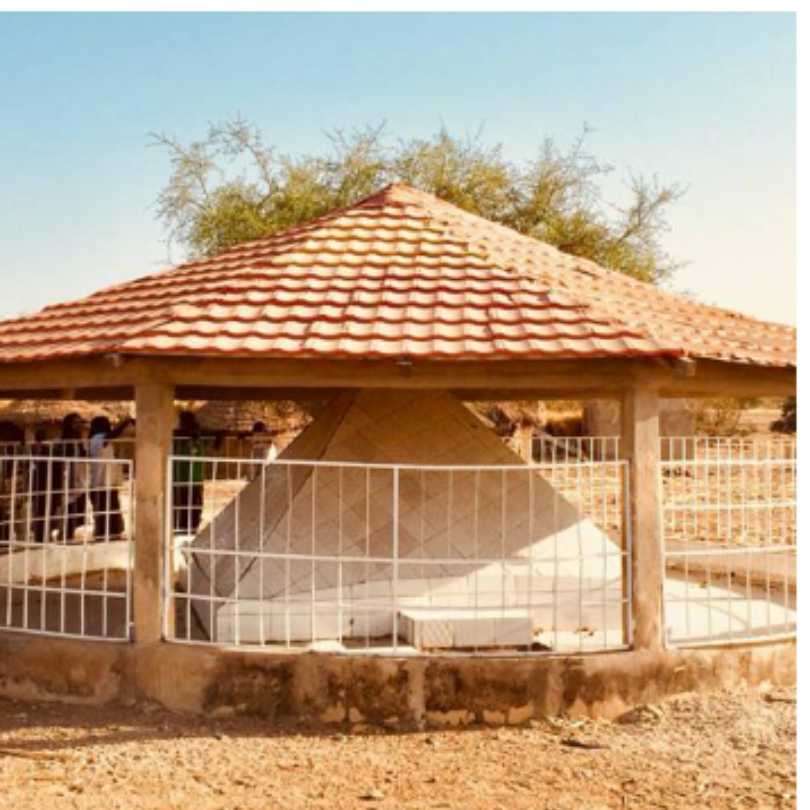
There were many things going on during the burial, and it would be difficult for me to describe them all. What I can say is that the elders of Tambiga were like pillars of strength. There was an air of safety and peace there, even during this trying time. The compound where we had stayed during the pilgrimage had undergone some small changes since last we were there, but there was still an air of welcome for us, even though the village was quite full with all the people who had arrived the night before.
The grave had been dug expertly by the students. Everything was in readiness for our Master's final resting place. When the time came for the burial, several of Master Naba's uncles and relatives from Togo and their family members spoke. They spoke of the fondness that we had for our master. It seemed that this was something they had not expected of people from America. I think that the old adage about a prophet not being acknowledged in his own land would probably apply here, though I cannot say that Master Naba was a prophet because I do not have the traditional knowledge of such things. It was clear that the effect that our Master had upon us was something that they had not accounted for.
Master Naba's brothers who live in Tambiga were a different story. These men were his elders in the initiation, and we held them in as high a regard as our Master himself. It is to them that we shall look for knowledge of the culture of our ancestors when we have reached a level that would permit us to study with them. These great and learned men, with their striking humility and peaceful demeanour, spoke of death as being a part of life, an aspect of life. The matter of fact way in which his elder brother spoke of this gave these words a power that lifted this concept into another level for me because in the past, I would have thought of this as patronising, but not so now. Not from a man such as this. He spoke of the knowledge that our Master had given us and our responsibility to our Master to pass this knowledge on. It would seem that at this time, they gave us the mandate to carry on his work, and this brought mixed feelings in me. I do not think that I know even a small fraction of what our Master knew, but I must honestly recognise the importance of this responsibility, and act accordingly.
Next, it came the time for Herpw to speak. He spoke of keeping the knowledge of our master alive. In this way, we would insure his immortality even in the world of the living. He was very brief in his words, and soon we were all on our way back to Ouaga. I felt a sense of loss at leaving the village without visiting the places that we had frequented during the pilgrimage. There was no time for such reminiscences and grief, no time to pour out the feelings that were brimming within our hearts upon the ground that we had once walked with our Master only a few months before.
This simple ceremony seemed to me to be very fitting. Our master lived his life among us in such a humble way. It seemed to me that he could have lived very differently had he chosen. So also was his burial, simple and clean in a place where the purity of his resting place could be assured. There were few tears, and the strength of the people surrounding him gave testimony to the value of the culture that he has allowed us all to aspire to.
I look forward to returning to that place, to commune with the spirit of my Master. I will learn what he has taught and pass it on to the generations to come as he and his brothers have asked me to do. Master Naba exemplified the quality of a Master in the most trying of circumstances. I will do my best not to miss him too much. There is much work to do to fulfill the promise of his teaching; and it is clear to me that every student who was there is dedicated to for us. achieving the goals that he has set for us.
The work and the teachings of Master Naba Lamoussa Morodenibig shall continue...