The Indigenous Mayan Community that Formed the Elijio Panti National Park
Spotlight: The Indigenous Mayan Community that Formed the Elijio Panti National Park
The Ancestors lived in the lush forest, honoring the Earth. They swam and bathed in the rivers and streams without disturbing the natural ecosystem. They ate fruit from trees and farmed the land respectfully, never taking more from the Earth than what was necessary. The ancestors understood the importance of nature and their environment, and lived peacefully with the plants, animals and insects. healed themselves with the many plants of the rainforest, and were vigilant in protecting and honoring the power of the sacred forests by creating temples and making offerings. The lands were cherished, protected and honored.
Traditional cultures and lifestyles are quickly disappearing as industry and modernization creep into territories of traditional peoples. Forests are cut down for agriculture, roads and industry, and people are displaced in favor of money-making businesses, with little regard for their lifestyle or well. being. This is a sad reality of globalization and modernization ("progress"), and while there are conscious groups fighting preservation and limits to the destruction of nature and native peoples, it is big businesses and corporations that have the political power and financial strength that influence decisions across the globe.
The rainforests of Belize are at risk of destruction due to "progress" in the area. Logging of endangered hardwoods, extraction of ornamental plants (orchids) and hunting have threatened the rainforest for many years, Indigenous Mayan villagers working to preserve their culture, lifestyle and environment and now, with the hunt for exotic tropical medicinal plants, the threat increases. Native villagers are pushed into smaller and smaller lots, and their traditional agriculture and way of life becomes difficult to preserve as they are separated from their traditional environment. The Mayan people of Belize have come to understand that if they wish to preserve their culture, environment, spirituality and lifestyle, they must be proactive in their fight. On December 5, 1998, five Mayan people began talking about creating a national park for their communities to ensure that their way of life is preserved. The result of their vision was the creation of the Itzamna Society and the Elijio Panti National Park, two important entities working to ensure the preservation of Mayan culture and lifestyle.
Five people shared one dream. Five people came together to put their vision in motion; led by Maria Garcia, the group surveyed the lands to be negotiated and met with representatives of the federal government. The park explorations proved to be very useful: they discovered the Kaam Actum, or Offering Cave, that is dated 250AD. ceremonial vessels and other Mayan sites. They saw pristine land, streams, and roadless terrain untouched by modern man. They were home, and they knew they had to act fast.
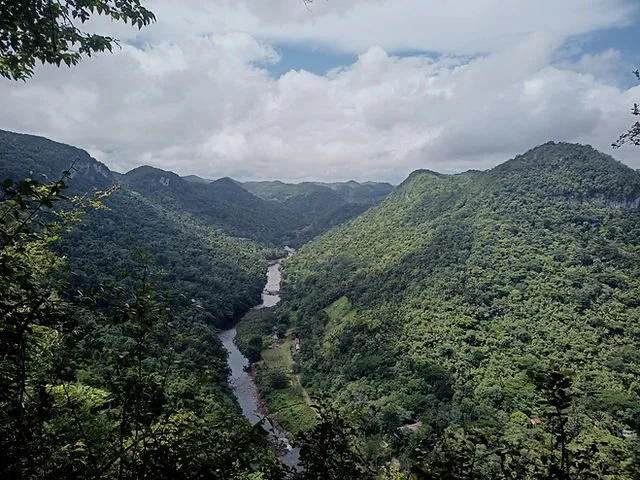
Stronger organization was needed, and the core group grew to fourteen people. A board of governors was formed, which gave birth in January 2000 to the Itzamna Society, which works for the protection and conservation of the environment and culture. Among the members were former police officers, doctors and teachers. Their work continued, and the group decided to identify a campsite and to build a road leading to it. Wardens needed to be trained to help protect the area and its wild and plant life. With the help of the government, two wardens were put in place in January 2000, minimizing hunting and stopping the logging that had been threatening the natural environment.
After repeated negotiations with the government, miles of red tape, and enormous effort, the group secured the boundary lines for the area, and the reserve became a National Park on February 23. 2001.
THE NAMING OF THE PARK
The founders of the Mayan National Park knew early on that they needed a name for the area, but deciding on the name was not a difficult task. *We all decided that there is no better name for our park than our beloved bush doctor's name, Elijio Panti. Elijio was a spiritual healer who passed away in 1996 at the age of 103. He was also the high priest of our village... Elijio dedicated his life for our village, his people. So, in return, we honored him by naming the National Park Elijio Panti," explained Garcia. "Now, our future generations will come and continue to remember him so that his legacy will never die, but live forever with us."
Elijio was a hero to his people, but the scope of his knowledge reached far beyond his village. He was trained in the forests of Peten, Guatemala, by a Cadbe Indian, Jeromine Requena, where he learned traditional Mayan medicine. In an honest attempt to help people, Elijio naively participated in a project that surveyed the Belize forest for the collection of medicinal plants for screening against AIDS and cancer, and this resulted in the collection of hundreds of plant samples which, today, are still being exploited by modern medicine.
Elijio was a very important resource for women's alternative health, as he introduced the Mayan Uterine Massage to practitioners in the USA and Europe. Elijio taught that a woman's uterus is her center; if it is out of balance, then her entire life will be unbalanced. The Maya believe that a woman's uterus is her "second brain" and comprises the spiritual center of her being. The traditional massage, a slow, penetrating massage which releases deep muscle tissue spasms in the entire abdominal area, prevents and corrects a fallen, tilted uterus and swollen prostate, and facilitates the normal flow of blood, lymph, nerves and chi throughout the entire body.
Elijio was recognized throughout the Americas for his skills in traditional Mayan healing, including plant remedies, massage, and acupuncture. His people wished to honor him after his death, and so by naming their National Park after their beloved hero, he will be remembered.
THE MISSION
The primary mission of the National Park, according to its founders, is to preserve the Mayan lifestyle and the natural ecosystem. The Earth gives us food, water, shelter and medicine; the Earth is precious, and without her we cannot survive. As more and more natural land disappears, it becomes urgent to take back the rainforests and preserve them, thus preserving humanity. "By creating the Elijio Panti National Park, we knew that we are giving the Earth the chance to accomplish these things as well as do our part as guardians and citizens of the world," says the park's mission statement. The importance of the rainforest is obvious. It cleans our air and replenishes the atmosphere with pure elements. It cleans our water, filtering it so that we can drink. It provides us with countless medicinal plants, necessary for healing and curing diseases. It is home to insects and animals. The rainforest is a vast natural resource for health and life; it represents our future. As thousands of acres of forest are ruined each day, we must realize that it is our own future that we are sacrificing. We must not take the Earth for granted
"The 13,006 acres of holistic Mayan National Park has been established to protect the way of life of our indigenous people..and the natural resources important for our existence. Reforestation and conservation projects, including the planting of a number of endangered vegetation species, will be done. This is a place where children are handed down the tradition of knowledge of their ancestors, a place where communion with nature is understood and honored. This is a place where the Yucatecan Mayan language is spoken daily, where children follow their parents into the rainforest in search of healing herbs and where the past is brought to life through the words of the elders" says the parks website.
THE PARK
The Elijio Panti National Park is home to several traditional villages. Most of the villagers are traditional farmers, and in the formation of the park, the needs of the farmers were of utmost importance. Despite the presence of visitors, the villagers live a traditional lifestyle and practice their traditional culture.
Villagers speak their native language, which is "Maya Taan", ', also known as Yucatec Maya. Outside languages are not taught or spoken, except in schools or when communicating with outsiders. Speaking the traditional language is a very important pillar to the survival of the Mayan culture and people, and the villagers have assured that their indigenous language and knowledge will not be lost.
Villagers adhere to the laws of their Gods. They do not kill animals or use forest resources unless it is necessary for survival. Their traditional spiritual practices are kept and often take place in caves and temples in the park.
Only traditional healing is practiced in the park: traditional chiropractors, herbalists and midwives care for the health of the people using knowledge passed down from their ancestors. They use medicinal plants, prayer, and "Zaas tun," or secret stones. The healers often find themselves treating outsiders who come to the Park to be healed. A botanical garden and research area is to be established within the park to help educate outsiders on certain plants, practices and history.
The National Park is accessible to visitors, who must abide by a code of ethics when visiting the Park so that the indigenous culture, environment and lifestyle can be preserved. One cannot record or document information shared by the villagers, and photos cannot be taken without permission. Modesty is expected at all times. Outsiders cannot stay in the villages, and must travel to visitor accommodations outside of the National Park. Hospitality is the rule, but respect is the law.
"We open the door to the past as well as to the future, opening the eyes 1o true self sufficiency, where planting and harvesting is sacred, where prayer and thanksgiving have great purpose and where life is rich and whole," states the park's website. "The Mayan way: where today's moments come to life within the mysteries of the past and the future."
Picture 1: Mayan elder holding candles
No caption
Picture 2: Child with baby on shoulders
Indigenous Mayan villagers working to preserve their culture, lifestyle and environment.
Picture 3: Tree - no caption