
The Most Beautiful Men in the WorldThe Bororo Geerewol Ceremony
The Most Beautiful Men in the World
The Bororo Geerewol Ceremony
The sun sets over the savannah. The dying sunrays highlight the baobab tree that stands
proudly on the horizon. The orange and gold of the retiring sky fade into deeper reds and
purples as night makes its grand entrance. Everything is still… calm… patient.
Those who have visited Africa will testify to her beauty. From the brightly colored textiles and jewelry to the greens, browns and reds of the lands, many consider the continent to be the most beautiful on Earth. African people, in general, appreciate beauty, and their clothing, adornment, and style accentuates their diverse ideals of attractiveness. All people appreciate beauty, but it is, perhaps, the Wodaabe people of Niger who are most known to hold physical beauty as the highest of values.
The Wodaabe are a proud nomadic people who are scattered across the sub-Sahara Sahelian steppe in Niger, West Africa. They are said to have originated in the upper Nile basin, and their exact origins are heavily debated by scholars; some say they are from Ethiopia, while others insist they are from Egypt. The Wodaabe keep largely to themselves and rarely marry outside of their own group, which has enabled them to keep their cultural and genetic identity pure. The Wodaabe people trace their origins to two brothers, Ali and Degereejo. A sub-group of the Fulani people, the Wodaabe are traditionally known as the Bororo.
The Bororo are known for their appreciation of beauty, which seems to hold a higher value than anything else. Physical beauty is held in very high esteem for the Bororo, and much of their daily society is based on beauty. It is during the annual Worso and Geerewol celebrations during the rainy seasons that the Bororo come together to display their collective beauty openly and with delight.
The Worso is a time when the Bororo from the same lineage gather to celebrate births and marriages. Family members meet in a designated place for the reunion. Dressed in their best and most elegant attire, three days are allowed for various rituals surrounding birth and marriage. Singing, dancing, and the slaughter of highly-prized animals are common daytime activities, while at night, storytelling captures the attention of young and old alike. The Worso allows the family members to join, celebrate, and reaffirm their ties.
The bigger, and more important, rainy-season celebration happens weeks after the Worso celebrations. It is called Geerewol, and it is a celebration joining two lineages for seven days of dancing and celebration of beauty. Not only does it allow two lineages to join together in celebration, but the Geerewol provides an opportunity for young Bororo men and women to find attachments outside of their circle of cousins.
The week-long celebration is centered around dance and beauty marathons. Two dances, the yaake and the geerewol, take precedence in the celebration, and it is these two dances that give the men a chance to show off their charm, beauty, and ability to attract women.
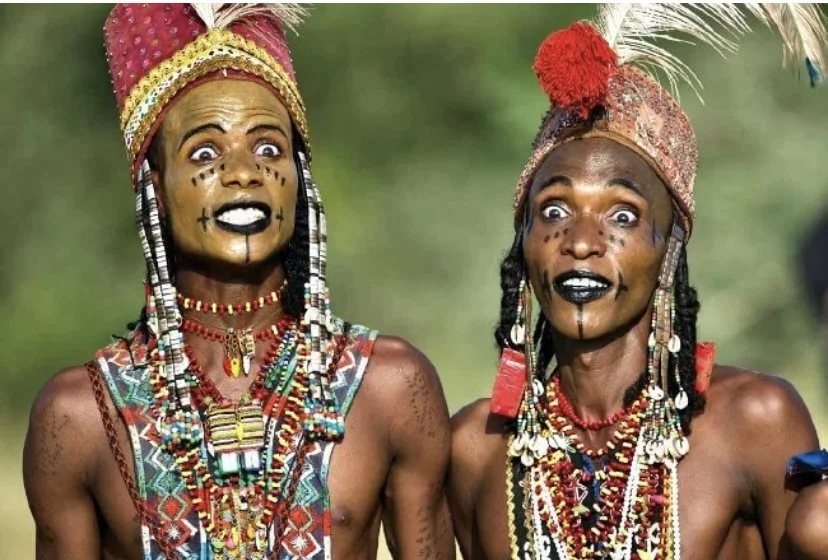
The yaake, or charm competition, requires much preparation by the men. Men devote many hours before the yaake to make themselves beautiful. They apply extravagant facial make-up and wear elaborate clothes to show off their attractiveness. A pale yellow powder is heavily applied to the dancer's face, and black kohl is applied to highlight the whiteness of the teeth and eyes. A line running from the forehead to the chin helps elongate a man's nose, and many men shave their hairline to show off their forehead.
Once the men have prepared themselves physically, they join together, shoulder to shoulder, and begin their dance. In a chorus line style, the men tiptoe forward to show off their height and display their charm by exaggerated facial expressions and sounds. Eyes roll, cheeks tremble, and teeth flash. Their cheeks inflate like a fish and then collapse again, and lips purse, part and tremble. A man will roll his right eye in and out, which is a talent that is highly recognized and valued. Meanwhile, elders of the group taunt the dancers, attempting to force them to try harder and show more of their magnetism. The men are being judged on their charm, magnetism and personality. It is not necessarily the most beautiful man that wins the yaake, but it is the one with the most "togu", or magnetism and charm, that will emerge the victor.
The geerewol dance is the most rigorous and prestigious dance of the celebration, and only the most beautiful men take part. The men take the same delicate and lengthy preparations for the geerewol dance, but their appearance is different. The men wear the same dress: tight white wrappers bound at the knees, strings of white beads crisscrossing bare chests, and turbans of ostrich feathers and cowrie shells. Their faces are painted red, and they line up for two hours of frenzied dancing and chanting.
Those who feel that their competition is too great often voluntarily withdraw from the challenge. Those who remain eventually replace their ostrich feathers with horsetail plumes, signifying the next level of competition. The dancing becomes harder, more wild, and more intense. This is a beauty contest, and the judges are three unwed young women who have been chosen by the elders by their beauty. Concealing their judging eyes with their left hand, they nit- pick the dancers, looking for the most beautiful man. In turn, the men use every facial expression and body movement they can to attract the judges favor. The young women are looking for precise characteristics in the men: tall, lithe limbs with graceful movements, long, straight hair perfectly braided in a beautiful style, and light, smooth skin. A slender nose, thin lips, sparkling white eyeballs and teeth, and an elongated face are desirable. A high forehead, long fingers, large eyes and a long neck are ideal.
Once the young women have made their choice, they slowly creep toward the dancers. The most beautiful men are chosen with a graceful swing of the arm. The winners receive an increased pride in themselves as well as the admiration of other men and women.
The Gereewol celebration provides a venue for men and women to meet and attract mates, and in the Bororo tradition, a man may have multiple wives. Many teegal marriages (marriages of love and romance, rather than an arranged marriage) are the outcome of these yearly celebrations. These teegal marriages often take the form of willing abductions, where both the man and the woman agree to flee, and often occur during the night after the charm competitions. Married women who are not happy with their current husbands are free to choose another man, and if she leaves her marriage, must leave her children behind as well. If the new couple who have "run away" can slaughter a sheep, roast the meat and share the food before they are caught by the family (or husband) of the girl or woman, the marriage is confirmed.
The Bororo tribe has attracted attention because of their traditional value of beauty. Dubbed as the inventors of beauty pageants, the Bororo consider themselves to be the most beautiful people in the world. Their long history of tradition, culture and values are the core of their lives. A nomadic people, the Bororo have been able to resist most colonization, imperialism and modernism that is plaguing Africa today.